Craig Morey
April 2026 onward
In April 2026 I began doing short daily when-I-feel-like-it bits of writing and putting them up on my website, as something sort of in between an overly-self-indulgent blog and a freewriting exercise. The first two entries have a more complete explanation for why I write this stuff and why I post it online. I don't really expect anything here to be particularly interesting or worth reading for anyone who isn't me, but its here on my website and so you are welcome to read it if you do feel so inclined.
In northwestern Scotland, on the ferry to Lewis. Passing all the bare and forlorn-looking little islands out past Broom Firth, it makes me think of Napoleon exiled to Elba (not Elba, that was his first exile before Waterloo, I'm thinking more of his second exile on an island that I can't remember the name of.) Imagine having the powers-that-be of the world deem you to have such a dangerous mind, or such dangerous charisma (or, more realistically, maybe just such a dangerous history and reputation and influence) that they decide the best thing to do with you is stick you way out in the middle of the ocean. Imagine sitting there in the wind and drizzle by yourself, just waiting to die, and thinking about how that's what the world thinks of you.
I think maybe we should bring it back. There's some world leaders who seem suited to it. It certainly is cruel, but maybe no crueler than the prison system. And really, I think they'd like it, in a way. If I think about Trump stuck out on some little island, I think he'd be pleased as punch to know that the world hated and feared him so much. Obviously he'd be pissed about being deposed and isolated and all that, but I think his ego would be gratified. I think a lot of less-than-ideal world leaders would feel that way. We could make a whole archipelago.
* * * * * * * * *
I'm almost too seasick to read or write. I have to keep taking breaks to look out the window. I've never felt seasick before, despite having been on ferries a dozen or so times before this. I hate it. Not the seasickness itself, that's whatever. But I hate thinking that there's something my body just isn't able to handle, and through no fault of my own. It's like if I were to suddenly find out that I was actually nearsighted, or allergic to nuts or something. There are very few things that my body is less than perfect at handling, my intermittent back pain and my weak sense of taste/smell are the only other ones that come to mind, and the taste/smell thing I don't even consider to be a true drawback really.
I am hoping that if I force myself to power through it and keep reading and writing as much as I can without puking, it will gradually make me less prone to being seasick. I don't actually know if seasickness works that way. Even as I write this just now I can feel myself starting to get a headache in addition to the nausea, so maybe it really would be better to just look out the window the rest of the trip. I'm going to go out onto the deck and see if fresh air helps any.
* * * * * * * * *
Fresh air is helping I think. Beautiful view sitting on the stern deck watching the Highlands fade away into the dusk and the distance. It's crazy to think about all the Hebrides natives sitting around me who do this commute so often that the views must get to be a boring routine.
I figured I should write a little about what and why I'm writing. I've never been a diary person before. I remember briefly having a diary when I was fourteen or so, which became so personal and my fear of it being discovered became so great that I ended up burning it after only a couple months. My reasons for starting again now are at-least-twofold (fewfold):
Firstly and most immediately, I'm currently about three quarters of the way through reading Among Others by Jo Walton, which is an epistolary novel in the form of a girl's diary, which got me thinking about journaling. It's a YAish story about a teenager in a British boarding school with light fantasy elements, which ordinarily would make for a book that I would hate, but really I'm enjoying it. And I'm only very slightly ashamed to say so.
Secondly and most significantly, I really want to write more. I enjoy writing, but I don't do it nearly as often as I would like. I have lots of little thoughts that I would like to have written down but never actually make the time. The bigger problem, rather than not having time, is that for quite a while I have pushed all of my desire to write into two opposite and inconvenient extremes: I either write inane little microblogging posts online, or else if I have any thought that seems like it could be larger than a tweet, I mentally file it away for later use in my other main writing endeavor, which is Writing The Next Great American Novel. Suffice it to say that the big novel-writing project is not actually happening, even a little bit, but the thought that it potentially could has been sapping and subsuming all of my actual will to sit down and put pen to paper (/finger to keyboard). I used to write little essays and short stories and things from time to time, but the problem with those is that I would only ever write them out once I had a fully formed and fleshed-out idea. I'm hoping that a diary, even if it isn't actually updated daily, will give me an outlet for putting down thoughts that don't need to be completely thought out first. I think I read the idea once somewhere, and thoroughly believe, that every person has some concrete amount of crap writing that they have to do before they become good at writing. Maybe for some people it's a million words and for some it's a billion, but everyone has a number, and if they can manage to write that much, it doesn't matter what they write about or why, once they reach their number they will open the door to being able to actually write well. To paraphrase another different person's metaphorical explanation, the good writing and the bad writing all come out of the same tube, and in the beginning the tube is plugged up with all the bad writing, and so if you want to get the good writing to come out of the tube the only possible way is to push the bad writing out first, to actually just make yourself write it all down for as long as it takes and as crap as it might be. So it's in that spirit that I'm writing this diary now. I'm clearing out the tube.
Lastly (and leastly), I believe that I am living in interesting times, and also that I am an interesting person who is doing interesting things. Although it is true that the interesting things I am doing are largely unrelated to the interesting times I am living in. But I'm currently (in addition to reading Among Others) about three quarters of the way through Mike Duncan's biography of the Marquis de Lafayette, in which a lot of the history is pulled directly from diaries of Lafayette and his contemporaries. And even though a lot of the info is coming from the big players like Marie Antoinette or the American ambassador to France, even random low level soldiers who kept diaries get their moments in the spotlight, contributing to the storytelling in ways that kings and ambassadors would not have been able to. I don't know that I'm actually motivated by thoughts of helping out future historians (especially in an age where things generally seem to be so much more well documented than they were two hundred years ago), but I do feel that my life is a part of history in some minor insignificant way and so even if no one ever actually reads it the things I write do still have some intrinsic value.
Boat is pulling into Stornoway now
I can only motivate myself to write things here if I actually truly believe that they are going to be shared, or at least that they could potentially be read by others at some point. The thought of all of this just sitting and rotting on my harddrive is maybe the most comfortable for me, but at the same time it makes the writing feel pointless and so why bother. My plan is to post this diary onto my website as some sort of blog, that way it is publicly accessible and could conceivably be read, yet at the same time it's hard to imagine many people going through all the trouble of actually reading it. In a way, it's the same mindset that lets me busk with my accordion despite my fear and dislike of public performances. I'm playing music for everyone walking by, but at the same time I'm playing for no one; in general no one is actually paying much attention to me specifically, I'm just there in the background, but all the same I get the chance to gradually build up my tolerance for performing music for people.
If I make this diary too personal, I will eventually run into the burned diary issue again that I mentioned yesterday. The only way for me to write things here while both staying motivated and also knowing they might be read some day is if I avoid writing anything too private, anything that I would be uncomfortable sharing with a friend, an enemy, and a stranger all simultaneously. So in a sense, this really won't be an actual diary, it defeats most of the purpose of why people keep diaries. I'm not sharing my deepest thoughts and my intimate moments, I'm just recounting surface level events and superficial observations plus long drawn out reflections on things that do not actually feel private or close to my heart. Oh well. If that also starts making me feel demotivated then I'll try to find some other solution I guess. Maybe two diaries, one public and one private.
* * * * * * * * *
Arrived at the croft in Leurbost last night. Terrain here on Lewis reminds me a bit of Newfoundland, and I said so to my WWOOF host. She and I watched BBC coverage of the Artemis II moon mission and of Trump's Iran War. I wonder which event will be seen as more important fifty years from now. There are other American volunteers here as well, and we agreed that it's a very embarrassing time to be traveling abroad as an American. I keep joking that I want to start introducing myself to people as being Canadian.
I occasionally feel like it's a deriliction of duties, that I'm running away from my inherent American responsibility to try to improve the situation, but realistically what could I really do? Even if there was a full blown civil war, would fighting in it really be a productive use of my life? As it stands, any sort of meaningful action I could imagine myself taking back in the states is mostly just stuff that would quickly land me in prison. Maybe it's cowardly, but I don't have a huge interest in making myself a martyr and doing some big ultimately-irrelevant political statement just to then get locked away for years. But at the same time, I don't think I could really approve of myself just keeping my head down and living a normal life in Pittsburgh in the midst of everything going on right now. It makes me think of questions like what would I do if I were living in Germany back in the 1930s. So for right now anyway, I'm continuing with what I've been doing for the past five months. I'm running away. And for the next two months that means living on a little farm out in the Hebrides.
My WWOOF host has a son and a daughter-in-law with a two-year-old son, and there's also an American couple volunteering at the croft with their five-year-old daughter. It's always interesting for me meeting people my age who have a family, a career, a house, and so on. I wonder what they think of me. I do think the drifter lifestyle that I've been living for the past decade or so has its own sort of dignity and respectability to it, but I doubt many of the people I meet would be interested in changing places with me. I'm also not really ever sure how I feel about them. They seem happy at least, and I don't know that there are any specific things about their lifestyle that I could pinpoint and know that I would be unable to live with, but all the same I don't think I would be happy living their lives. My experiences so far have been that the closer I get to domesticity and settled stability and all, the less content I am and the more I start to feel trapped and stifled and depressed. I have a very hard time imagining myself happy with or motivated by the things that seem to guide other people through their lives.
I don't dislike kids, and it's certainly been entertaining to have the young kids around the farm here, but I'm also feeling very happy with my choice of having gotten a vasectomy. Having said that though, I am seeing some of the appeal of parenthood while here, more so than I have in the past. There is some core human experience there that I have cut myself off from, there is an entire dimension of life that I will never get to see except via little glimpses into the lives of other parents that I meet. But their choice comes at the cost of an enormous sacrifice. Access to the experience of parenthood requires carving off and offering up a large chunk of one's own life, which is a cost that I am not and will never be willing to pay. Those who would criticize my choice not to have children might call it selfishness, and in a sense I think they're right. I am selfish about my own life, I am unwilling to exchange any of it, and by hording it the way I am there are incredibly meaningful experiences and connections that I will simply never have, and I'm okay with that.
I used to think that I would probably be more interested in having children if I lived on Anarres. Which is to say, if I lived in a society which shared responsibility communally for child raising, and which was built around an ethical framework I supported and had a potential future that was worth bringing children into. Thinking about it more though, I'm not convinced I actually would. Certainly on Anarres I would feel more optimistic about children being born into the world generally, but I think blaming society for my unwillingness to have children is externalizing a problem that is actually just internal. I think I am simply by nature uninterested in the role of parent, and I don't think that would change even if I were living in a utopia. I believe that it is perfectly reasonable and natural if people choose not to have kids for practical or logistical reasons, but in a case like mine where the choice precedes any actual concrete reasons for it I do kind of feel like it might be indicative of something actually wrong with me. I think it is normal for people to weigh the pros and cons and decide to not have kids, but I worry that it points to something deeply abnormal about me that I can't even imagine any hypothetical scenario where the pros could outweigh the cons.
* * * * * * * * *
Finished reading Among Others. Wrote the following review:
"This book was better than it really had any right to be. It's a YA novel about a teenage girl in a British boarding school, with light fantasy elements, which is ordinarily a genre I would not expect to enjoy. Additionally, the narrator does not feel to me like a realistic portrayal of a teenager, and also seems a bit Mary Sue-ish.
Despite all that, and somewhat to my own embarrassment, this book really did draw me in. There were frequent moments of real insight, which I think is something largely missing from the rest of YA as a genre. One of the highlights of the book for me was the unreliability of the narration with regard to just how real the magic in the book actually is, which I found simultaneously both more and less impressive after learning that the author apparently did not actually intend for the existence of the fantasy elements in the book to be at all in doubt.
It's hard to say much else positive about the actual plot and contents of the novel, since it largely follows typical YA coming-of-age beats, but that isn't inherently a bad thing if it's done well. It is overall a pleasant little book when read by an adult, about as much as I think anyone could reasonably expect for a book that seems to be mostly for and about teenagers."
4 / 5 stars (https://www.goodreads.com/review/show/8507983658)
Somehow hadn't noticed until reading a news article today that the USA's 250th anniversary is this July. Very happy that I'll be abroad for all of this year.
* * * * * * * * *
Work so far this week has been tree planting, and building fences to protect the new trees from deer and rabbits. The twenty acre croft here is being planted with native tree species, partially funded through grants from the Scottish government as part of a larger environmentalist effort to reforest the Hebrides. The previous two farms that I've worked at had a little bit of a feeling of winding down their operations, but this one, as with most farms I volunteer at, has much more of a character of planning and building for the future.
As much as I enjoy doing volunteer farm work with the WWOOF program, there is a sort of contradiction there between my worldview and that of most farms and farmers I work with. We are both motivated by thoughts of sustainability and environmentalism, but whereas the typical WWOOF ethos is one of optimism, my thoughts about the future are mostly tinged with pessimism. I don't really want to think about what the world, and especially the natural world, will be like decades in the future after this croft has finished being reforested. Actions to preserve or reclaim the natural world and to fight climate change feel like loosing battles at the best of times and pointless self-delusion at worst. It is difficult to enjoy my work if I think about it in these terms, and so I mostly try not to. I do believe that there is some inherent value in well-intended projects that are undertaken even in the face of a hopeless future, but it's difficult to come up with a real justification for that value. I almost feel as though I am planting trees for a hypothetical lost future that could have been, rather than for the real one that's coming and that I have no particular interest in seeing. There is real good in the world, there are well-intentioned people doing well-intentioned things, but the good and the bad alike are all going to be drowned in a flood of runaway climate change and the resultant shortages, famines, and wars.
So, why bother planting trees? If the world cannot be saved, which I don't believe it can, I might as well ask why anyone should ever bother doing anything. I think the best answer I can give at present is that if I were living in a good world with a good future, it would be good to plant trees, and so even in the real world there is still some lingering goodness wrapped up in the act of planting trees, even if they will one day be knocked over by man-made hurricanes or bleached by acid rains. Or maybe the better answer is that I'm planting trees purely for myself. That in the moment of the act of planting a tree, I am connecting myself, however briefly, with some lost timeline where a better world was possible.
I feel in some sense as if I have transcended doomerism and come out the other side. I can't quite say that I've made my peace with the approaching age of decline, but I've reached a stage where I can somehow draw satisfaction and fulfillment from hopeful actions like reforestation even without having any actual hope in me. This stuff all used to make me depressed but it doesn't anymore.
More fencing and tree planting tomorrow assuming the clear weather holds.
Headache today. Fellow volunteer thinks it might be from gasoline fumes from me having spent all day using the brush cutter. I have some Ibuprofen with me but haven't taken any. I usually don't like taking medicine for headaches unless things get really bad or unless there is some particular reason why I definitely need my head to be functioning optimally as soon as possible. I mentioned all this to some of the people here when asked, and said that I am generally fairly anti-medication, but I didn't really have a concise explanation for why. The best short answer I think I can give is that taking medicine for a non-serious issue feels like taking the easy way out. But I don't know if that answer by itself really holds up to serious scrutiny. I am not generally interested in making myself pointlessly suffer or in making my life harder or more painful just on principle. Every time I use any sort of tool or technological convenience could conceivably qualify as "taking the easy way out" and yet those other shortcuts don't usually bother me. I think maybe a more accurate explanation for my avoidance of medication is that I don't want to get used to always being able to wipe away any minor inconvenience just by swallowing a pill. If I keep Ibuprofen set aside as a rarely-indulged luxury, I will always be able to tolerate its absence and will never have to live to see it become a taken-for-granted necessity. Maybe someday I really won't have access to modern medicine anymore, and so I'll be glad then that I never made taking headache medication into a habit. Although having written that, I suppose I can just as easily imagine myself shipwrecked on a deserted island or surviving in the post-apocalyptic wastes and suffering from a bad headache and thinking "damn, I really should have taken every opportunity to use Ibuprofen back when I had the chance." I'm not actually expecting to ever be unable to access modern medicine, really, and I don't actually justify my avoidance of medication by thinking about how civilization might collapse someday. But the general principle is there regardless, that I don't want to ever become completely accustomed to something that I know I can manage to do without. This same principle applies to several other conspicuous self-deprivations in my life, for example: I regularly sleep on floors, in part because I don't ever want to feel like I'm unable to cope with not having a bed available; I regularly take cold showers, because I don't ever want to feel like I need to have hot water; I (used to) regularly wash my clothes by hand, because I don't want to feel that my life requires me to have access to a washing machine. (Though people who know me may be tempted to suggest that my eating habits should also be included in this list, my general neglect for how my food tastes isn't really due to self-deprivation; rather, its usually the case that I really just have no actual desire for better-tasting food.)
I believe that all of these sorts of self-deprivation ultimately contribute to my freedom in life. If I choose to live a life where a bed, a hot shower, and a laundry machine are all necessary requirements, then I am restricting the sorts of lives that I am able to choose to live. I won't ever be able to do something or go somewhere that involves losing access to those things without it feeling like an unpleasant deprivation. Whereas on the other hand, if I never regularly use any of those things anyway, then I won't feel like I'm giving anything up by losing my access to them and so I will be perfectly free to travel anywhere and do anything without worrying about whether a bed, hot shower, or washing machine will be available. Ibuprofen is a little bit different in the sense that it's something small that can be carried with me, but the overall idea is the same. I don't want to ever feel that my choices in life are restricted to only those where medicine is easily available.
The counterargument to this whole line of reasoning, and (I assume) the reason other people don't usually live their lives this way, is that it is comfortable to sleep in beds, to take hot showers, and to not have a headache; and that feeling comfortable is generally more important than abstract hypothetical ideas about freedom. If I felt that material comfort was a major component of happiness then I would maybe be more open to this argument, but I honestly just don't. I don't think any material self-deprivations have ever made my life even slightly less happy. There's a quote from Thomas Jefferson that goes "we never repent of having eaten too little" and I think that goes for a lot of things. Maybe a cold shower is uncomfortable in the moment, but I never look back on it thirty minutes later and think "oh that really was so uncomfortable, I really should have taken a hot one instead." Comfort and discomfort are fleeting, they are ephemeral. The "happiness" that a person might measure by taking stock of their immediate material condition and deciding how comfortable they feel is a type of happiness that I have very little interest in. And just to be clear, nothing about this line of thought ever leads to me causing myself to suffer, or reveling in my own suffering, because lack of material comfort is not actually a form of suffering. Conflating discomfort with suffering is the purview of animals, small children, and helpless spoiled aristocrats.
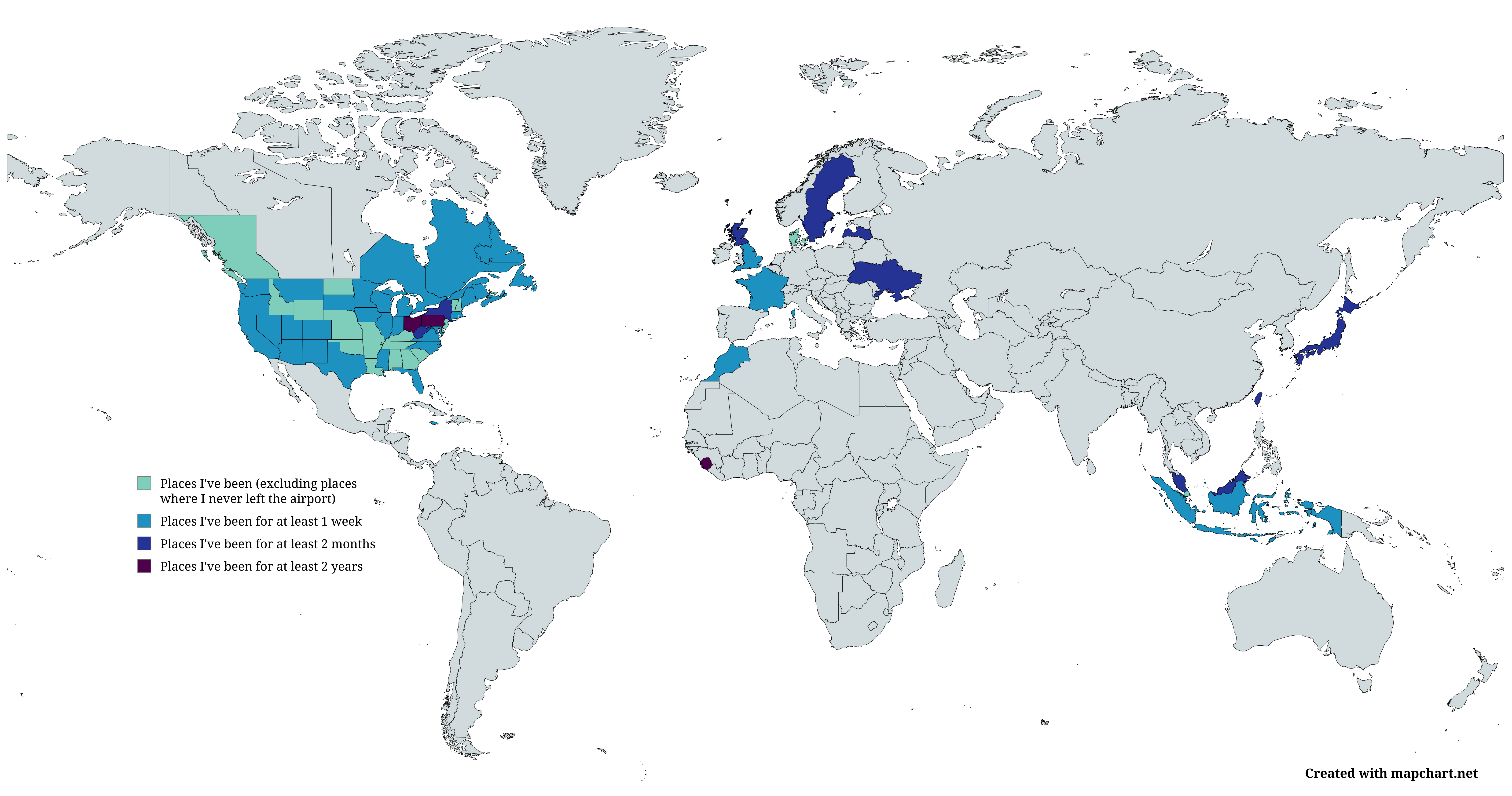
Added a color-coded world map to my website today (https://t0bor.neocities.org/world_map.png), sorted into four categories as: places I've been to for less than a week, for more than a week, for more than two months, and for more than two years (so, Pennsylvania, Ohio, and Sierra Leone for that last category).
I realized after making the map (or maybe while making it?) that most people might sort the places they've been to into either "places I've lived" or "places I've visited", but I don't really feel like I have a clear divide between the two, or at least not since becoming an adult anyway. At eighteen, it always sort of felt like I had one foot in my parents house and one foot in college, without either place really feeling like my home. The closest I've felt to actually living somewhere, as an adult, was probably the year I spent in Pittsburgh immediately after college graduation. Other than that it's just been a series of shorter or longer stays in various places without ever really feeling settled or moved in anywhere. I felt like a guest the whole time I was in Sierra Leone, and felt like a sort of long-term couch-surfer the other two times I was in Pittsburgh, and other than that I've never been anywhere for more than six months, with even those six-month stays being in foreign countries where I was volunteering with WWOOF and staying as a guest in someone else's house.
* * * * * * * * *
Finished reading the Lafayette biography. Wrote the following review:
"Manages to walk the fine line between telling a good story and giving an academic recounting of the history, something which unfortunately seems pretty rare in popular biographies. Despite being very much about politics, the book never really felt to me like it was pushing any political agenda of its own. I can definitely recommend the audiobook for any fans of Mike Duncan's podcasts."
4 / 5 stars (https://www.goodreads.com/review/show/8514574644)
Briefly tried reading a YA fantasy novel that had been recommended to me but gave up very quickly. (Not going to say what book or who recommended it other than to just say that it almost certainly wasn't you, person-who-happens-to-be-here-reading-this.) "Then, he could emerge from the cave a [magic monster-slayer]: a survivor gifted with one of four magical classes. He was tired of being a student. Going off to discover what happened to his father was completely unreasonable without having the strength of a [magic monster-slayer]." Actual excerpt from the first two minutes of the audiobook. This book could easily have been written by an actual middle-schooler. I dropped it and started reading Dying Inside by Robert Silverberg instead, and the contrast between hot garbage YA and an actual fairly-well-written novel by and for adults is astounding. Guess which one has a higher aggregate review on Goodreads of course...
I think if all the hot garbage YA out there was only being consumed by middle-schoolers it wouldn't make me as upset, since then I'd be able to fit the whole thing into the mold of "low quality product being foisted on ignorant teenagers who don't know any better, shame on the writers and publishers for taking advantage of children like that." What gets me is how many educated and otherwise-intelligent people my own age happily read this stuff and seemingly can't even tell the difference between it and actual good literature. Certainly it's always been true that a lot of people enjoy crap or have shitty tastes, but I feel like the thing that's changed more recently is that there isn't an obvious public distinction anymore between the crap and the good stuff. People are out there having serious debates about whether or not the Marvel movies are the pinnacle of modern cinema. The garbage used to all be published on pulp, you could look at the quality of the paper itself and know more or less what you were getting. Now I have to wade through an undifferentiated sea of bestsellers without being able to tell whether its actually good or just low-effort pageturner slop that I wouldn't have liked even as a teenager, unless I just go ahead and get ahold of the book to try it for myself. This happened (to an admittedly less egregious extent) with Gideon the Ninth, which I was tricked into reading by enormous hype and after multiple people whose opinions I otherwise respected had made it sound as if it was a book that adult readers could expect to like. I keep my guard up a bit more these days (e.g. I'm not going to touch Dungeon Crawler Carl with a ten foot pole) but it still keeps happening. I don't like living in a world where I can have serious and sophisticated conversations with a thirty-year-old, tell them I enjoy reading science fiction and fantasy novels, and then have them earnestly recommend me this afternoon's attempted hot garbage YA novel, without them having the decency to tell me that it's hot garbage YA, or even without them seeming to know that that's what it is. People are allowed to like what they like, that really isn't my issue here, it's just that they (and more importantly, society generally and all the cultural powers-that-be) need to be able to notice and articulate the difference between good stuff and low-quality trash, even if they then choose to continue to enjoy or even prefer the trash.
* * * * * * * * *
I've been trawling through and consolidating some old correspondence, as part of the same recent general effort to write more and to better document what I've written that led to me starting this journal. Came across this paragraph, taken from an email to my dad written in January 2015:
"I think you're right that a lot of what's bugging me is having to choose what to do with my life after college. Ideally, it wouldn't matter too much what I decide to do immediately afterward, since I should always be able to switch paths, but I'm worried that I'm the sort of person who would just get complacent and decide that that wherever I am is good enough. I get your point about how I should be able to make any path I choose into the right path, but that sounds to me too much like settling with what's just good enough. I think I'd rather be the sort of person who switches what they're doing all the time, rather than be a physicist or philosopher or whatever and wonder if I would have rather done something else."
Mission accomplished, baby!
Funny how my perception of age changes as I get older. Ten years ago, age sixty onward seemed to me to be all one sort of indistinguishable monolithic Old. Whereas now, it feels like there's a huge difference between sixty, seventy, eighty, and ninety.
The croft has an electric piano that I've been playing a bit the last couple days. I really enjoy playing, but piano in particular can also be frustrating for me. With guitar, for example, I already have more or less all the skill I've ever really aspired to have, I can play basically every chord (or at least any given chord in any song I'm likely to encounter) and my skills are comfortably at what I usually describe to people as "campfire level", without me feeling like I need to put any time or effort into maintaining my skills. When I play guitar, I just play for enjoyment without ever feeling like I'm missing anything or ought to be pushing myself toward anything.
With piano, in contrast, twelve years of formal lessons have both given me a higher level of skill (which I've since then largely failed to maintain), and have also showed me the possibility of new levels of skill that I could potentially reach if I were more diligent about practicing regularly and if were to actually put effort into improving. I have always had the problem, even as a teenager actively taking piano lessons, that when I sit down at the piano I mostly just want to enjoy playing songs I already know well, rather than work systematically to improve on difficult passages or to practice new material, let alone actually drill finger exercises and such. On the one hand, the fact that I enjoy playing so much means that I never feel as though I have to force myself to sit down at the piano, but on the other hand actual improvement feels like pulling teeth. And unlike with guitar, I have a hard time just being content with where I'm at rather than feeling like I ought to be improving.
The fact that I spend so much time traveling without regular access to a piano certainly isn't helping things. Whenever I do get brief chances to play (such as here), and time to myself to actually practice rather than just playing through whichever songs I remember, any effort I'm able to put into practicing is taken up entirely with just trying to relearn things I've forgotten and trying to slow down my overall decline a bit. I know I still have quite a bit of skill at the piano but it's frustrating always comparing where I am now to where I was ten years ago, and losing things faster than I can ever regain them.
At this point I only really know about a dozen songs well enough to play them confidently, and only a couple of them actually fully showcase my skills. It would probably require a year of daily practice to get myself back to the level I was at back when I stopped taking lessons, so that I could then actually start trying to improve and to learn new things. But given the sort of life I'm living and the lack of self-discipline I tend to have with regard to actually practicing rather than just playing for fun, that year of daily practice is probably just never going to happen. And so instead, every time I sit down at the piano, even though I'm having fun and people tell me how impressed they are with me, I'm still always also thinking about what could've been, what could potentially be. Which is frustrating.
Accordion is a nice middle ground. I've never had any actual instruction in it, so as with guitar I'm mostly able to treat it as just something I do for fun rather than as a curriculum that I've given up on part way through. Objectively I'm better at piano than at accordion, but a lot of the skill from the former carries over to the latter, and with accordion being less common and less central in classical music and music education it's easy to feel that I am much farther along, relatively speaking, with accordion than I am with piano. Sort of like how if you spend a lot of time practicing at chess, you might be able to qualify as a novice, whereas if you spend that same amount of time practicing at a more obscure board game you could easily be one of the best in the world at it. I'm certainly not one of the best in the world at accordion or anything, but there are comparatively fewer people out there for me to be forced to compare myself with, and fewer people qualified to judge me. I feel much more comfortable with calling myself good at accordion than I do with calling myself good at piano, despite my objectively higher skill level in the latter.
I miss my accordion. I wish it was small enough to be easily brought with me when I travel.
The moors are on fire out on the far side of the loch. The assumption is that it was some sort of controlled burn that then got out of control. There was smoke visible all day and now at night I can see the fires from my bedroom window.
There were several women over at the croft this evening for my host's Tuesday craft night. I'm working on knitting another pair of mittens, not so much because I need another pair of mittens but rather because I'm worried that if I don't keep knitting somewhat regularly for a while I'll forget everything I've learned so far and the muscle memory and have to start from scratch if I ever want to knit anything again in the future. The big gossip tonight among the other knitters was that next week Gabe Newell is apparently going to be renting out a lodge here for a couple months; the husband of one of the women works as the lodge's gamekeeper. I was the only one present who knew who Gabe Newell was.
Having one of those days where it feels like a struggle to convincingly portray a normal well-adjusted human. The sort of day where I find myself getting derailed thinking about how long to wait before responding during a conversation, how close to stand or walk near people, where to look when I'm not looking at anything, what to do with my hands, etc. Everything I say and can think of as potentially wanting to say feels awkward and/or banal, whereas the things other people say feel completely correct and yet also completely fake.
I think being around small children brings out this sort of feeling more often. Not the children themselves, though. Small children are straightforward and tactless and so talking to them requires no overthinking or performance from me. Sort of like with Prince Myshkin in Dostoevsky's The Idiot. But the way parents and other adults interact with small children is full of artifice, dishonesty, and manipulation, and to see adults constantly switch modes as they switch between talking to children and talking to me serves as a stark reminder of the reality of how orchestrated and artificial every conversation really is. Every line is a performance, an attempt to influence or misdirect or achieve something in some way. Every bit of communication and every interaction is wrapped up in layers and layers of what that communication is subtly and indirectly meant to accomplish beyond just conveying information. I don't mean to imply that the people around me are conscious and calculated manipulators, I think it all mostly happens unconsciously and automatically and is just a default part of how human interaction works. I also don't mean to imply that this whole charade is something that I consider to be beneath me or that I'm personally excused from it. Of course I do it too. It's just that with small children around I'm suddenly frequently much more aware that I'm doing it and that everyone is doing it to me, whereas usually it's something I can often manage to ignore or just forget about.
It's always difficult for me when it feels like the people around me all have their shit together in terms of how to navigate social interactions. I find it reassuring whenever I see someone clearly struggling with awkwardness or with the little subtleties of conversation and social expectations, since it shows to me that they are in fact having some authentic experience down there that they're then visibly struggling to filter into the social mask that we all wear. It's like seeing someone in a stage play briefly and accidentally break character and in that way remind you that they are in fact a real person and not just a robot following a script. I've been getting comparatively few of these sorts of reminder moments from the people around me at this current croft where I'm staying. It almost makes me feel like I should be mentally categorizing myself with the raw and affectationless two-year-old and five-year-old rather than with the polished and masked adults. I feel like I'm in Invasion Of The Body Snatchers, trying my best to convincingly pretend to be one of the aliens, while simultaneously hoping to be shown some sign that any of the aliens around me are actually still humans.
Finished reading Dying Inside. It was good. Pleasantly schizoid and misanthropic. Going to start Where The Axe Is Buried by Ray Nayler next. Also starting to slowly trudge my way through Ivan Goncharov's Oblomov. Unclear if I'm actually expecting to like it or if I'm just desperately chasing the high of Dostoevsky and Tolstoy and being unable to read them for the first time again.
I also skimmed through a big how-to book on different types of needlework (Good Housekeeping's Step-By-Step Encyclopedia of Needlecraft, Judy Brittain, 1979) that had been left behind by one of the ladies at craft night to give to a different craft night member not present. I've read about a few new techniques now (specifically, cable stitch knitting, swiss darning/duplicate stitching, and cutwork embroidery) that I want to try to add to my repertoire with the occasional bits of knitting and embroidery that I've previously been doing.
I think tailoring and other sorts of string and fabric crafts have had happen to them the same sort of thing that happened to painting after the invention of photography, and western classical music during the ending of the common practice period. Those arts had been completely perfected within the scope of their original purpose, and in becoming perfected any further work became pointless and unnecessary. The only way to make worthwhile music or paintings was by purposefully breaking rules and always striving for a way to think outside the box. With knitting and weaving and sewing and so on, machines can now work more efficiently and perfectly than humans ever could, and the most perfect and functional and traditionally beautiful clothes have already been made and will never be handmade. The only reason left for practicing these arts is novelty, to make something that no one else would think to make and that no machine would be likely to ever duplicate. (Actually there is another reason, which is the desire for historic traditions and the human touch that keep things like Harris tweed and sweaters from Grandma in constant demand. This reason for doing handicrafts is completely uninteresting to me.) Industrial textile production has moved fabric craft as an art form thoroughly into the era of Picasso and Stravinsky. My end goal, in knowing how to sew or knit or embroider, is not to recreate clothes that anyone or any machine could make but that are unique in having been made by me. My goal instead is to hopefully be able to make weird and unexpected things that no one else could think to make.
I'm also not particularly interested in achieving any sort of traditional technical mastery over knitting or embroidery (or really any sort of craft or skill whatsoever). The Encyclopedia of Needlecraft book is full of hallowed techniques passed down through the centuries that someone could clearly spend their whole life practicing without ever reaching the end of it. My experience with piano (see 26-04-13) makes that whole route pretty unappealing. There are endless depths to many of these skills, but I believe I will only continue to enjoy doing them if I restrict myself to learning things as they come and as I want them and have use for them, rather than going as far in with the skill as I can simply because the depths are there and because I feel like I'm supposed to want to learn everything.
Trying to figure out who it is really that I'm in dialogue with when I'm out here planting trees. The Scottish isles were deforested gradually by their inhabitants roughly three thousand years ago. Is that, like slavery or the Native American genocides, a recent enough crime to still have some lingering ancestral culpability? Or is it all too far away now maybe to be seen through any sort of moral lens? In the 1700s and 1800s, after this land was incorporated into Great Britain, much of the native population was forcibly evicted and suffered under the Highland Clearances. Does that mean that maybe history has already settled the score for their crimes of environmental degradation?
Or, could it be that the deforestation was morally absolved as it happened, as a sort of crime of necessity, like when a hungry person shoplifts for food or like when my neighbors in Sierra Leone killed and ate a pangolin despite them being endangered. Could it be even more than that, could the deforestation have been not a crime at all, but instead the right thing for the people then to do, to cut trees for lumber and firewood and for making more pastures and farmland. Could it be that for those people, in the context they were living in, cutting down trees was the morally correct thing to do, but now in 2026 that act has now been reevaluated to have been bad and it's now me planting trees that is the right thing to do. Could it be that all of this is in a deeper sense just morally neutral, that the tree cutting and the tree planting and maybe even the slavery and the genocide and the Highland Clearances was all just people doing whatever seemed like the thing for them to be doing. Maybe I'm just assigning "right" and "wrong" to all this stuff in order to be able to tell myself a story, to fit myself and my actions into some meaningful larger narrative. What is it then that I dislike so much about that narrativeless alternative?
A world where some people long ago cut down trees and now me and some other people are planting trees, where there are no protagonists or antagonists or good guys or bad guys and instead only a bunch of background extras ad-libbing stuff with no actual plot relevance, just feels sort of empty somehow. I want to feel like history leads somewhere, and that by playing my part in it and trying my best to take meaningful actions I'm aligning myself with something that extends through the ages, a cosmic battle of good versus evil. When I go out to plant trees it isn't enough for me to just believe that what I'm doing is right, I need to feel like I'm righting some historical wrong. I need to be doing right in opposition to something, even if there are no actual individual people past or present for me to oppose. Even if it was just planting trees in the aftermath of a landslide, in opposition to a "bad" act of nature, that would at least still be something. I don't like this feeling that what the tree cutters did and what I'm doing is all just neutral, that we're all just going around doing whatever we're doing, endlessly, without ever opposing or moving toward or away from anything. A world in perpetual stasis, where a thousand years from now someone else will cut all these trees down again and none of it will have ever meant anything.
I remember seeing a video online years ago of footage of an aerial drone dropping a grenade on a Russian soldier. It was a Ukranian drone killing a Russian, and so it was put in front of me online in a celebratory sort of way, as opposed to Russians killing Ukranians which was tragic. I remember being disgusted with the video, but also thinking about how that video was probably representative of the future of warfare, both in the sense of robots killing humans without the victim even being aware of what was happening, and also in the sense of the whole thing being recorded and posted online as part of some sort of gaudy spectator bloodsport. Like watching a football match, except even better, because the opposing team was actually geopolitically evil and because the players were actually being killed in a big gory spectacle for our viewing pleasure rather than just being tackled or whatever.
I worry that I might be part of the last generation capable of reacting with disgust to all this. Certainly society is aware of the shift that's happening and will periodically try to comment on it with things like The Hunger Games, Squid Game, etc, but no amount of self-awareness seems to actually stop the cultural impulse to make entertainment out of mass death. I can't pretend that it's all anything new. I'm told that during the US civil war, battles were often treated by civilians as afternoon entertainment, with families going out to the field to watch the fighting and maybe have a picnic. People casually watched the guillotines during the French revolution the way people today watch TV. But I think there was always some inner voice and/or some fraction of the populace that was disgusted, that recognized the evil in war and execution regardless of how well deserving its victims were said to be. I've read that prior to the mid-1900s the majority of bullets fired during wars were intentionally fired to miss. But then that humanistic impulse was systematically overwritten through modifications in the way militaries are now trained (for example, using human-shaped targets during shooting practice). I'm worried that the internet and modern culture is having a similar overwriting effect on our natural impulse to be horrified and disgusted with any sort of killing.
The Palestinian genocide seems like a straightforward counterexample to this worry, a situation where most people seem sad and disgusted about what's happening, but I wonder if those people would feel the same way if it were happening to a population who were thought to "deserve" it somehow. Which is not to say that all of the grieving and mourning for Palestinians is inauthentic or only politically motivated, but just that we have in a sense been "allowed" by our political disposition to grieve in this case, whereas we might not be in others. Trump supporters are not "allowed" to grieve for families separated and imprisoned by immigration control, even if individual Trump voters might otherwise feel so inclined, but those same Trump voters do authentically grieve for fetuses killed by abortion since that's something they've been given permission to feel. If we were to strip away all of the political alignments surrounding every sort of killing, how much feeling is actually left? Do I actually believe that twelve million people murdered by Nazi Germany was a tragedy, do I feel it deep down in my soul, or is the fact that it was a tragedy ultimately just a fact to me, something that I've assimilated into myself and my identity and my political worldview but without it actually meaning anything in any real human way. I would like to believe there is some core observer inside me capable of actually judging, of separating out human tragedy from political tragedy, of noticing that a video of a robot dropping a grenade on someone is disgusting regardless of who the someone is, but the fact that everyone else in the world seems to evaluate tragedy as just a simple product of what they align themselves with and what they're allowed to feel makes me suspect that deep down I'm no different. I don't think the human brain is able to really comprehend the atrocities that humanity is capable of committing. The fact that we've entered an age where these incomprehensible atrocities are now being beamed into our awareness constantly from every direction in 4k resolution makes me think we're just destined for a future of thorough desensitization. The killings won't ever stop, we'll just learn to stop feeling anything at all about them.
* * * * * * * * *
The croft has a free-range peacock and peahen in addition to the dozen or so chickens, and whenever the peacock is wandering around randomly in the yard or showing up unexpectedly in the background while I'm working it makes me think of The Lobster.
I feel weird talking to other people about having had cancer. Everyone has been touched by cancer in one way or another, it's always everywhere you look, and there have been several conversations where in hindsight I probably ought to have mentioned my own cancer but didn't. Typically the only times I bring it up are if it was incidental to some other topic, e.g. talking about my experiences with Medicaid, talking about why I didn't rejoin the Peace Corps, etc.
I got off too easily with my cancer. No chemotherapy, no long treatment, no lingering sense of mortality or uncertainty really. The progression from initial discovery to surgery to casually routine follow-ups all happened so fast that I never really even had time to dwell on the whole thing. To identify myself as a Cancer Survivor in the presence of other people actually impacted by cancer in significant ways feels like if people were talking about some war and I mentioned that I was also a veteran in that war but then it turns out that I had some bowel obstruction or something and was honorably discharged before having seen any actual combat. I feel like mentioning my cancer is stealing valor from the actual cancer survivors out there.
I can't even try to turn it into just some interesting fun fact about myself either, since being flippant about cancer feels wildly disrespectful to the real cancer victims (correction: I am in fact jokey and flippant about it among my friends, I feel safer doing so knowing people know me well enough to not ever take me too seriously and knowing that people my age are less likely to have their own cancer horror stories. But among strangers and the sorts of acquaintances I meet while traveling and WWOOFing like this, I do not laugh about it and generally keep the whole thing to myself). So the cancer stuff has to just stay there in my head quietly as a serious but simultaneously nonserious thing that happened to me, that I'm unable to brag about or joke about or seek sympathy for or sympathize with others about or even talk about really.
* * * * * * * * *
Finished reading Where The Axe Is Buried. Wrote the following review:
"An ambitious book that feels like it actually lived up to its potential. Unfalteringly engaging the whole way through. The sort of book that's explosive enough that I almost feel surprised that I've been 'allowed' to read it while living under any government whatsoever."
5 / 5 stars (https://www.goodreads.com/review/show/8537030538)
Going to start The Name Of The Wind by Patrick Rothfuss next, which I expect will take me a while (28 hour audiobook. I'm also still planning on making it through Oblomov on my kindle, which will probably take longer, since I can't read it while working).
Offhand throwaway line from near the end of Where The Axe Is Buried that I've been chewing on since yesterday, concerning people's emotions and motivations when traveling: "He wondered if people went away simply so that they could return." It fits with a recurring theme running through some of Ursula K Le Guin's work as well, that going somewhere is only half a journey and that returning is the thing that completes it.
I do think my travels would feel very different if I didn't have Pittsburgh in the back of my head, this idea that I will presumably be going back there some day. There is no specific building there that I consider to be 'home' but the city itself does feel like a sort of anchor. I wonder if having that sort of thing is a basic human need. If Pittsburgh was destroyed somehow, if the whole US sank into the ocean while I was in Scotland, I wonder if I would then try to latch on to whatever farm I was at or maybe some farm I had volunteered at previously and try to make that into a new sort of anchor for me. I think about stories about people truly displaced, people who had a home that vanished and who are, for a time at least, unable to make a new one. Those stories always seem to say that it isn't possible for people to really be happy like that, but I've always assumed that the issue was more with being forced into it, having your home taken away or destroyed by force rather than by choice. I've personally always felt like I've managed to be happy while homeless and wandering, but thinking about it more I wonder if I would still be able to feel that way without carrying with me some abstract idea of coming back to Pittsburgh at some point in the future.
Last night and the night before were the first cloudless nights since getting to Lewis. Stayed up and watched out the window for several minutes to try to get a glimpse of the Lyrid meteor shower that peaked last night but didn't see anything.
It feels good to have little reminders of scale and permanence in the face of overbearing feelings of the present. I'm usually able to tune out current events if I want to but even thinking about things like the reforestation I'm doing and the long decades it will take for the trees to grow up gets all tangled up with feelings of decline and fatalism. But the Lyrid meteor shower will continue happening every year regardless of what humans manage to do to the planet. It's not that it's reassuring exactly, meteors and cosmic timescales and all that are completely separate from anything human, I can't manage to see a shooting star and think that there's a god out there tying it all together with some meaningful human connection. But if not reassuring, it is at least grounding and centering to think about recurring events that will continue to happen for eons no matter what. It helps put things in perspective.
When I was younger I assumed that living an unconventional life as a drifter wanderer type of person was more difficult, and that having a career and a house and a credit score and getting married and having two and a half kids was the easier more straightforward sort of life, the path of least resistance. I don't believe that now. I believe long-term relationships and marriages, parenthood, careers, and so on all take effort, both in the sense of requiring hard work and hard choices to establish them and carry them out well, and also in the sustained effort required to maintain them, to wake up everyday and continue with a marriage or a career, to make long-term sustaining choices rather than easy carefree choices. In contrast, the life I've mostly been living is more like the easy way out, it's the choice of life paths that a person more or less defaults to if they refuse to make any real meaningful choices, if they have no real interest in long-term goals or plans or commitments of any sort. I live a shallow sort of existence, but it is one that requires very little maintenance or dedication or effort.
I think my earlier confusion was partly due to the fact that the vast majority of people I encountered, especially as a kid, were people with conventional lifestyles rather than aimless drifters. The adults I might meet at school or via youth groups or church or my friends' parents were almost all, almost definitionally, people with careers and permanent addresses and typical nuclear family structures and so on. The only way really in which I was exposed to the idea of people being purposefully homeless or careerless or happily unmarried was through books, movies, and television. I think this led to me seeing the conventional sort of suburban life as the default, the thing people would grow up and fall into if they weren't strong enough or brave enough or dedicated enough to be some sort of romantic heroic adventure-movie-protagonist wanderer. Adults could sleepwalk into becoming normal and boring like my friends' parents, or else they could actively put effort into turning away from the beaten path, resist the pull of the trappings of normal boring life and fight to be something else instead.
So it then came as something of a shock to me, in my early twenties or so, to find out that there wasn't actually any gravitiational pull toward the conventional lifestyle stuff. It's like I sort of assumed that marriage and homeownership were things that would just happen to me unexpectedly if I didn't diligently keep my guard up. But in reality, I never had to fight anything. It turns out being single and careerless and homeless and so on at age thirty is as simple as simply doing nothing. I braced myself to pull against restraints that just weren't ever actually there. The people around me all rent nice apartments or work for promotions at their jobs or have children not because those are the things they've been brainwashed into doing or because there's some societal zeitgeist subtly urging them to conform, but because they actually just want those things for themselves. If I tell people about my life and about what I want or don't want out of it, they often get skeptical or confused but they don't usually try to change my mind or to convince me of the merits of the components of conventional life. To the people I talk to, those merits are self-evident and require no argument in their favor.
In theory all of this ought to lead to me having a greater respect for people who live these conventional lives, who put real effort into jobs and homes and families because they truly want those things. It mostly doesn't though. I think it would be different if the people around me actually seemed happy with their lives more often. I feel like I see too many relationships and marriages that look like people who have gotten used to each other rather than people who actively want to be with each other, too many people employed in careers that they don't actually seem to like in the day-to-day but feel too invested in to quit or too scared of being poor or unemployed, too many homes that people aren't really happy with but where they live anyway because they don't know where else they'd rather be or because they've decided that they have some arbitrary standard of living they feel they have to uphold in order to respect themselves. People actively put effort into getting these lives that they want but then it seems like they aren't ever really happy with it in the end all that often, they're just sufficiently comfortable with it.
So all things considered, I think I'm pretty happy with my life choices so far and intend to continue drifting.
My WWOOF host took me around the west side of the island today to see two stone circles (from five thousand years ago), the ruins of Dun Carloway broch (from two thousand years ago), and a preserved blackhouse village (from two hundred years ago, but still inhabited up until fifty years ago).
It's strange to see the history of the island laid out as a mostly unbroken chain like that. There's a sharp divide in the Americas between indian burial mounds and mesoamerican ziggurats on the one hand and then the colonial period and everything after it, with no real continuity extending across the gap. Even in places like Europe or in cities that were more or less continuously inhabited, the history of the place tends to be broken into distinct periods (before, during, and after Roman imperial rule, for example). It could partly be my own ignorance, and I do know that there were multiple different historical periods in the Hebrides with various influence from the Vikings and the British and such, but it feels like the history of the people and places here is mostly a continuous unbroken chain, a series of gradual shifts and slow depopulations and repopulations but without any sudden dramatic changes or distinct eras.
I've personally never felt as though I have any real ancestry, and I wonder how that affects my perspective on the world. I know that I have mostly European ancestors but I don't really know anything about who they were or where specifically they came from, and I kind of make a point of not knowing. I'm not interested in tracing my ancestry or in doing genome testing or anything, partly because I think that stuff is silly and irrelevant but also because I have no desire to be linked, however tenuously, to any place or group. Being from the US certainly helps me with not being tied to anything. White American immigrants never had their heritage erased to the extent that black Americans did, but it does still tend to obfuscate things quite a bit. America also is somewhat unique in having both very little concrete unifying culture (due to its comparative recency, large size, and cultural syncretism), and also spreading that culture pretty thoroughly over the rest of the modern world through American hegemony, so that American culture (such as it is) is much closer to feeling like the "default generic international human culture" than any other country's national culture is. Sort of like how American English has established itself as the default generic international human language. Being from the US, and eschewing any sort of warm feelings of attachment or patriotic loyalty, gives me the ability to feel like I'm from nowhere and simply come from the world as a whole. Or at least, I would assume, I can feel that way as much as anyone really can after having spent their first two and half decades in a single place.
So coming back to the Scottish historical sites visited today, it feels a bit strange to be walking around a place with so much constancy and continuity, all while holding myself as some sort of unattached history-less identity-less free agent. Like I'm a ghost or something. The rest of the world is real, they all have a heritage and an ancestral homeland and culture and connections to each other, and I'm floating around in between them all, looking but not touching, purposefully never staying anywhere long enough for me to become anything real.
* * * * * * * * *
Another assassination attempt on the president. It seems like security is so much tighter than it was decades ago, hard to imagine what it would take for someone to succeed at this point. Maybe someone will eventually but I suppose that would just end up making it that much harder to kill the next one.
I'd like to be able to say that I don't think assassinating the president is the right way to go about things. One thing I can say honestly is that I don't think it really accomplishes anything or changes anything at the end of the day. People like Trump are symptoms of their time and of the systems that produce them, if they die another one would just step in to replace the one that was killed, there's no way to actually kill enough Trumps to make a difference just through assassinations. To borrow an analogy from Where The Axe Is Buried, the rot that gives rise to Trump is like a fungal mycelium, spread throughout the soil of the country. Trump himself is just the fruiting body, the mushroom sticking up out of the ground, and if you kill him you don't actually kill the organism.
In a healthy democracy there would be no need for assassination and any political assassins would be justly demonized for selfishly and recklessly subverting the will of the people. We don't live in a healthy democracy though. When regular people feel disempowered by their government and unable to make changes via the orthodox channels, the next step is necessarily the unorthodox channels, of which violence tends to be the most straightforward. Assassination attempts are, to my mind, a healthy way of coping with an unhealthy democracy. Not productive or advisable or ethical, but healthy.
Finished reading The Name Of The Wind. Wrote the following review:
" It's not badly written, and probably qualifies as one of the better epic fantasy YA novels out there, so for fans of that genre it certainly has plenty to offer but for me I still felt like it was a bit lacking. I kept being told implicitly and explicitly to expect to have my expectations subverted, but then it never actually happened really, nothing in the book ever ended up being particularly unexpected. The main character's progression through the course of the novel pretty closely followed the format and tempo of a sort of wish-fulfillment shonen anime, to the point where I think I would have enjoyed this book more if it had been a TV show or a comic book rather than a novel.
There were a lot of promising aspects to this book that then never felt like they got properly developed. The magic system could have had a lot of potential, the early chapters set up expectations for further developments there and the parellels between magic and real-world chemistry and physics were interesting, but then it all never really went anywhere. Every opportunity for clever problem solving through use of the established rules of magic fizzled out and defaulted to the main character just repeatedly setting things on fire with his mind. The themes brought up regarding the interplay between history, myth, and religion, and how it all related to the main character's focus on cultivating his own heroic reputation, was another topic that felt like it could have all gone somewhere but then never did. It's possible that this stuff is handled better in the sequel, but after the limited payoff from having invested this much time already, I don't think I'm going to be reading it. The fact that this was the first part of an unfinished trilogy that has seemingly been abandoned by the author after only two books certainly doesn't help things either."
3 / 5 stars (https://www.goodreads.com/review/show/8560557883)
Planning on starting The Glass Bead Game by Hermann Hesse next.
Only one other person tonight at my WWOOF host's Tuesday craft night, so it was a very relaxed evening. The other Scottish WWOOFer left this morning and the American couple and their daughter are leaving tomorrow, so it's going to be a very quiet week until the two new Belgian WWOOFers arrive on Monday.
We finished planting all of the trees today that have been delivered from the nursery so far, ~3000 trees out in the field plus ~1000 trees in the hedging closer to the croft. The last ~1000 for the field and ~500 for the hedges won't be delivered until Thursday or Friday so I'll be working on other odd jobs around the croft for most of this week.
Warm (~15°C) and sunny without too much wind all of last week (other than a little rain two days ago), with more of the same expected for the rest of this week. A nice contrast from the first couple weeks I was here, when it was 10°C and raining almost every day.
The nice weather continues. Spent yesterday evening burning off briars, rotted pallets, and unneeded cardboard in a big bonfire in the yard. Most of the time the last couple days has been spent cutting and moving firewood, as well as doing some random odd jobs around the croft.
Having some complicated thoughts about The Glass Bead Game. I'm only a short way through it so far, although I've also skimmed the Wikipedia article on it and the plot summary. Castalia is supposedly a metaphor for Hesse's having found refuge in Switzerland during World War II, yet the novel doesn't actually feel to me like it's taking an entirely positive view of Castalia's separation from the rest of the real world. If so, I think there's a little bit of a parallel there with The Dispossessed, where a fantasy utopia is built around some philosophical ideal that's been taken to its utmost extreme (dispassionate insulated scholasticism in the case of The Glass Bead Game, anarchist communism in The Dispossessed), and the resulting society is then both celebrated and also critiqued and undermined by the author. Looking at the plot summary, it also reminds me a bit of Hesse's Siddhartha, with a spiritual seeker leaving behind orthodox prescribed paths and finding their own uncertain way to enlightment (although apparently that's true of every Hesse novel).
Overall though I can't say I'm exactly enamored with the book as a book, independently of what it's about and what it's trying to say. This being the third Hesse novel I've read (and having been not particularly impressed with Steppenwolf), I'm not sure if I'll end up trying a fourth one after this. There are so, so many good books out there that I haven't read yet, there are undoubtedly books that would be my new favorite that are languishing somewhere on my to-read list, or that haven't made the list, or even books that I've never even heard of. It feels like a wasted opportunity to spend time reading a book that I know I'll probably like but also know that I probably won't love.
I wish I could play the glass bead game. Maybe everyone does. At the same time though, I don't think I could devote my life to it with the total monasticism Hesse's world requires. There are probably times in my life when I could have mustered up that level of devotion to pure scholasticism. While at university before having become disillusioned with academia and science-as-a-career, for example. Today though the whole thing makes me think of nothing so much as the two Torumekian princes near the end of Miyazaki's Nausicaa Of The Valley Of The Wind manga, so enraptured by rediscovering pre-apocalyptic classical piano music that they're able to forget and ignore the plight of the entire world. Arts and sciences cultivated in isolation from the outside world are empty, meaningless. Truth itself is meaningless by itself. The world makes itself worthwhile, without it everything else is ultimately drained of vitality. Maybe the glass bead game is one of those cases where the only winning move is not to play.
I don't think I could be a Castalian scholar monk, but I also don't think I ever had my big blowout Samsara phase, like Siddhartha had with Kamaswami and Kamala. I've never in my life cared about money or power or relationships of any sort, or even more innocuous things like entertainment or beauty or comfort. I'm living almost like a monk out here while WWOOFing, except for the fact that I'm not actually devoted to anything, and don't want to be devoted to anything. Does that mean I'm still seeking, like one of Hesse's characters? Or have I truly given up, fallen off the path completely? I suppose the fact that I still can't stop myself from asking the question proves that it's not over yet.
* * * * * * * * *
I feel so much more alive, more mentally active and awake, these past couple days. It could be a coincidence or maybe just the extra sunlight or something but I really think the main thing that caused the change was the departure of the five-year-old. Being around children is like the opposite of meditation. Thank goodness I will never be a parent. It's also been nice just generally having fewer other people around. I feel so much more content being by myself. I wish I was able to say that to myself without still feeling a bit guilty about it.
Somewhat related, I came across the term "amatonormativity" for the first time while wandering around Wikipedia earlier today. I suspect maybe I'd have an easier time figuring out my own situation with regard to what I ultimately want out relationships and such if I had been raised in a non-amatonormative society. Maybe if I had been born on Anarres. Except that Anarres had its own arbitrary and sometimes limiting cultural expectations with regard to sex and romance. It would be an improvement certainly, but I think even if I were raised on Anarres I would struggle to navigate things, like Shevek did. Although now that I think about it, I guess most of the Anarresti characters in The Dispossessed had issues with relationships and with figuring out what role relationships played in their lives. Maybe that's the point, that it's part of being human to struggle with that sort of thing regardless of what kind of society you live in. But I still feel like a society that presumes or enforces nothing or almost nothing would be an improvement over one that comes with a strict expected trajectory (monogamy, intimacy, commitment, marriage, children) built in.
Started writing a short story, inspired in part by bits and pieces of The Name Of The Wind and The Glass Bead Game. Actually the idea for the story is much older, I remember coming up with it and jotting the idea down in a notebook in sophomore or junior year of college, but then I was busy and forgot about it and never actually bothered writing it out.
* * * * * * * * *
Finished the story thingy. The Hermit and the Master (https://t0bor.neocities.org/the_hermit_and_the_master.txt). I think it turned into a fun little piece. Sometimes the stuff I write seems better and better to me the more time goes by, and with other stuff it starts to seem worse and worse to me until I eventually just bury it somewhere in my harddrive in embarrassment. I'm curious which way this one will end up going.
Still thinking about The Glass Bead Game and the Torumekian princes in the garden (as per 26-04-30). The Castalians don't actually produce art themselves (although I don't quite understand why not, it feels like that fact exaggerates the uselessness and irrelevance of Castalia to such a degree that it ultimately makes it into a sort of strawman and weakens Hesse's overall themes and discussions running through the book, in my humble opinion anyway), but all the same it's been making me think more about how I view the purpose of practicing art.
I have dedicated a not insignificant portion of my life and my attention to the craft of baking. It's a skill that people can devote their entire lives to, that whole schools can be built around, and that can produce extraordinarily difficult and ornate products. But in all my life and experience, the single most memorable, valuable, and meaningful baked good I've ever encountered was the cake that was served at the wedding of the principal of the school I worked at in Sierra Leone. The cake was, objectively speaking, pitiful. It was tiny (maybe ten inches in diameter, an inch or so high, such that the people at the wedding each got to eat only a less-than-bite-sized sliver) and looked completely unappetizing and ugly, like a child's first attempt at baking. But all the same, that cake was the only instance I ever saw in my two years in Sierra Leone of a pastry of any kind, or of any sort of attempt at treating food as a decoration or artform rather than simply as nourishment. I didn't get the impression that anyone present other than myself saw the cake as pitiful. To them I suspect it was seen as a moving and hallowed experience, a once in a lifetime luxury.
That is the sort of baking that I would like to do. I want to make things that can be truly appreciated by others. Making more and more elaborate cakes just for connoisseurs who are completely numbed to it all is a waste of talent. Any form of making nice things for people who are so used to nice things that they take them for granted is a waste. Art is only valuable when it provokes a reaction in a person's life. A public mural that actually makes people stop and look and think is worth a thousand paintings in a museum or a million rarefied works of insider art that can't be understood or appreciated except by a handful of overeducated specialists. Artistry is wasted wherever it has no impact, and in my experience that occurs only very rarely in the 'pearls before swine' sense, where the audience is too unrefined and uneducated to appreciate good art. Much more frequently, I think artistry is wasted when it's a case of 'pearls before jewelers', when the audience is so inundated with the art that they're completely incapable of even seeing it as art anymore.
I believe that I am someone who likes music. I like making music. I suppose everyone on the planet claims to like music but I feel like I actually truly like it deeply, I think it is my primary interest and hobby, and the single form of art or craftsmanship that is most accessible to me as a creator, my best avenue for reaching out and touching another person's soul. But I do not like music in some idealized academic or abatract platonic sense. I do not like music the way the Castalians or the Torumekian princes in the garden liked music. My music has to touch people, or else it's meaningless. I think this is a big part of what draws me to busking. Busking is the music equivalent of a public mural, or maybe even graffiti. An actual music concert is like an art museum, people go there already knowing what they're going to be getting, they're expecting it, they're used to it, they can completely tune it out. It's pearls before jewelers. Wasted. But busking is bringing the art to the people, whether or not they asked for it, without them being prepared for it, without them having any defense against it, any ability to calmly look at it without actually seeing it. I do not want to make music for people who already know the music they're going to be getting. It's boring for me and it's boring for them, regardless of how much they may think to themselves that they like it. If I do ever make music by request, I want it to be the musical equivalent of a Sierra Leonean wedding cake. Something where the people know better than to tune it out and ignore it. Pearls before peasants.
* * * * * * * * *
My WWOOF host's son went to the hospital yesterday seemingly almost on a whim for a concerning but probably not life-threatening issue, without him having to worry at all about how that decision would affect his finances, his employment, etc., and my immediate instinctive thought was about how pampered these people are. Truly living in the US has poisoned my brain. No matter how much I might consciously believe that access to hospitals is a basic human right, apparently some deeper part of me is still brainwashed into the American belief that worry-free healthcare is a privilege only for the rich.
Put Oblomov on hold for a bit (I've been crawling my way through it, though not through any fault of Goncharov's) to read a fun little book on firewood techniques that my WWOOF host recommended to me off of her bookshelf, Norwegian Wood by Lars Mytting.
There's a minor reference in the second of The Glass Bead Game's "Three Lives", about the hermit confessor and his self-doubt, where the deuteragonist mentions that it's only possible to reach people with Christian argument and proselytizing if they're in a place of weakness. People (e.g. the philisopher scholar who comes to the hermitage and horrifies the main character with his casual blasphemy) can't be converted if they are happy and content with their lives, only if they are uncertain, suffering, brought low, etc. Maybe the blasphemous scholar will have something terrible happen to him in a day or in ten years and then come back to the hermitage, and at that point he would he ready for a Christian conversion.
I remember discussing similar things with fellow atheists in college discussion groups a decade ago, this idea that devout atheists and casual non-believers are all just one really bad day away from becoming religious. Or framed in a different light, the idea that organized religions prey upon the weak and vulnerable when seeking new members. There's also a related idea in Nietzsche's Genealogy of Morals, that Christianity and religions like it originated as the religion of slaves, and are designed to appeal to the weak and to elevate weakness over strength.
My understanding of Hesse's religious views was that he was a thoughtful and uncertain person, a spiritual seeker pulling from many different sources, but still ultimately a Christian, both in heritage and in personal beliefs. It was interesting to me to see someone with a positive view of Christianity (unlike Nietzsche or my college atheist friends) basically affirm that same idea about Christianity only being able to reach the weak and the suffering. I would think that a thing only being understandable and acceptable when a person is weakened and mentally distressed would be clearly seen as a mark against that thing. It feels like it puts Christian conversions in the category of "rash decisions made irrationally under duress", sort of the way non-depressed people think about suicides.
Overall I don't think I'm an especially happy person on average, but if I've made it to 30 years old without suffering any calamity that has forced me into a religious way of thinking, can I begin to safely assume that maybe I'm just immune to that sort of thing? Nietzsche certainly wasn't a happy person either, he seems like he was about as morose as they come. So maybe it's less about unhappiness and more about having an uneven temperament. Maybe the sort of person who has a tragic low point followed by a religious conversion is the same sort that gets inadvisable tattoos and cries when a pet dies and falls in love too easily (which biographers seem to agree Nietzsche was... not). Am I right to be looking down my nose at those people and at the belief systems that require them, or am I just doing that thing where I casually assume my disposition and worldview is automatically the best one simply because it's the only one I've ever known?
The last batch of trees was delivered to the croft this morning, so with the Belgian couple here now we're on track to finish all of the tree planting this week.
I had a brief but good talk with my WWOOF host's son about planting trees for a future I don't really believe in (as per 26-04-09 though not in so many words). We seemed to largely agree on a lot of the main points, that several different factors are pointing to a fairly bleak future, that some things are improving with regard to green energy technology and such but probably not fast enough and that we are already past a tipping point, that the next couple centuries are probably going to involve a lot of famine and a lot of death. It is simultaneously both encouraging and discouraging to learn that my pessimistic mindset while continuing to plant trees isn't really as unique as I might have thought.
He seemed to be coming at the problem from a more "keeping our own hands clean" angle (e.g. "the trees we're planting are offsetting our own carbon, so we personally are good") which feels to me largely symbolic and beside the point, which I sort of said to him. I've never felt motivated to build things or help people or help improve the world out of any sense of guilt or personal responsibility or anything like that, that almost feels to me to be reducing things down to a more simplistic sense of karma or atoning for sins or whatever, this idea that one good action cancels out one bad action of equal magnitude. I suppose if I did see things that way it might be easier for me to come up with a straightforward answer to questions like "why am I out here planting trees if I believe the world is doomed" though.
Finished The Glass Bead Game Wrote the following review:
"It has a lot in common with Hesse's other novels, particularly Siddhartha, but I can't help feeling that while The Glass Bead Game almost certainly has more in it than Siddhartha did, it also feels like I got less out of it. The whole thing is somewhere in between a philosophical digression and an actual novel. As a philosophical digression, it would probably have been more clearly insightful and meaningful if it were pared down to just the meatier bits. As a novel, it is unfortunately missing just about everything that would make a novel actually worth reading (plot, real characters, motion, engagement, wit). Hesse seemingly lacks the ability of someone like Dostoevsky to unite both philosophical insight and good story into a single book. The Glass Bead Game was thought-provoking enough overall that I can't just dismiss it entirely as a waste of my time, but I also can't claim that I particularly enjoyed reading it."
3 / 5 stars (https://www.goodreads.com/review/show/8582496327)
I feel a little bit weird going ahead and assigning it a three-out-of-five-stars rating as if it was just some other mediocre book that I felt vaguely unimpressed with. It feels like apples and oranges putting in the same bucket as a three-out-of-five fantasy novel like The Name Of The Wind. A lot of the stuff discussed in The Glass Bead Game is stuff that I find important and meaningful, and I suspect aspects of the book will stick with me for a long while, but ultimately it just wasn't really all that fun to read. An unnecessary end-of-career magnum opus from a guy who probably already put all his main ideas into words more succinctly in his previous works. I wonder if I would have gotten more out of it if I had read it ten years ago instead, or if I had read it before having read Siddhartha or Steppenwolf maybe.
Going to start reading No Longer Human by Osamu Dazai next.
* * * * * * * * *
When I'm doing long-term WWOOFing like this I get periodic momentary flashes of "What am I even doing here? I'm spending months out in the middle of nowhere, getting nowhere, I'm wasting time and wasting my life, I should be—" and then the thought abruptly ends there, because of course I don't actually have any idea what it is I 'should' be doing instead. I sometimes have this vague idea that if I was in America right now then I would be able to be more 'productive', or would be contributing to the story of my life in some way in contrast with WWOOFing which just feels like a sort of time-out from 'real life'. But then that idea never really holds up to scrutiny. There isn't actually much of anything that I value that I could be doing in Pittsburgh but couldn't do while wandering around Scotland. Most of what I consider to be productive or life-building uses of my time (reading, writing, learning, making music, meeting people) I can do just as easily or in some cases more easily while on the road. The only things I'm missing out on out here are (1) working, e.g. at the bakery (or perhaps at some equivalent blue-collar job that I would also find moderately enjoyable and fulfilling, maybe bike mechanic or something), which is to say that I could be slowly increasing my bank account instead of slowly depleting it. Except that I don't actually care about money or saving it up or having more of it, I think I just have some lingering sense that I'm 'supposed' to care about it and so if the number is going up then I'm living life 'correctly' and if down then I'm doing things all wrong and wasting my precious life. Which is all bullshit. And then there's also (2) the fact that my friends all live in Pittsburgh. I don't think I actually count being around friends as inherently 'productive' or 'life-building' or whatever, I think it's more that being in the company of other people who are generally moving in the same directions as me is reassuring. I have other friends who have lingered in Pittsburgh (or whatever city they've ended up in), who work dead-end-ish jobs that they like well enough but have no real love for, who have no plans for or interest in marriage/children/etc., and being around such friends makes it easy to believe that whatever it is I'm doing with my life can't possibly be all that wrong since other people are in the same boat with me. Whereas long-term WWOOFing while being homeless and unemployed and having no future plans whatsoever means that I have to be constantly explaining and justifying my life, both to the people I meet and to myself. I think at the end of the day I am happy with how I'm living my life and I'm confident in the path I'm on, but there are plenty of people I meet, even among the fellow WWOOFers, who seem to not really get it or think I'd be happier if nudged onto some more conventional or 'successful' path, and being all alone and on the defensive can get exhausting.
The periodic moments of "Oh no! What am I doing with my life?"sometimes make me wish I had been born into some culture that views human life as inherently meaningful, rather than feeling that a life needs some sort of career or historic achievement or something to pin its worth to. I've read that in some Native American tribes, it was understood that the purpose of a human life was simply to experience things, to live life peacefully and happily, to dance around the world for a little while before being folded back into the earth. Such a culture has no value or need for ambition, striving, greatness, and all the consequent anxiety and unrest that comes with it. I wish I could truly feel deep down all of the things that I say I believe, about not wanting to have any goals and not wanting to accomplish anything with my life other than to live it compassionately and adventurously. I do believe those things, but I don't feel them in my bones. My bones want a 4-digit credit score and a paragraph to be written about me in future textbooks. I can't ever change how I was raised or the values that were originally instilled in me, but maybe hopefully if I spend long enough believing and living out the values that I actually do want to have, I will be able to gradually internalize them. It's been about a decade so far, and I suppose only about five years or so that my ideas have actually all been more or less settled into place. So maybe another decade and then I can have an inner peace that actually reaches all the way down.
I think staying at these farms for two months or longer is part of what prompts these reflections and all this uneasiness. If I only ever stayed in any one place for a month or less while traveling I don't think things would ever quite become placid enough for the "what am I doing here, why am I wasting my life" thoughts to show up. But I don't think I would want to switch to only WWOOFing for a month at a time per farm. The thing I like about spending months rather than weeks in each location while I'm out doing this is that I get the chance to really settle in and become part of the place and part of the work. Staying less than a month would mean I would begin leaving a place almost as soon as I had finished arriving. The second month onward always feels qualitatively different from the first month. The first month is about learning and settling in, the second month I become the 'gaffer' and get access to a deeper sort of experience. Both months feel worthwhile and important and I wouldn't want to give up either one. If I currently feel antsy or listless or whatever now that I'm entering the second month here at the Lewis croft and the novelty has worn off, then really that's just a shortcoming of my own constitution and my capacity for serenity, rather than a shortcoming of the actual experience itself.
Tree planting is essentially done, minus thirty rowans which no one has quite figured out yet if they were supposed to be planted out in the field or in the hedge woodland corridor thingy closer to the croft. I'm presumably going to be doing odd jobs around the croft for the rest of the month now. Weather is back to being typically Scottish, cold and windy with bits of rain coming and going constantly.
One of the Belgian volunteers asked me today which country in Europe I would most like to live in out of the places I've been so far. If I were to ask myself that question and try to answer it honestly I would think the answer would be somewhere in between "I don't know" and "I don't really want to live anywhere". But the thing I said was, either Latvia or Sweden, with my justification being that I like all the big empty land, and that even though the Hebrides also feel pretty big and empty, I miss being in and around forests. Which is all true, in fact. I hadn't realized it was true until after I had said it, I was just trying to improvise my way into some sort of answer more socially acceptable than "I don't want to live anywhere" and in doing so I ended up saying something that turned out to be true. I miss forests. Maybe I wouldn't really want to live anywhere, but I especially wouldn't want to live anywhere without trees.
Retaught myself Debussy's Clair de Lune on the croft's electric piano over the past few days. Or actually, I've always been able to play it pretty well for the past fifteen years or so, essentially by sightreading, I just never actually memorized it and so was always restricted to having to find sheet music for it whenever I happened to have access to a piano to play. But Debussy's First Arabesque is one of the piano pieces I've known and remembered for the longest and never forgotten how to play, even having gone three years without touching a piano from 2017 to 2020, which I assume is at least partly due to the fact that it's also one of my all-time favorite songs to play. So I'm hoping Clair de Lune will benefit in the same way no matter how infrequently I may have the opportunity to practice it in the future.
* * * * * * * * *
After rereading my short story thingy a week later (The Hermit and the Master, https://t0bor.neocities.org/the_hermit_and_the_master.txt), I'm happy with the overall idea of the story still, but the execution and the actual writing itself feels clunky to me. I think I'm just not very good at writing dialogue, or descriptions of things and people and scenes, or pacing and flow between plot elements... which is to say, all the actual building blocks of fiction writing. On the other hand though, I do believe that I am fairly good at this style of discursive explanatory nonfictional writing that I'm doing here in this journal, and which can be found in various other forms and places around my website. I suppose it could just be that I have a lot more practice with this style of writing, but I also think writing in the style of explaining a topic or constructing an argument just comes naturally to me in a way that telling a story does not. I feel like this journal and my other nonfictionish writing is to fiction and writing generally as photography is to visual art. I can accurately, photographically, convey an idea in my head fairly easily and without really having to think much about how to do it. Whereas writing a short story, analogous to painting a watercolor maybe, involves artistic techiniques and flourishes and things that I don't have any knack for. I wonder if it's just something about the way my brain works. I read a lot of fiction, and so I can try my best to mimic the way other fiction is written in my own writing, but it always feels like mimicry, artificial. I reread my short story and can almost hear how a better author might have written some given paragraph differently instead, and so one might think I could then try to capture that and rewrite my own writing to match that hypothetical better style, but I don't really want to. It feels like it would be inauthentic. When I write this journal, or long political emails to my dad, or book reviews, I don't feel like I'm borrowing techniques from other authors or from other things I've read. I don't feel like I'm trying to conform to any given style, to make my writing sound like anything in particular. I'm just trying to get my ideas across and I'm doing it in the way that comes most naturally, and after I've written it down and I reread the thing I've written I generally tend to be pleased with it. Whereas if it's a story, and I write it out naturally and straightforwardly as I think I would want to convey it, then afterwards when I reread it it feels flat, stilted, empty of life, lacking color and texture and everything else I expect a story to have when I read one from someone else. If I then try to go back and add in color and texture, it doesn't work. The end result just ends up feeling to me like something that's had color and texture bolted onto it in post-production. I can't write a story so that it comes out the way I would like to read a story, whereas I can always do that with non-story writing, easily and automatically.
I've always felt that Isaac Asimov was a writer who was good at coming up with ideas but then not very good at execution. He was very successful as a science fiction writer because ideas matter a lot for that genre, but I don't think he was actually a particularly good writer in terms of the actual writing itself. If I flatter myself by saying that I think I'm good at coming up with good ideas, then I wonder if that's the kind of writer I would end up being. Someone who thinks of good stories but who's words, the actual dialogue and prose and stuff, comes off as flat and awkward and unengaging.
Maybe I'm just kidding myself. Maybe my fiction writing is fine actually, and the issue is just that I'm the one who's reading it and I therefore can't engage with it the way I would with someone else's writing, and if someone else were ever to read my fiction writing they wouldn't see anything at all wrong with it. Or maybe I'm kidding myself about the other stuff, maybe my story ideas are shit, hell maybe my nonfictionish writing is all shit as well. The actual thoroughly-unexciting answer to all of these questions is probably just that writing is a skill, a type of craft, like every other creative enterprise, and if I want to become good at the skill of writing then I would need to study, to take writing classes and attend writing workshops, to read about how to be a better writer, etc. If I wanted to be good at watercolor painting, for example, it would be pretty stupid of me to spontaneously try my hand at it without any direction, be unsatisfied with the results, and then just keep making more untrained watercolors anyways and wallowing in my lack of education, like pointlessly slamming my head against a wall. But that's what I'm doing with writing. And I am going to keep doing it. I have no interest in treating writing as an actual skill that could be studied or taught. I will write in my own individual untrained way, and whether it's good or bad I will continue to stubbornly refuse to do any of the concrete straightforward things that could potentially make my writing any better.
If I wanted a way out of uncertainty, I suppose the pragmatic thing would be to go in for a reality check at some point. To do the extremely normal and reasonable thing of sending stuff I've written to some trusted friends and soliciting their feedback. And although it is true that this journal and various other writings and even a selection of my hopefully-least-cringey short stories are all posted publicly up on my website, I am not othewise interested (at least for now) in actually going out of my way to share my writing, particularly my fiction, with anyone. I'm uninterested for basically just the normal reason why everyone ever avoids a reality check: If no one else ever gets to review my writing, then maybe actually the best case scenario really is true after all! Maybe I'm secretly a Nobel-Prize-worthy writer, who has been tragically undiscovered all this time. Maybe upon setting eyes on their first line of text, people would in fact demand that I send everything I've ever written to a publisher immediately, and that I devote all the rest of my free time from now on to writing down as much of my beautiful life-changing fiction as I possibly can.
Bleh. This is the world's most boring and unoriginal form of angst. "Oh no, I don't want to share the thing I made because what if it's actually bad??" Pathetic. Pedestrian. This is honestly now getting into the sort of embarrassment-adjacent topic that I need to be wary of discussing here in this journal, lest I deem everything written here to be too revealing and I pull it all off the internet to hide it somewhere on my harddrive in shame.
Stern reminder to self: I don't write (journaling, fiction, or otherwise) because I think or hope that maybe my writing might secretly be amazing. I write simply for the purpose of practicing writing, of sharing ideas and of organizing my thoughts. Ultimately, at the end of the day, I write for no one but myself. I write, because I want to write.
Continuing yesterday's thoughts about writing. I've never felt nervous or self-conscious really about sharing music I've made, or even original songs that I've written, so I don't think that "what if people think the thing I made is bad??" is some universal anxiety running through my entire life, but rather just something specific to writing (or possibly even more specifically to fiction writing).
I remember explaining to a friend once why having people judge my music feels different to me from people judging my writing. If someone writes a novel and it gets a less-than-great response, if it comes off as flat or uninteresting, then the implication is that that person has a flat and uninteresting soul. Whereas if someone writes music that gets a bad reception, all that that really implies is just that the person isn't all that great at writing music. Judgements of most arts and crafts aren't judgements of the creator's character but simply judgements of their level of skill. Writing (and I would say specifically fiction and poetry) is somewhat unique for being a window into a person's actual inner thoughts, in addition to being the creation of a work of art and/or form of entertainment. Writing is an uncomfortably vulnerable form of expression.
I guess the normal defense against worrying that the things you make aren't very good (continuing the topic from yesterday and the day before) is to affect a sort of casual nonchalance. If I make out like it doesn't really matter to me whether people like my writing or my music or whatever, if I treat it all like it's just some silly trivial stuff that I did in my free time and don't take seriously, then it can't really hurt me if I don't get the response I might hope for.
I use this defense frequently when talking in person about my music and other things I've made. I think everyone does it to some extent. Actually Caring About Things is a dangerous business out in the modern world, real life is made out of jagged shards of glass and you need to wear a cultivated mask of indifference like a suit of armor if you want to make it through without getting cut. I'd rather not resort to that here in this journal, however. I don't think I've written anything dishonest here yet and I'd rather not start now. The truth is that I do care about the things I make and I do want them to be good. I suspect that, with me being neither an expert nor prodigy nor savant in any field but rather a dabbler and jack-of-all-trades, most things I do or make are fairly mediocre, and at the end of the day I have mostly made my peace with that fact. But saying that I've mostly reconciled myself with mediocrity is not the same thing as saying that I don't care. I put care into what I make and do even when I know from the beginning that realistically the result is going to be mediocre, and for me to then put on a show of careless indifference to use as a shield after the fact feels like a betrayal. A stronger person wouldn't need such a shield. I would like to fully achieve the mindset where if a thing I make is good enough for me to be pleased with it, then it is good enough, period, regardless of what anyone else might think. Maybe I'll get there someday.
* * * * * * * * *
Memorized the first movement of Mozart's Sonata no. 16 in C Major. As with Clair de Lune, it's another piano piece that I've played quite a bit by sightreading but have never made the effort before to actually sit down and learn it. It was much easier to memorize since musically speaking it's very simplistic and straightforward when compared with Debussy, but there are a few complicated fingerings in some places and so it'll probably take me a bit longer before I'm able to play it at the speed I would like. I would also potentially like to learn the second movement as well eventually, though in reality that's probably a pretty low priority in the context of all the other music out there that I'd like to be able to play. And I'm really not interested in learning the sonata's third movement, it's garbage compared to the other two (sorry Mr. Wolfgang).
* * * * * * * * *
Finished No Longer Human. Actually it was very short, I just haven't had as much opportunity for listening to audiobooks while working alone lately now that the tree planting has finished. Wrote the following review:
"Disappointing. Based on the description I was expecting something along the lines of Albert Camus' The Stranger or Sylvia Plath's The Bell Jar, but this book never really got there. It mostly just felt to me like a chronicle of severe undiagnosed autism combined with some run-of-the-mill chronic depression and substance abuse. In place of any deep philosophical insights, the main thrust of the book seemed to me to be a sort of childish confusion more than anything else. If it weren't for the book's popularity in the West, I would be tempted to think that there must have just been too much that was lost in translation, or too much that would have felt relatable only to readers more familiar with Japanese culture maybe. At least it was short."
2 / 5 stars (https://www.goodreads.com/review/show/8593235440)
So yeah, not a big fan of the book. I haven't read any actual Japanese literature before and I'm really hoping this one was a fluke and not indicative of typical quality or anything. I like Kazuo Ishiguro a lot but I suppose that doesn't really count.
Going to start reading The Circle by Dave Eggers next.
* * * * * * * * *
Starting to make arrangements for WWOOFing in Switzerland beginning in August. It's looking like getting from Scotland to Switzerland via train and bus will be about half the price of a plane ticket, so that'll be exciting. I also bought my ferry tickets and such last week for WWOOFing in Shetland starting in June, although I still don't really have a clear picture of what the farm I'm going to is like or what it is I'll be doing there. My current WWOOF host has had previous volunteers who worked at the same Shetland farm that I'm going to, but the only detail I've gotten is that it apparently involves a lot of washing dishes.
Actually I can feel that the thrill of international travel is starting to wear off. Ordinarily the thing I say about traveling is that I start making plans to end a trip whenever I can feel my thoughts about Pittsburgh turning from JOMO into FOMO. In other circumstances I would probably continue WWOOFing in Europe for another six months or so and then head back to the states, which would make for a total of one year abroad, which matches the pattern and timeline of the year I spent WWOOFing in Asia in 2023-2024. In reality though, my JOMO during this trip has now started to run out but isn't really being replaced by FOMO. Which is to say, even if I'm starting to no longer get enjoyment from being away from Pittsburgh, I also haven't started to miss it at all really. If I felt like there was stuff I wanted to be doing back in Pittsburgh then I think I would be hitting the turning point right about now where that stuff would start to outweigh my desire to continue traveling. But I don't really feel like there is actually anything much to draw me back. I do enjoy spending time with my friends (and I hope any of them who might be reading this don't take it personally), but I don't really miss any of them whenever I'm away. The only two things I really miss about Pittsburgh at the moment are my bicycle (there are a bunch of bikepackers doing tours through the Hebrides who I see passing by the croft nearly every day on their way to or from Stornoway, which has me missing bikepacking as well) and playing my accordion, and neither of those things are actually specific to Pittsburgh or to America at all. The actual day-to-day of my life in Pittsburgh the three times I've lived there post-college doesn't actually appeal to me much at all. There must be things I could change in order to make a life that I'd be happier with, but it's hard to see from a distance what that would involve, and probably even harder to see from up close; I think if I were in fact back in Pittsburgh now I would probably fall back into most of my usual hobbies and activities and routines, and even though every choice I made would individually seem like the right one I would probably still wind up feeling desperate to leave again in a matter of months or weeks.
The hard reality though is that I will eventually get sick of traveling and WWOOFing as well and will be ready for this trip to end at some point, and so unless some other better alternative comes up out of nowhere I expect I will be returning to Pittsburgh in about a year from now.
One of the women at my WWOOF host's Tuesday craft night tonight had just returned from a week-long quilting retreat event in Texas, and so it was interesting to hear her talk about her impressions of the US and all the things that she found strange. My WWOOF host is going to be out of the country starting next week and so the craft night is going to be moved to a different member's house, and I was surprised and honored that the people there tonight invited me to come and offered to give me a ride to the craft night happening two weeks from now. I've been half-jokingly asked to give a report on my impressions of Scotland, in the style of tonight's report on impressions of Texas, so I'll have to brainstorm about that a bit. Also I finished up the mittens I've been knitting, so I'll have to come up with a new craft project to work on as well.
Keir Starmer hasn't resigned as prime minister, but the BBC makes it sound like he might at some point in the near future. It's concerning to hear about how well Nigel Farage's Reform Party did in the elections last week. If part of my motivation for even being out here in the first place rather than in the US is a desire to outrun fascism, apparently I'll need to be running even further away.
After Tuesday's craft night report on one member's impressions of Texas, I had asked my WWOOF host afterwards if I ever seemed rude or obnoxious or anything in the way that the Texas visitor had described Americans as being, and she reassured me that I didn't come off that way. She also let me know this morning that she had mentioned the craft night episode to her son and that he had said that I seem to him more stereotypically Canadian than American. Feeling very proud. Even if it is just a case of them politely telling me what I want to hear.
I do put in effort, particularly when traveling, to be quieter, slower, more mindful of my words and actions, but I know I still have a lot of unconscious behaviors that are stereotypically American and that it's hard for me to outgrow. A lot of the work (taking up less space, interrupting less, self-aggrandizing less) is stuff that I think overlaps considerably with trying to overwrite my having been raised and socialized male within a patriarchal society. I do not want either my maleness or my Americanness to protrude into conversations and social events unexamined or unrestrained. I do often notice positive differences between myself and other Americans that I meet while traveling, but it's hard to tell how much of this is actual progress I've made versus just a sort of projected self-loathing for my American identity.
Aside from mannerisms and such, I've also had a much harder time with decentering America from my worldview. It is very hard to not view the world as broken up into just the USA, and then a bunch of other lesser countries which are only ever really important in terms of their relation to the USA. Hearing about world news or news from whichever country I'm currently in, my first instinct is still to relate it back to America in some way, to compare political news with my views and knowledge of American politics, to think of economic or cultural events in terms of how they will impact America, etc. Some of this is probably just the normal way that everyone feels about their own home country when traveling, but some of it definitely goes beyond that into a sort of internalized American exceptionalism. I want to learn to stop thinking of America as the default country or as the most important country in any given conversation, the same way I want to learn to stop thinking of English as the default language, white as the default skin color, male as the default gender, and so on.
* * * * * * * * *
Finished reading The Circle. Wrote the following review:
"I get that this was presumably meant as a sort of 21st-century 1984, but it felt cartoonishly and almost painfully over-the-top and heavy-handed. The meat of the book was mostly a series of teachable moments and John Galt-esque didactic speeches, which made it feel like something in between a YA dystopian novel and some Baby Boomer's anti-technology rant. It's as if Eggers was primarily driven by a terror that some potential reader might somehow be too dense to see his point.
While I don't think that the sentiment of "maybe Facebook and Google are eating up TOO much of our information and personal lives, maybe people are tweeting TOO often" was anything particularly groundbreaking back in 2013, I can't deny that this book makes a good point and is certainly culturally relevant. And I'm willing to admit that I was engaged enough that despite my annoyance I did still want to keep reading through just to see how things ended. I believe this book does in fact cover an important topic, I just really wish it had been done better. More subtlety, more nuance, more sophistication. Better characters and plot. More artistry. I could be here writing what I assume is the intended review, something like "Wow! A thought-provoking story that really makes you think more about how much of yourself and of the world ought to be shared publicly on the internet!" but instead I have to write a much longer review about wasted potential and how it came up short. It's good science fiction political commentary (if I excuse the fact that it felt like I was being hit in the head with a hammer), but it's a mediocre book. On the other hand though, I suppose this book may very well be written at the level of ethical sophistication and maturity that the average American tech worker is operating from, and so maybe I should be giving it more of a pass in that light."
3 / 5 stars (https://www.goodreads.com/review/show/8601850754)
Honestly it was okay I guess. I wrote a pretty negative review, mostly just because it felt like I was being engaged and annoyed in equal measure simultaneously while reading. I wish I had read a different book that was about the same thing but that was done better. Where The Axe Is Buried was also a sci fi about totalitarianism and social control, but comparing the two feels like apples and oranges. Nayler's book was an actual work of art, the discussion was elevated, there were depths to it. The Circle was like being hit in the head with a hammer.
I suppose I'm supposed to reflect here on the fact that after reading a book about oversharing and the total erosion of distiction between public and private life in the internet age, nevertheless here I am sharing all my thoughts publicly on my website and posting a review to Goodreads.com where it can be collected and assimilated into all the instruments of corporate control. Actually though, I feel pretty good about my information-sharing habits and my internet presence. I have a Mastodon account, Goodreads and a couple other scrobbling sites, music videos on YouTube, some curated Google albums of travel photos, and this journal and a handful of short stories, and that's the extent of my public internet presence. The Mastodon, Goodreads, and YouTube accounts all have single-digit numbers of people who actually follow or interact with them, all of whom are people I actually know in real life, and to my knowledge no one has ever looked at any of my photos or writing. What's more, I actively do not want more followers on Mastodon or Goodreads and would probably stop using the accounts if they somehow became popular with anonymous strangers. I feel like the vast majority of my identity and inner life is kept private and only things I actively want shared ever get shared. The danger menacing the characters in The Circle is, to my mind, less the technology itself than the way it warps people into seeking validation and into trying to become what they think people want them to be. I think I have made myself pretty immune to these impulses over the years. I think I have an inner serenity which makes the negative effects of internet socialization roll off me like water off a duck. I can comfortably have social media accounts that I use only occasionally, without the risk of it melting my brain.
I used to be more worried, five or ten years ago, about the way observation or even the possibility of observation warped my actions and desires. I worried that having any internet presence whatsoever or being part of a friendgroup that kept informed about my life was causing me to live my life less for myself and more for the 'audience'. I would watch out for signs that my excitement about some upcoming adventure was due in part to me being excited about taking good pictures to share, or being excited to tell people about the trip afterwards. I worried that knowing my life was and would continue to be shared would prevent me from living authentically, living in the present and for myself. I don't really feel as worried about this stuff anymore. I am in fact a part of the world and of a social species and so some amount of living for the sake of sharing is natural, but really I think I am pretty solidly in control of my own life and free from most external influence. I will occasionally catch myself thinking something like "oh that happened it would be a great photo to send to such-and-such group chat" or "if I did that it would make for a great story to tell so-and-so", but even when they happen I can tell that these thoughts have very little power over me. I spent a long time actively pushing back against such impulses and so now I really don't think they pose any danger to me. So anyway, short of being microchipped or having a government-mandated Facebook account assigned to me, I'm not worried much about the effects on me personally of anything touched on in The Circle.
Planning on reading bell hooks' The Will To Change next, kind of on a whim. Actually it's been on my list for a while, but I had it in mind again after thinking earlier today about trying to be less stereotypically American and the parallels and overlap there with trying to be less stereotypically male.
Relearned Mozart's Turkish March. Fairly simple since it's one I can already play on accordion, so mostly I just needed to relearn the left hand. As with Sonata no. 16, it'll still take me a while before I'm able to play it at speed. Not planning on memorizing any other pieces during the last two week that I'm at the croft here. I'll be lucky if I can still remember how to play the three I've already learned whenever I next happen to find a piano.
Bought yarn and some double-ended needles from a charity shop in Stornoway yesterday, which I'm planning on using for practicing cable knitting by making a sort of celtic knot patterned scarf. Not that I need any more knit items at the moment, I already have a scarf and three pairs of mittens now, and it's about to be summer anyway. But I'm worried that if I don't keep knitting at least periodically for a bit I'll end up forgetting a lot of what I've learned and losing the muscle memory.
Weather has been mostly nice, and the work is going well. After having planted the final thirty rowan trees, the tree planting is now all finished. I finished building a stone wall garden bed yesterday, and today (and probably most or all of next week as well) have been working on excavating, lining, and graveling a new path from the house to the road running along the west end of property.
Finished reading The Will To Change. It was good, but not in a way that I would really know how to write a review of for my Goodreads account. I had a lot of thoughts while reading, many of which I don't think I want to share here. But I'll write down the stuff I do feel comfortable sharing, in no particular order.
I think with books about psychology, sociology, self-help, etc. and especially with those which ask for introspection and self-evaluation, I have a tendency to keep them at arms length by telling myself that they don't really apply to me. Books written about humanity and society and such are written for and about 'normal' people, and so they might still be worthwhile for me to read as a way of learning more about how other people work, but they won't help me understand myself (and so therefore I don't have to actually engage critically with whatever is being discussed). Objectively there are in fact many ways, both internally and externally, in which I am set apart from the normal human experience, and the stuff in The Will To Change was no exception. Entire chapters about, for example, men's role in the home (I will never be a father and intend to never marry or have a home) or the relationship between masculinity and work and finance (I purposefully participate in the economy as little as possible, do not like or want money, and am intentionally chronically unemployed and do not want a career) just do not seem relevant to me. Additionally, in many other less external and less surface-level ways, I do not feel that common characteristics of men or of humans generally are applicable to me. I have tried my best to read and engage with the book despite all of that, and I do think it has a lot of important things to say about masculinity and patriarchy and future paths men can and should take. But not me. At the same time though, I'm worried that I'm wielding this sense of 'otherness' as a defense mechanism, as a way of taking the easy way out and excusing myself from the need for reflection or growth. Am I actually so unrepresented in the book, or do I just tell myself that so that I can pretend that I'm not part of the problem? Does my non-engagement mean that I lack bell hooks' "will to change"?
On the topic of how anger is the only emotion that patriarchy allows men to express: I personally can't remember the last time I felt angry. I can remember a fellow WWOOFer in Japan three years ago asking me once whether I ever get angry, and I had said no and that personally I think getting angry is a sign of immaturity. Given that I don't really feel or express any other emotions either, I wonder whether the author would see my lack of anger as an improvement, or as indicative of me being even more emotionally stunted than most other men.
There was a lot of talk in the book about developing a new alternative masculinity distinct from toxic or patriarchal masculinity, but still no firm description of what that alternative masculinity would actually look like, beyond just generally being a good person and I guess also the absence of any overtly feminine traits. If that's the case, if an alternative feminist "masculinity" is just whenever someone with a penis (as bell hooks puts it) is a decent human being, with no actual uniquely masculine or non-feminine characteristics, then why bother using the word "masculinity" for it at all? Why insist that "good masculinity" is being a good person while also being male, when it would seemingly be much more straightforward to just say that masculinity is a bad thing and that men should seek to divest themselves of it in order to be good people? I wonder if the conversation is framed this way because too many men would simply stop reading the moment they were told that masculinity is bad actually. The way I would state it is that being a man doesn't inherently make a person bad, but all stereotypically male personality traits are in fact bad and should be avoided.
I personally have no interest in being masculine. Neither in a toxic macho 'traditional' sense, nor in whatever sort of tenuous reimagined sense bell hooks and other progressives might mean by feminist or 'non-toxic' masculinity. I personally have made use of the stance, touched on briefly in the book, that manliness ought to be reimagined as an inherent state of being rather than as a code of behaviors or characteristics to be conformed to. This view of manliness runs along the lines of "I am a man, therefore everything I do is automatically manly. If I choose to get into knitting, then that means that definitionally knitting must be a manly activity." In my opinion and in my experience this view works well for combating the shame and hostility of enforced patriarchy that non-traditionally-masculine men experience out in the world. I remember seeing an analogous sentiment (jokingly) expressed online once concerning heterosexuality and attraction to nonbinary or transgender women: "I am a heterosexual man, therefore if I am attracted to something, then definitionally that thing is a woman".
I have expressed the view to friends before that I view transgender people and all other nonbinary or gender-nonconforming people as doing important groundwork in the path toward the eventual destruction of gender as a concept. We aren't there yet (as much as I would like us to be), but I think moving toward a collective worldview where gender identity is seen as fluid and arbitrary and having no actual concrete defining characteristics is all getting us closer to that point. I have no real interest in being a 'man', in any of the ways that that category has been put in front of me. I have been assigned to the category, and I'm generally happy enough with that assignment and not interested in changing my appearance or pronouns or anything like that, but I also have zero interest in performing maleness or conforming to male interests and stereotypes. I do unfortunately have stereotypically-male traits instilled in me from having been raised as a boy, but I actively want to get rid of them and if I could go back in time and remove my male conditioning I would. But on the other hand, I also have no interest in being feminine either. I think if I had been born into a society that assumed children were genderless by default, I would probably be genderless, but I don't feel strongly enough about it to actively cultivate a nonbinary identity or to pick fights with people who look at me and see a man or anything like that. I am, ultimately, given the world we live in, a man, but that is such a small and meaningless part of me and I have no desire to actually indentify myself with manhood. I want to be a good person, an interesting and likeable and happy person, in all the ways that transcend the gender binary. I think most people would feel that way, if they were stripped of the conditioning that makes them see the world as primarily divided into men and women. I hope humanity will be able to one day destroy the concept of gender. I think if patriarchy is someday eradicated, gender itself will have to follow. Once stripped of its hierarchy and power dynamics and cult-like enforced conformity, I think the gender binary will start to seem meaningless, like how handedness stopped mattering once left-handed people stopped being demonized. Or like how specific white American ethnicities became meaningless as soon as discrimination against specific ancestral European homelands (e.g. Italians, Irish, Slavs) stopped being commonplace. The fact that I was born with a penis could be seen as being as irrelevant to everyday life as the fact that I'm left-handed or the fact that my great-great-grandfather immigrated from Germany.
But given that we do not yet live in a post-gender world, no matter how disconnected I may feel from masculinity I do still ultimately have to figure out how to navigate the world as a man. I remember talking once with a female friend who also did a lot of traveling, camping, hitchhiking, etc. and explaining to her about how when I'm out on long bikepacking trips and generally looking homeless and eating my meals sitting outside in parking lots and such, women and families would give me an extremely wide berth and not interact or even make eye contact with me. And that I don't fault them at all for that, it's the prudent thing to do in a world where strange men are often unsafe. My friend told me that no matter how unconventional or homeless she has looked, she has never before felt that anyone saw her as threatening or seemed at all afraid of her. I envy that. I do not want to be feared. If the world has to be divided into on the one hand people who automatically instill fear in others and on the other hand the people who must fear the first group (which is to say, men and women), then all else being equal I think I would rather be part of the second group. I would rather live a life where I did not feel that I could safely walk around the city alone at night, rather than the life I currently have where I'm one of the people who is making others feel unable to safely go out. I think this is the closest I have felt to wanting to be a woman, this feeling that if the world must be divided into masters and slaves, oppressors and oppressed, then I would rather be oppressed. I have often wondered if there is anything I could do to make myself no longer inherently threatening to others, without simultaneously making myself liable to be threatened. Some way to make myself look both incapable of mugging or assaulting someone and also incapable of being assaulted or mugged. I think visibly-trans women get the worst of both worlds, being perceived as a threat by many cis women while simultaneously being seen as a target for patriarchal violence. Really I want to just be exempted from the hierarchy entirely. I suppose old men are largely exempt from both being perceived as threatening and also from being perceived as a target, so I guess if I just wait long enough I could get there eventually. But honestly I just wish the whole division itself was abolished.
Regarding the book's many involved discussions of love: I do not feel that I am a very loving person, but I also don't particularly feel like that is something connected to patriarchy in my case, that I have been 'forbidden' from loving or from being loved due to my maleness. I do not have any particular desire to be more loving. Whether romantic love, familial love, or platonic love, I experience very little of it and I think I don't particularly want to experience more of it. If someone were to get especially abstract about what counts as love, then certainly some of it applies to me. I am interested in being a good and compassionate person, I am interested in helping people, I like spending time with my friends, I am interested (at least in theory) in building community, and generally in making my corner of the world a better place through my words and actions. But I personally don't think of any of that as love. I think love, capital-L Love, as it shows up in songs and books and movies, is an emotion that I do not experience. I get the appeal of canned phrases like "make love not war" or "I'm a lover not a fighter", but really I don't want to be either a lover or a fighter. I want to be some third thing.
* * * * * * * * *
My WWOOF host left Scotland today for a wedding and extended vacation in Arizona, along with her son and daughter-in-law and grandson, so for the next two weeks it will be just me and the Belgian volunteers (plus a couple of their family members coming to visit from Belgium) housesitting, dogsitting, and taking care of the croft's chickens and gardens.
The cable stitching for the scarf I'm knitting is actually pretty straightforward. It's simple enough that now suddenly it feels like the magic is gone and the cabling doesn't actually look all that impressive to me anymore. I think it mostly only looked so cool to me in pictures because I couldn't really wrap my head around how it was done. Hopefully the women at craft night next week are impressed at least.
Still thinking about The Will To Change. The only thing I can come up with as a seemingly good masculine trait, something that I believe is beneficial to the man and also to society but that I don't think of as being associated with women or with humans generally (and which also isn't just a direct consequence of having testosterone or a Y chromosome, e.g. physical strength or facial hair) is stoicism, the ability to calmly weather hardships, to be unperturbed by misfortune and level-headed in the face of danger. It's the one thing that's been instilled in me from having been raised as a boy that I actually do value in myself. But this masculine stoicism is directly adjacent to and probably dependent on men being emotionally stunted and repressed, so it's hard for me to imagine how the stoicism could continue to exist if all the other bad masculine traits went away.
I think that men are a net negative in society. Not just men as they currently are in our imperfect patriarchal world of today, but men in abstract, definitionally, no matter what society is like or how 'improved' their masculinity becomes. This isn't a belief that I've come to from reading bell hooks, it's something that I've believed for a very long time now. Actually part of why I wanted to read The Will To Change was out of a hope of being proven wrong, of having someone who's thought about it all more than I have tell me reasons why men are ultimately worthwhile to have around or why some aspect of masculinity might be worth salvaging. I didn't find anything like that in The Will To Change though. She didn't outright say that she thinks men and masculinity ought to be abolished, but she might as well have. Her vision of an 'alternative masculinity' is just people who have been born as men but who are devoid of any recognizably masculine traits. That isn't actually masculinity in my opinion. If I believe that having a penis doesn't inherently make someone a man (actually I don't know what views, if any, bell hooks had on transgender identity, but the category of 'men' seemed to be synonymous in the book with 'people born with a penis'), if I think there is a distinction between sex as a biological category and gender as a social category (which I do in fact believe), then hooks' idealized alternative man is not actually a man at all, just a genderless male.
I wish I lived in that world. If hooks' argument is that patriarchy can only end when patriarchal masculinity ends, and if my theory is correct that there is nothing much left of manliness or masculine identity once the bad parts are removed, then the thrust of the book becomes the idea that patriarchy can only end if men are abolished. I wish I lived in that post-patriarchal post-man world. I have long believed that many aspects of society would be wildly better if men were not present. The internet would be a much kinder and more useful and pleasant place if only women were allowed to use it. If men were somehow required to follow strictly enforced curfews and restrictions on their freedom, violent crime would all but vanish, and everyone else would be free to do and wear and be whatever they wanted. If men were not allowed to be politicians, I suspect there would be basically no war.
In my own life specifically, I wish I could spend more of my time in female-dominated spaces. Bakeries, Peace Corps, and WWOOFing are all nice places to work in part because they all tend to attract more women than men. I wish I could have gone to an all-girl high school. Note that I am not saying that I wish I had been a girl going to an all-girl high school, or that I wish I had gone to a high school that only allowed girls and also the occasional "good" boy like me. I get that it's a contradiction. How can I dislike male society if I am myself a man? I don't believe it's a case of projection, something where I actually just hate myself and so I then shunt that hate into a hatred of the fact that I'm a man and by extension a hatred of all other men. I don't think I hate myself or hate what I am. I also don't hate individual men. But as a collective, I do hate male society and the concept of men.
I remember hearing about how scientists have figured out how to fertilize a woman's egg and produce a child using only another woman's DNA, but that the resulting child would as a result always be female herself. So it's scientifically possible anyway. You could hypothetically eradicate patriarchy by force, wipe it out at the roots like a weed or an invasive species, and leave behind a better world made up of only women. But my issue isn't actually with people born with penises, my issue is with men. I think, rather than through eugenics, male genocide could be more realistically and more ethically achieved if society simply stopped raising male children into becoming men. But how to get to that point?
I'm thinking about the Jana'ata from Mary Doria Russell's novels The Sparrow and Children Of God. How do you successfully convince a group of people that their entire culture and way of life is bad actually? I suppose my blunt direct way of voicing things here in this journal isn't helpful, I think if I were to start preaching what I've written here from a soapbox I would just sound like a man-hating feminist, a man who has been brainwashed into being a gender traitor. But espousing anything less than that while believing in the fundamental badness and ultimate need for eradication of masculinity feels underhanded. Did bell hooks write the way she did because she actually believed that a masculine but non-patriarchal future is possible? Or would she have agreed with everything I've written here but then purposefully wrote her book in weaker and more compromising terms anyway in order to avoid upsetting and scaring away men?
What can I personally do, as a man who wants 'man' as a gender category to be eradicated? I don't think I could convince even my most left-leaning male friends of the need for ending masculinity in its entirety, but I suppose I could at least try, and hope that maybe that view will become less fringe in the future. I guess my analog in the Russell novels would be the character Supaari. Was Supaari self-hating in the end? Mostly it just seemed like he wanted the whole awful system brought to ruin, through whatever means necessary, which I guess feels relatable. Malcolm X used to say that the only good white person, the only actual 'white ally' in his opinion, was John Brown, since he was willing to actually kill his fellow white people because of how strongly he believed in abolition. I don't actually want to kill men, I just want to destroy manhood. Is there some gender extremist equivalent of Supaari or John Brown? What does a true and earnest gender traitor actually look like, and how do I become one?
* * * * * * * * *
I think there's a temptation to say, in response to all this, "But I've known good men! I wouldn't want men to disappear entirely if it means that those good men I've known would then be gone as well!" I've also known good men, but in every case I can think of, their goodness was independent of their masculinity rather than being a result of it. Good men are simply good people who have managed to make it through life without be dragged down by masculinity, or maybe while only carrying superficial trappings of masculinity. I think in most cases the good men would be even better if they were less manly, or if they weren't men at all.
I think I also ought to reemphasize that my intention is not to denigrate masculinity in order to glorify femininity. While I think it is true that feminine traits are largely benign or beneficial when compared to masculine traits, and seem to me to be only occasionally negative (being overly deferential, or prioritizing beauty and grace over actual substance, for example, are traits that I would characterize as both syereotypically feminine and also generally detrimental to society and to their possessor), femininity is ultimately just the reverse side of a dichotomy that I would prefer to see entirely erased. Femininity and masculinity are largely defined in contrast to each other, and if one can be abolished the other will evaporate in its wake. A society with only one gender would be indistinguishable from a society without gender. The remaining gender would just become the ubiquitous societal culture. When I say that I want gender abolished what I effectively mean is that I would like for one single gender, made up of all the traits characteristic of humanity at it's best, to become the default identity and behavioral mode of all people.
* * * * * * * * *
Started reading When We Were Orphans by Kazuo Ishiguro.
I unraveled the six inches of scarf I had knit so far and started over with a different pattern idea. After having now understood the principles of cable stitching I wasn't super thrilled with the way it was looking so far and wasn't exactly enthusiastic about continuing for another four feet or so. Plus also the cabling was coming out way too tight and unbendable for it to have actually worked well as a scarf I think. The project that I killed was a five-strand (celtic?) braid bordered with garter stitch, based on a pattern for a headband that I had found online. The new one I'm starting still uses cable stitching but is something a bit more experimental, more in line with the sentiment expressed in 26-04-16. I don't know much about knitting terminology but I would describe it as a seven-strand braid, borderless and doublesided. Actually I wasn't quite sure if the geometry would even work out when I started it, but it seems to be going okay so far. I'll need to get a couple dozen more rows done though before I'll really be able to get a sense of what it's going to look like.
I'm not quite naive or cocky enough to think I'm actually truly inventing something new here. Knitting seems like one of those things where there really isn't much room for new techniques to be discovered, given that it's an art that's been around for something like fifty thousand years probably, and certainly not by me given that I only learned how to knit less than six months ago. But on the other hand I am at least somewhat convinced that the scarf that I'm making now is something that I personally haven't seen or heard of before, and so that's at least something I can be proud of and feel motivated about even if ultimately I am just celebrating my own ignorance. Really I have done basically zero research online to actually know whether the thing I'm trying to do is common or not. In all likelihood I'll show the finished scarf to an actual knitter and they'll be like "Oh nice, I see you made it with Anglo-Moravian Twist Stitch" or something. Or worse, "Oh that looks like Anglo-Moravian Twist Stitch, but why did you do it in such a stupid way instead of the normal simpler and better-looking way that everyone else uses?"
Well in any case, I suppose maybe I'll find out what's what in a week from now when I bring it to Tuesday craft night.
Currently overthinking the fact that I put parmesan on my pasta during dinner yesterday, even though I couldn't actually taste the difference between cheesed and uncheesed pasta. I did it for the sake of keeping up appearances since I was eating with the Belgian volunteers and they were putting parmesan on their pasta, so I did as well without really thinking about it even though I couldn't even taste it. When I'm out traveling and meeting lots of new people for relatively short periods of time I usually try not to make a big deal out of the fact that I can't really taste food. Mostly I try to just not rock the boat and generally just eat whatever the people around me are eating in whatever way they're eating it. I haven't explicitly told the Belgians or anyone else I've met here on Lewis about the fact that my sense of taste is almost nonexistent, but I have told them that I'm extremely not picky and will eat basically anything, and I suppose at this point they probably have had the opportunity to witness me eating some weird things or at least eating things in weird ways even in spite of my having half-heartedly tried to blend in.
The problem with the cheese thing though is that objectively it probably would have been better for me had I not eaten it. I guess there's some protein and vitamins in parmesan cheese but there's also fat and salt and in the end it probably made my dinner less healthy overall, if only in some extremely small way. It also was just an unnecessary waste of good cheese that someone else could have eaten and actually enjoyed. It's not the waste of money that bothers me so much, but rather I think about the farmers raising the cow from a calf, the workers at the cheese factory, the truckers and freight haulers carrying it around for miles, the grocery store worker putting it up on the shelf, all so that in the end it can get eaten by some guy who can't even taste it and who now just regrets the fat and salt it contained, who only ate it out of some misplaced sense of decorum.
Obviously it's a ridiculously stupid thing for me to be dwelling on this much. Objectively, there are almost certainly much more consequential consumer decisions that I'm fumbling dozens of times per day. Casual choices between which of two stores I shop at or which brand I buy at the supermarket, which then add up down the line to significant amounts of other people's time wasted, of resources needlessly consumed, of extra carbon pumped into the atmosphere. I thoughtlessly eat bananas and chocolate and in doing so I do my part to help sustain modern-day third-world slavery.
If there existed a magic button where pressing it instantly gave you two thousand dollars but also caused someone you didn't know in some other part of the world to die, I would not press the button. I believe most other people also would not. But two thousand dollars donated to high-impact charities is the estimated cost needed to avert one death by malaria. So the reality is that there is in fact a button where pressing it causes you to lose two thousand dollars and causes someone you don't know to not die. How is not pressing that button any different from going and pressing the previous one? In both cases you're up two thousand dollars and someone you don't know is dead. And yet here I am continuously not pressing it. And it hardly feels like much of a consolation that no one else is really pressing it much either. I'm sitting here condemning twenty people to death (the math wizzes among you can use this figure to calculate the current size of my collected savings) and worrying instead about a handful of cheese I ate.
* * * * * * * * *
I feel like thinking too much about that sort of stuff is paralyzing. It's basically an infohazard, in particular the two-thousand-dollar malaria death button. And so as anyone should do with any good infohazard I of course posted the relevant paragraph on social media (https://mastodon.online/@tobor/116611236720694718). Turns out the number is probably actually closer to five thousand dollars (I trust GiveWell.org more than I trust any government or any actual charity) so really I'm only consigning eight people to death rather than twenty. Yippee.
The reality of course is that there is a huge difference, in a deep human way if not in any real consequential way, between directly acting to save a person's life and indirectly giving money to an anonymous save-people's-lives fund. I believe that if I were to witness a stranger dying in front of me and had the option of paying five thousand dollars to save them, I would. I feel like charity is to helping people as masturbation is to sex. Human lives are not meant to be reduced to numbers, and the impulse to equate a real human life to a simple five-thousand-dollar figure is the same impulse that lets people dissociate enough to be able to start wars or to bomb civilians. Helping people is good, but making people abstract and unreal in order to help them is bad.
I gave away half of my life savings six years ago, when I returned to the US for the first time after having been with the Peace Corps. It wasn't exactly the magic button idea that motivated me, but it was done out of a deep sense of guilt. I had more money than I actually needed, and for two years I had witnessed first-hand what life in countries at the receiving end of high-impact charities often looks like. I have often wondered over the years which action of mine had more positive impact in the end, the two years I spent teaching in Sierra Leone, or the few thousand dollars I impulsively donated to anti-malaria charities.
My bank account today is larger than it was when I made that donation, and I really have no more actual need for the money now than I did back then. So I guess it's just that, being more removed from Sierra Leone and the direct experience of it all, I'm able to feel the guilt less powerfully. As with war in Ukraine and genocide in Palestine and every other terrible but far away news item, I've managed to make two years of my actual lived experience into something that's only there off in the background, something I can successfully ignore in order to live my own life more happily. It all no longer feels quite as viscerally present in my everyday life as it did four years ago when I had written about a trip through Sierra Leone's Falaba District three or four years before that (https://t0bor.neocities.org/blog_addendum#1), instead it's now been reduced from a distracting foreground static hiss to more of a dull roar. Objectively speaking, I feel 'better' now than I did back then, but at the same time feeling better makes me feel worse.
I often think about a fellow volunteer from Peace Corps who, after a landslide near the Sierra Leonean capital had killed many people and displaced many more, had been adamant about wanting to go to the site and help out, if only in some minor token way, to give some bottles of water to the refugees or something maybe. When her fellow volunteers tried to convince her that all the straightforward simple things that could be done were already being done by other people, her response was that she just needed to feel as though she were helping. I think that that sort of person and that mindset is the real meat of charity work. Charity is ultimately less about helping people, and more about letting other people feel as though they are able to help.
Something consistent across all the people who devote their lives to helping others, the NGO workers and food bank operators and Christian saints and dedicated peace activists and so on, is this idea that people can't truly live a life of helping others unless they actually enjoy what they're doing and get fulfillment out of it. No amount of guilt can actually force someone into living that kind of life, no religion or ideology can do it, no traumatic experience or life-changing connection can all by itself make someone into a do-gooder. People have to like the good work they're doing in order to do it. I personally get more fulfillment and contentment now out of planting trees for a reforestation program in the Hebrides than I did out of teaching with the Peace Corps, and got more fulfilliment in turn from Peace Corps than I did from a large one-time anti-malaria charity donation. So even if it is ultimately the case that the positive impact of those three actions is the reverse, that the charity money helped the world more than the Peace Corps service, which helped more than the tree planting, I am nevertheless going to continue helping in ways that I enjoy. The guilt isn't productive. It can make me depressed but it can't ever actually make me a better person.
Finished reading When We Were Orphans. Wrote the following review:
"Brilliantly done. In classic Ishiguro style, it rolls along slowly and pleasantly enough for the first three-quarters or so of the book, then suddenly hits like a lighting bolt and ties your guts in a knot. By far the best detective novel I've ever read. Although having said that, I should probably clarify that it isn't actually a detective novel.
It's true that this probably isn't Ishiguro's best book (I personally thought Never Let Me Go and Remains Of The Day were both slightly better) but at the same time I feel like that hardly matters. When We Were Orphans feels like a full display of the heights that novels as a medium are capable of."
5 / 5 stars (https://www.goodreads.com/review/show/8621669296)
It's so good. None of the books I've read this year have been particularly bad and several of them have been very good, but even so, this one felt like a sudden breath of fresh air, a beam of sunlight breaking through clouds.
I wonder what it must be like to be conscious of having that much power as a writer. Ursula K Le Guin had the power, but I don't think she really came into a consciousness of it until later in her life. And writing mostly science fiction and fantasy mostly in the 70s and 80s, I don't think she ever really got the recognition she deserved. But Ishiguro has won a Nobel Prize. I wonder how it feels to have that level of craft at your disposal, to look out on the world knowing how much power you can bring to bear through your storytelling.
I suppose reading fifty books a year makes me qualified to say that reading is one of my hobbies, but I don't usually like to think of it as one or to say so to people. Saying that my hobby is reading novels feels too much to me like saying that my hobby is watching TV or reading comic books or playing video games or something. It's all just passive consumer entertainment. Reading has a bit of a lingering stigma of being a more 'elevated' medium than those others, but I wonder how much longer that will last for. Already if I meet someone else who tells me that they read novels as a hobby, my first instinct is typically to assume that maybe they're talking about shitty romance novels, or maybe murder mystery slop or something. And if I tell people my favorite genre is science fiction, it's even worse. Science fiction as a popular genre is by-and-large the sort of YA or YA-adjacent crap I ranted about in 26-04-11. Yes I'm being a hater. I do think people are allowed to enjoy what they enjoy, but I reserve the right to judge them for it. And so I also don't want to be judged for liking novels myself, for saying that I read as a hobby, even though the majority of other hobbyist readers I meet are doing it in a way that I would judge them for. I want a word I can use so that if I tell someone I like reading they will immediately think of When We Were Orphans rather than Sword of Darkness Chronicles, Book 23: The Wizard Slayer's Apprentice. Something like the difference between the words "movies" and "films", or "movies" and "cinema" maybe. "Literature"? Is that the word I'm looking for? What gets conveyed about me if I were to tell someone that my hobby is "literature"?
And then of course the other problem is that every so often one of the books called something like Sword of Darkness Chronicles will turn out to actually be incredible, in contrast to all the trash it's shelved next to. Whenever that happens, those rare science fiction and fantasy books that are actually well done will often end up being my favorite books of all time. But then half of the time it seems like the very fact that they're actually good and sophisticated and subtle and made for adults will mean that they don't get all that popular with the typical science fiction crowd, and so they never get any particular recognition commensurate to their actual quality. And so if I want to find them, my only option is to trawl through the shelves full of trash, to keep on the alert for the slightest hint of any book being mentioned as being something more than just a run-of-the-mill page-turner sci fi. Science fiction award lists, the Hugos and Nebulas and Locuses, help a little bit, and it has still been an ongoing project of mine to read through the winners, particularly the Hugos, but even then it tends to be pretty hit-or-miss.
So anyway, with all that in mind I'm going to try reading Lois McMaster Bujold's The Curse of Chalion next. Wish me luck.
* * * * * * * * *
The two family members of the Belgian couple arrived at the croft last night, one of whom doesn't speak English (or at least, it seems like her English is worse than my French). So, a good opportunity for me to practice my French in preparation for going to Switzerland in a few months. Still haven't arranged a Swiss farm to WWOOF at, though I've messaged a couple places nearish Lausanne that I'm waiting to hear back from.
It's been rainy all week and so I've been procrastinating on working on the new path construction and have been spending the work days mostly moving firewood around instead. My sleep schedule has been forcibly shifted ahead by almost two hours at this point now that sunrise is happening before five o'clock. Curious what that's all going to be like next month when I'm even farther north in Shetland.
Haven't touched Oblomov in ages, since all the time I would normally spend reading my Kindle has instead gone into knitting. The new scarf pattern seems to be going well still though. After my WWOOF host's departure, I've taken on responsibility for the dogs and the Belgians have been taking care of the chickens, and the dogs here are all neurotic and are gradually driving me crazy. I'm planning on baking an apple pie at some point this weekend I think. Hoping to go swimming in the loch next week maybe assuming the weather gets nicer. Nothing much else to report.
I had arranged to arrive in Shetland next Tuesday but it turns out the ferry from the main island to the small island I'm planning on WWOOFing at doesn't operate every day (or at least, it won't be running that Tuesday), so my host-to-be arranged for me to stay at a different farm on the main island with a friend of his when I first get to Shetland. Digging in some old gardens and working with sheep, by the sound of things. Excited to be going somewhere different at the last minute without any idea really of what I'm getting myself into, it makes things feel more like an adventure again. WWOOFing in northern and western Europe is nice in that it's so organized and established and never really involves any hiccups or surprises, but the downside is that it's very organized and established and never really involves any hiccups or surprises.
I'm about a third of the way through The Curse of Chalion. It's pretty good so far, maybe not as good as I might have hoped for but still a bit better than I was expecting, and certainly better than the title and cover art would otherwise imply, in any case. It reminds me of the Game of Thrones books more than anything. Not sure yet if I'll continue on with the sequel, but I think I will at least be giving Bujold's Vorkosigan Saga a try at some point. Apparently that one is her more celebrated series, I honestly don't remember why I had originally decided to read her fantasy first rather than her sci fi.
* * * * * * * * *
Okay I actually just learned from Wikipedia that the Curse of Chalion sequel (Paladin of Souls) won the triple crown in 2004 (i.e. the Hugo, Nebula, and Locus awards for best novel), so even if I'm not exactly blown away by the first book I will in fact be going on to try the sequel if only on that recommendation. I suppose that must have been the thing that originally got The Curse of Chalion onto my to-read list in the first place however long ago, and then I had apparently competely forgotten about it by the time I finally got around to reading it.
Craft night was nice. Uneventful other than reaffirming the thing I said in 26-05-19 about how much I appreciate and tend to prefer woman-dominated spaces. Actually one of the women complimented the scarf I'm working on as being a "masculine color" (it's dark green and black) and I think I physically cringed. People were impressed with the scarf and with the fact that it's a custom pattern, but no expert cable-stitching opinions were expressed regarding whether the non-ribbed double-sided thing I'm doing is actually anything out of the ordinary.
The Belgians were having a conversation at breakfast this morning about what they had dreamed about last night. Actually the conversation was all in French and so I missed about ninety-eight percent of it, but I did manage to contribute that "je ne souviens jamais mes rêves" ("I never remember my dreams"). Not only do I almost never remember by dreams, but also (at least this was the case several years ago, though less so lately) the occasional dreams that I do remember tend to be pretty mundane, dreams about things like walking through shopping malls or folding laundry, etc.
I've often wondered whether my lack of dreams is actually a kind of advantage. Or at least, whether it has contributed to my choices in life and to the sort of life I've lived so far. My theory is that if I were having exciting and vibrant adventures every night in my sleep, then maybe I'd be able to be more content with a boring and routine life during my waking hours. Whereas lack of night-time enrichment has instead forced me to seek out a more interesting path in my real life while I'm awake.
The temperature went up to 22°C today, I think the first time in the four months I've been in Scotland that it's been above 15°. I went for a (very brief) swim in the loch during high tide in the late afternoon. In typical fashion, the first foot or so of water was a nice swimming temperature but then everything below that was like ice still and it was too cold to swim for more than a couple minutes. I'm pretty sure that's the first time I've been swimming since having biked through San Diego late last summer. I'm also pretty sure I haven't been in an actual swimming pool since Japan three years ago. I don't like swimming pools, but I do like swimming and wish I had more open-water opportunities for it.
I didn't swim nude (I had a swimsuit packed with me), but the fact that I had the loch all to myself got me thinking again about a recurring philosophical-ish question I've had about nudity. The question is as follows:
Is it the case, socially rather than legally, that (1) nudity is explicitly allowed in certain designated places (bathrooms, bedrooms, locker rooms and changing rooms, doctor's offices, strip clubs, European saunas, etc.) and implicitly forbidden everywhere else, or is it that (2) nudity is explicitly forbidden in certain places (all buildings, all vehicles, all parks and other public outdoor areas, etc.) but implicitly allowed in any remaining areas? Putting the question another way, if someone were all alone in the woods or out in the middle of the ocean, and knew themselves to be alone, would they be "allowed" to be naked (case 2), or would they merely be able to get away with being naked without getting caught (case 1)? Again my question isn't about the legality of public nudity but rather abou society and how we ourselves internally think about nudity.
I think I personally view the world as in the second case, that nudity is allowed by default unless prohibited, but I also feel like that's a stance that I've had to fight with myself to bring out. I think society, or American society in any case, encourages us to think of the world more as in the first case.
There's a distinct but very similar question, of whether humanity's "default" state is to be nude or clothed, which I think is the question that leads people more in the direction of nudist colonies and such, and gets more at the topic of what it means to be human and more abstract and simultaneously more foundational questions of that sort. There's also all sorts of questions to be asked about whether social nudity is good or bad for society and /or for individuals; I personally think it is a good thing and that there should be more of it, I think never seeing other humans naked except in a sexual (or, rarely, medical) context is ultimately unhealthy. But in contrast, what I'm trying to get at more with my question is the way we internalize society's rules, the way we take unspoken social norms and make them in our heads into actual facts about the world. Whatever we may theoretically believe about nudity, our clothes become as real a restraint around us even in the middle of an isolated empty loch as lines of yellow paint are to us while driving down an empty road.
* * * * * * * * *
Finished reading The Curse of Chalion yesterday. It was fine. About at the level of The Name of the Wind I suppose. It wasn't exactly YA but it also wasn't not YA, I would say it was sort of borderline, like Mistborn or Dune maybe.
I'm about halfway into the sequel Paladin of Souls now. I'm liking it slightly better. It feels more like what I might expect from a middle-aged female author. I hope that doesn't come across as chauvinistic at all. I mean it entirely as a compliment. I don't think it's just the fact that the role of protagonist has switched from a man in his 30s to a woman in her 40s, although I do think that's part of it. The Curse of Chalion was a story of action, whereas Paladin of Souls is a bit more of a story of introspection, and in sci fi and fantasy novels I tend to like the latter much better. It reminds me somewhat of the turn that occured in Ursula K Le Guin's Earthsea series after the first three books, from book three (The Farthest Shore) to book four (Tehanu). The move from book one to book two in Bujold's series is much less striking, and Paladin of Souls hasn't actually made it up to the level of Tehanu (which is probably my favorite fantasy novel) but it's a change and a direction that I very much appreciate. If I remember right, Le Guin wrote Tehanu many years after having written the first three Earthsea books, which might lead me to want to jump ahead to Bujold's later writing to see if it gets even more Tehanuish. But then again, The Dispossessed, despite being my favorite book of all time, was written relatively early in Le Guin's career. So who really knows.
A quote from near the beginning of Paladin of Souls that stood out to me: "You can't solve problems by running away from them, it was said. And like the good child she had once been, she had believed this. But it wasn't true. Some problems could only be solved by running away from them."
I don't think Uno is my least favorite board/card game, but I do think it's the board/card game that I dislike the most. Like, there are plenty of games that I think are worse than Uno, but I end up crossing paths with all of those games much less frequently than with Uno. The fact that Uno shows up in my life so often means that I have experienced more negative feelings toward it than toward any other game. So if you were to take the integral of all the board/card game hatred I've felt over my entire life, Uno wouldn't ever account for the maximum of the function being integrated, but it would have the single largest cumulative total hate out of any game I think.
Last day in the Hebrides. Having a hard time staying present. I suppose it's only natural when I'm leaving tomorrow after having been here two months, but I wish I could actually spend my last day here, rather than mostly in my head thinking about wherever I was a year or ten years ago or wherever I might be a year or ten years from now.
I finished work on the new path through the west end of the croft on Thursday, and spent Friday on finishing restacking the firewood shed. Haven't done any work yesterday or today, partially because of constant rain but also because I don't really have any other obvious projects that I could start and finish in a single day. I haven't gotten done quite as much work as I might have liked these past two weeks (I had originally intended to rebuild one of the raised wooden garden beds as well, and maybe work on another walking path closer to the loch) but I think I probably did okay all things considered given that the main priority while my WWOOF host has been away has been housesitting and dogsitting rather than actually WWOOFing.
Spent part of yesterday studying some sheet music I found online for the Gentle Giant song "Raconteur, Troubadour". It's always been one of my favorite songs of theirs, and they've been one of my favorite progressive rock bands for quite a while. I remember I used to be able to play and sing their song "Think of Me with Kindness" on piano a decade ago. I messed around with "Raconteur, Troubadour" a bit on the piano here yesterday, but really I think I'd like to be able to play it on accordion. It's a complicated song obviously, but I think it should hypothetically be possible to get all of the important moving parts mapped onto a single accordion, at least for the lyrical parts if not the instrumental interludes. The lyrics really speak to me, both abstractly in the sense of chosing an itinerant unconventional life and also specifically with regard to busking.
This is all a part of that issue I'm complaining about in the first paragraph though. Here I am out in the Hebrides thinking about what I would like to be playing on accordion in Pittsburgh, but I'm sure if I were back in Pittsburgh playing accordion I would instead be thinking about the next remote wilderness I'd like to travel to. Is there any way for me to actually be where I am?
* * * * * * * * *
Copying out some thoughts that I've written a few times before in various places, about the controversy surrounding trans women in women's sports:
I think society needs to start making a distinction between "sports" in the sense of a fun activity where people try to move a ball around or whatever with their friends and other people watch them do it, and "sports" in the sense of "let's find out which human out of all the ones currently on the planet can jump the highest". Because with the first kind of sports, I think the trans debate honestly has the potential to just blow over, nobody should care if a trans girl is 'too good' at high school volleyball because that isn't even remotely the point of sports of that kind. People are there to have fun.
With the second kind of sports, the Olympics and things like that, how to include trans people is a valid question but so are a ton of other things. I think a lot of sports have already understood that having just two categories based on sex is wildly insufficient. In wrestling or boxing for example, in addition to men's and women's boxing there's also heavyweight, cruiserweight, middleweight, welterweight, lightweight, featherweight, and so on, because without adding weight classes the vast majority of people would just never get a chance to compete, through no fault of their own. Or as another example, 5Ks and marathons will often have age categories. Maybe hypercompetitive basketball or polevaulting competitions could add height classes. And so I think if sports of the second type continue down that path, "men's" and "women's" sports categories will evolve into perhaps several levels of gradation based on hormonal levels or prior sexual development.
The answer to the question of "which human can jump the highest" will still ultimately end up being one of the ones with a lot of testosterone, and it's probably the case that the majority of sports fans will only ever care about that highest-jumping category, but honestly that's kind of already the case with women's sports of the second type anyway. The same way that no one gives a shit about who the current boxing champion is unless you specify heavyweight boxing.
So ultimately I just don't think women's sports of the second type has much of a future, because women and men aren't actually distinct or meaningful enough categories to cleanly divide up all competitions in that way and only that way. But the vast majority of sports in our current society are of the first type, played for fun and entertainment rather than for determining superlative ability, and so in my opinion those sports can continue to have women's categories while still being fun to play and to watch, if only everyone can agree to stop losing their minds about trans women for a little bit.
This does of course all overlap a good deal with my views on gender abolition as expressed in 26-05-18 and 26-05-19, but I don't think it's necessary for someone to believe in and desire the eventual abolition of "men" and "women" as distinct social categories some day in order for them to agree with the idea of abolishing men's and women's sports categories as we currently think about them at the Olympics.
* * * * * * * * *
Finished reading Paladin of Souls. It was okay. Nothing spectacular. Honestly it was a bit of a letdown in light of how promising it seemed in the beginning. I haven't written any review for my Goodreads account because I think the book probably doesn't actually deserve any of the criticisms I would be tempted to lob at it, and because honestly an uncommented three-out-of-five star review probably sums up my feelings about it all better than any sort of long-winded tirade would. [edit: I ended up updating the review from three stars to four a couple weeks later. I think in hindsight the disappointment of my high expectations overshadowed what was objectively a perfectly fine book.]
Overall it was hugely disappointing for a triple crown winner. It wasn't necessarily anything less than what one might expect for an award-winning fantasy novel, but neither was it anything much more than that. It wasn't especially immature but neither was it anything particularly mature, despite my hopes after seeing the turn to an older female protagonist. It followed the script, charted its plot around satisfactorily, would potentially make for an entertaining movie if it were adapted, etc, etc. But none of that is what I was actually looking for. I wanted something that I've found in very few places outside the writing of Ursula K Le Guin, something where an author uses a foundation of fantasy or science fiction to then go well beyond the traditional bounds and scope of those genres and bloom into a full-depth adult novel, combining the heights of artistry that fiction writing is capable of with the speculative, exploratory attitude that gives fantasy and science fiction its spark.
Oh well. I suppose I've crossed another book off my to-read list now in any case. One fewer place for me to have to look to potentially find the sort of writing I'm hoping for.
I've spent the weekend pirating a few dozen more audiobooks, so that ought to keep me supplied for a while.
On the bus from Ullapool to Inverness. Slept for most of the ferry ride from Stornoway back to the mainland. Left the croft before six this morning, and won't make it to the new farm in Shetland until ten tomorrow morning (after sleeping on the overnight ferry from Aberdeen) so over twenty-eight hours of travel total from door to door.
Caught myself doing the America-brained thing while lining up for the ferry with the other carless passengers, where I assumed that anyone traveling by foot and bus must presumably have something wrong with them that prevents them from owning a car, either being too poor, too old, too young, disabled in some way, etc. Because obviously no normal, healthy, and well-adjusted person could choose to not own a car. Which is all a fairly reasonable assumption to make living in the US but obviously doesn't apply to most of the rest of the world, which is something I ought to have started to internalize after having spent as much time abroad as I have.
* * * * * * * * *
On the twelve-hour ferry from Aberdeen to Lerwick now. I've had a headache for almost the entire day and basically no appetite. Seasickness isn't as bad as it was on the ferry to Lewis two months ago, but it isn't great either. Not really feeling like writing, or doing anything else. Hopefully I can at least manage to arrive in Lerwick tomorrow morning feeling healthy and rested.
Overheard a conversation between an American guy and a Scottish guy while trying to fall asleep on the ferry last night. It started out fun. It was my first time overhearing the classic in the wild, where the American guy says that his family is from Shetland and the Scottish guy goes "Really? Well, you sound American. Um. No offense." And the American then explains that he lives in America but his great great great great grandfather moved there from Shetland back in the 1790s.
From there though the conversation went downhill fast. A lot of right-wing politics, misogyny, bigotry. The Scottish guy mentioned wanting to move to America but can't because he was previously arrested for stabbing someone during a fight. Mutual admiration for Andrew Tate. One guy suggested investing in cryptocurrency, which the other countered by saying that he's able to make more money selling drugs. The American guy (somewhat older) telling the Scottish guy to never get married, because women change as soon as you marry them and bitches only want to marry you in the first place in order to trap you and control you. All the problems in their lives are ultimately caused by the Jews, sucking away all their money and keeping people down.
Repeatedly the conversation seemed to keep returning to idea that the core motivations in these men's lives is money and sex. Its their only reason for living, everything they do has to lead back to getting either money or sex in one way or another. It just seems so empty to me. The way an animal lives its life. Accumulate, fuck, repeat. I have to believe it makes them unhappy on some level. Some innate sense of justice in me demands it. I have to be able to imagine them lying awake at night, eaten away by the hollowness deep in their soul. But in reality, they don't actually seem visibly unhappy. Momentarily frustrated by insufficient money and sex maybe, but not unhappy. It's infuriating. The thought that people like that could be happier than people like me makes me want to scream.
The bigotry and the misogyny is so deep set. I don't think there is any possibility for reform for that sort of person. How could someone ever truly recover from having lived their entire life seeing women and minorities as something less than human? With enough pressure, they can be forced to behave decently, to keep their actual shitty opinions to themselves, but they can't truly be corrected. Society would honestly just be better off without them. I wish a new generation could be brought up clean somehow, free from their influence. I think that maybe that's the hope with all the suppression, the idea that if you can just force the bigots to be quiet enough then their children will have a chance to grow up free from the bigotry. I don't think it actually works that way though. That stuff spreads like a disease. The fact that an otherwise seemingly empty room (I was asleep by the window to all appearances) was all it took for all that rancid shit to come bubbling out between two complete strangers seems like proof enough that this stuff can't ever just be politely ignored out of existence.
How many of the men that I've met in my life have secretly been like those two? How many of my male friends are like that, and just know better than to express their real thoughts in front of me? It makes me wish that I lived at the bottom of the ocean, or on another planet. I think I would be willing to forgo the company of all the good people I've known if it meant the chance to never again have to share a room with these monsters who are just casually walking around among us.
* * * * * * * * *
Headache was gone by the time I left the boat. Spent an hour or so walking around Lerwick and then a one-hour bus ride out to the croft where I'm staying temporarily until heading out to my actual WWOOF host. On arrival I helped the farmer bury a ram that had died the day before and then spent the rest of the afternoon digging up grass in a neglected garden area. Plan for tomorrow is to fix some fencing and maybe run most of the sheep through an antibacterial foot bath.
Heard back from one of the farms in Switzerland finally, a commercial vegetable farm near Lausanne, so I'll be heading there at the beginning of August. While talking on the phone with the farmer he mentioned that it was important that I be able to speak at least a little bit of French, and so we then talked for a bit in my terrible French and apparently I passed the test. So that was cool. But I should probably still try to practice a bit more over the next two months as well.
About halfway done with making the cable knit scarf. Also started reading Kazuo Ishiguro's A Pale View of Hills.
Finished reading A Pale View of Hills. Wrote the following review:
Definitely feels like an Ishiguro novel, but at the same time it just felt somewhat hollow compared to most of his later works. I kept waiting for the other shoe to drop, for the floor to fall out from under me and the knife to twist, but it never quite happened. If the last handful of pages was meant to be the big Ishiguro moment then it was underwhelming. The unreliability of the narrator's memory and her projection and confusion of memories between her daughter and her past acquaintances, all of that makes for the ingredients that a different Ishiguro novel would have cooked with, but in this novel they're sort of just presented to us raw. The book is eerie and engaging but it never quite comes together into anything. Good but not great.
3 / 5 stars (https://www.goodreads.com/review/show/8659766208)
Actually it's a bit funny, the book didn't feel at all like what I might have expected for the first novel by an author I like. The fact that it was so subtle and subdued that I almost felt like I was missing something is the sort of thing that I might expect from an author's later, more sophisticated work. Like with Ursula K Le Guin's novel The Telling, which I mostly felt like I couldn't quite wrap my head around (and which I guess I should probably reread at some point). A Pale View of Hills felt a bit like that to me, like it was whispering things to me under its breath that I just couldn't quite catch. First novels, in my experience, by contrast, tend to whack you over the head and to show rough edges that the author then gradually sands down over the course of their career. Come to think of it though, I wonder how much of that impression I have of first novels is due to the fact that so much of what I read is genre fiction (science fiction, fantasy, etc) and in particular genre fiction from the previous century, which was often barely considered real literature at the time and whenever it did end up actually being good (i.e. the secretly-good high-brow adult sci fi stuff that I particularly like) it was almost more like outsider art, where authors had to sort of fumble their way into their niche without clear laid-out guidelines for them to follow.
Going to start reading Cormac McCarthy's Blood Meridian next.
* * * * * * * * *
My previous WWOOF host on Lewis let me know today that her brother had died. He apparently passed away in his sleep around two weeks ago, although it wasn't until today that it had been discovered by the police. He had been coming to the croft for dinner every week and so I had met him and spoken with him several times, including on the day before my host left for her trip to America, which was apparently just a couple days before he died.
I didn't know him well enough for me to personally feel any particular sadness or loss hearing about his death, but it certainly does feel strange. He was in his early seventies, and not particularly unhealthy as far as I know. You never really think about how death is just right there, all the time, waiting right around the corner for everyone around you. And then suddenly it happens and they're gone.
My host thanked me for having baked some of her brother's favorite desserts (cheesecake and apple pie) for him before he died. It's a strange feeling. Just like that, that cheesecake went from being an ordinary cheesecake like all the ones I had made dozens of times before to being a meaningful work of craftsmanship like the Sierra Leonean wedding cake mentioned in 26-05-02. I would like to think that it shouldn't take a person's sudden death to inject importance into ordinary objects and experiences and to paint meaning into the world, and yet it does. A cake baked for the occasion of a visit from an unknowingly dying man is magically transformed by the death, retroactively becoming an act of great significance.
In reality though, everyone is dying, all the time. Everything is ephemeral. To be alive is to be in the gradual continual process of dying. So how do I go about making everything I bake thus take on its proper significance? Everything that's ever said aloud is in fact being spoken to a dying person. So how do I recognize the power in every word I say, to feel in everything the inherent gravity appropriate to last words spoken to the almost-dead? It's like David Foster Wallace's "This Is Water" speech. I shouldn't be sitting here retroactively assigning importance to the cheesecake from two weeks ago, because in reality the cheesecake was already important back then as it happened, and I just didn't recognize it. I ought to have felt the importance in the moment, in the cake and also in every single thing I do. How do I stay awake? How do I feel the interconnected universe in every waking moment, pressing in around me and flowing out from me, in every pebble and every blade of grass? I don't want to spend my time sleepwalking, to pass through my life with my eyes closed and only see the scenery and the landmarks after already having passed them by. I want to be present, here, now, always.
It doesn't matter how badly I want it. I will go to sleep and wake up in the morning and the world will have shrunk back down to its ordinary little meaninglessness. I will spend entire days without ever opening my eyes, going through the motions without ever noticing what I'm doing or why. Telling myself that 'this is water' isn't enough, not nearly enough. The surprise death of someone around me comes in like a pinch on the arm to wake me up from a dream, briefly, but then I inevitably fall asleep again.
The Buddhist sages speak of a state of expanded heightened awareness that makes ordinary waking consciousness seem like sleep. Maybe it's just wishful thinking, but I believe them. I have to believe them. I can't be satisfied with just these meager crumbs of awareness that are only given to me in the wake of sudden major life events and unexpected tragedies. It's like I'm living by the faint light of stars and fireflies but yet I believe in my heart of hearts in the theoretical existence of the sun. Or it's like I've been spending my entire life dragging a boat around with me through the desert, and all I've ever known of the existence of water is from the occasional rainshowers, and from that alone I have to try to believe in the possibility of the sea. Impossible. And yet, I have the boat. It's right here with me. The existence of the boat necessitates the existence of a sea, doesn't it? I've felt the rain, I've felt the weight of the boat, why can't I find the sea? Why can't I wake up and stay awake?
That was a terrible analogy. Let me go on record stating that I'm aware it was a terrible analogy. But the point stands. I know that a deeper, truer experience of life exists because I've felt it, in brief snatches, such as when learning after the fact that I baked a dying man his favorite dessert. I yearn for this deeper truer experience. I want it, I know it exists, why can't I get to it?
Nothing for me to do I suppose but to keep trying my best. I'll wake up tomorrow and try to keep myself fully awake, as often as I can, for as long as I can.
We worked with the sheep for the first time today, sorting them into different fields, giving anti-worm meds and cleaning the feet for the ones who needed it. There's about a hundred or so sheep (I would give an exact number but every time I try to count them I end up falling asleep! Ha ha ha), and the lambs are all mostly between a couple weeks and a couple months old now (apart from two ewes which are still pregnant and expected to give birth any day now). I really like herding animals. Sheep, goats, and cattle all feel slightly different but it's always fun work for me. I also got to see the border collie in action which was really neat (the farm has a shetland sheepdog as well, although she didn't actually help with the herding much). Despite being collies, the dogs here seem much saner than the ones at the last farm.
There's a loch just downhill from the house, freshwater rather than a sea loch like at the previous farm, and since the house has only a bathtub and no shower I've been going down and swimming/bathing in the loch every day after work. The water is cold, but not too cold to jump in and wash up a bit. It rained briefly but was otherwise sunny today, whereas the rest of the week had been overcast with periodic showers. Temperature has been between 10°C and 15°C every day. So about the same as the weather on Lewis.
The farmer I'm staying with is a real chatterer. It makes me wish that English had an equivalent for the Japanese "sō desu ne" / "sō da ne" that I could chant like a mantra whenever he's carrying on talking at me and saying the same inane meaningless things over and over again. He lives alone with his animals and doesn't get volunteers often and seems desperate to have people to chatter at. I could interpret it as a sort of warning I suppose, something like "this is the lonely future you will have if you ever reach this man's age without having socialized properly and formed relationships". Except that I don't really think I would turn out the same as this farmer even were I to wind up in his same circumstances.
Overall things aren't bad here but I don't think that I'd want to stay here for more than a few weeks. Being alone is totally fine for me but being alone with someone who sort of annoys me and who isn't much for actual decent conversation is draining. (Actually now that I think about it, I wonder how many of my previous hosts in other countries would have been equally annoying were it not for the fact that I was being protected by the language barrier.) The experience here is reaffirming for me that I ought to try to stick to WWOOFing at farms with multiple other volunteers present. It sounds like the other Shetland host that I'm going to be staying with next does have at least one other worker out at his farm, and from talking with the Swiss host on the phone it sounds like that farm will be pretty busy, so that's something to look forward to at least.
We took the bus into Lerwick today to buy groceries and paint, and also went to the Shetland historical museum. A fun day overall. My host ended up inadvertently playing tour guide at the museum for a group of English tourists (including long discussion on the museum's taxidermied Shetland cow, which he had personally known before it died), which put him in a good mood for a bit, and then we ate dinner at a cafe where the waiter was black, which put him in a bad mood for a bit. He pointed out for me all the villages and crossroads and other points of interest during the bus ride out, and then pointed out all of the same things again during the bus ride back.
I think sometimes about the protagonists from Jane Austen novels, effectively trapped for their whole lives in some village or rural manor house with just a handful of other people around, where their only real hope of escape or at least respite from all the Mr. Collinses and Mary Musgroves around them is if some man of integrity and intellect suddenly swoops in and marries them out away from the oppressive bleakness. I usually reassure myself that that sort of thing could never happen to me, that I could never wind up trapped in my life and in my circumstances, simply because of my willingness to cut and run at the slightest bit of unpleasantness. But I guess the fact that I've written two days in a row now to complain about being trapped here with the farmer I'm staying with proves that that isn't really true. Nothing is technically preventing me from leaving, of course, yet here I am. I can try to tell myself that the good outweighs the bad (and possibly it actually does), that I'm learning and experiencing and having fun at all times other than when talking to my host, but that feels to me more like a comforting rationalization rather than the actual reason. The actual reason for not leaving is just a stubborn sort of inertia, a sunk-cost commitment to see my plans through to the end for no reason other than that I planned them. That, plus the fact that I did commit to staying in Shetland with the farmers here for two months, and I guess also the fact that I don't really have anywhere better to be until Switzerland in August.
I really try, generally, to not get into the mindset of just sticking things out, of staying the course in a less-than-ideal situation simply because I know it to be only temporary. Maybe this is a weird way of thinking about it, but it makes me think of the movie Moon, where the main character is working alone on the moon on some shitty mining job for what he believes is just a six month contract before he gets to return to Earth, but then it turns out that actually he's just one of a sequence of clones that are worked for six months before being killed and replaced with the next one, and in reality the moon mining gig is their entire life and none of them ever get to go 'home'. Or in Cloud Atlas where the future Korean waitress clones all think they get some magical happy ending after their work is all finished when in reality they just get euthanized. I guess what I'm trying to get at with that comparison is that I think you ultimately have to be satisfied with what you're doing as you're doing it, you can't let yourself only be happy with your current situation by making it part of some larger equation, telling yourself "I'll put up with this shit for two weeks but then it'll be worth it after that" or "I'll work hard now and then relax and be happy when I retire" or anything like that. Not because I believe there's any serious possibility of finding out that you're actually a clone fated to be euthanized, but more just because it's a losing strategy to devalue the present in favor of the future. The current moment has to be worth it in and of itself. Life isn't a continuous function, a graph of how-happy-am-I-right-now where you then take the integral and total it up and that tells you how good your life was. It's a series of individual moments, of which only the one happening right now actually exists. Moments of happiness don't cancel out moments of unhappiness, in the same way that saving someone's life doesn't cancel out a murder.
This isn't the same thing as saying that you shouldn't ever plan for the future, or that you shouldn't ever do hard things or willingly put up with inconveniences. It's also not an argument in favor of extravagant unrestricted hedonism (which I hope would be obvious from the way I live my life as evidenced in this journal). What it's an argument for is that you have to be able to accept and be satisfied with every individual moment of your life in and of itself, without reference to the past or future.
There's an old story I read somewhere where three monks ride to their monastery on bicycles, and the master asks each of them in turn why they ride their bicycle. The first monk says he does it to save time and the master says "Good! Your life will always be punctual and efficient". The second says he does it for the exercise and the master tells him "Great! Your life will be active and healthy." The third monk says that he rides his bicycle to ride his bicycle, and the head monk says "Truly, you are the master!"
So on the one hand, yes, riding a bicycle is in fact efficient and also a good form of exercise, but at the same time you really shouldn't get into the habit of just letting it be a means to an end. You have to make riding the bicycle the reason for riding the bicycle. The alternative is that everything becomes instrumental rather than essential, until every little thing you do ends up being only a component of some other more distant goal, and your life becomes a series of payments and investments and future potentials that all somehow never quite pay off. Your life becomes entirely a web of past and future rewards, every moment either leading away from or leading up to some other more important or more worthwhile moment. In reality, there is no actual moment when you finally crest the hill, when the sacrifices are all at once revealed to have been worth it after all. That just isn't how life works. If you force yourself to suffer eating vegetables because you want to be thin and healthy, there is no actual chutes-and-ladders moment where you then get to go "Nice! I ate vegetables and now I'm thin and healthy!" and the happiness of being thin and healthy cancels out the past suffering of having eaten the vegetables. That just isn't how it works.
The point isn't to say that you shouldn't eat vegetables, or that you shouldn't try to be healthy. The point is that you have to enjoy eating the vegetables. You have to enjoy it for it's own sake, rather than for the sake of the future. If you really can't stand the taste, then you have to invent some other reason, some other method of enjoying it. Something abstract is fine, so long as it's rooted in the present. You have to always be able to look around you and be satisfied with every individual thing and every moment of your life, in and of itself. Because in the end that's really all there is. Life isn't what comes next or what you can look back on, it's what's happening right now. It's all the little things that happen in between. All the intermissions, all the transitional periods, all the liminal spaces, all the downtime and boring moments and things you have to just get through. That is your life, there is nothing else. There are no culminating moments and there is no finish line. It's like in the movie Click, when Adam Sandler uses a magic remote to fast-forward through all of his less-than-ideal in-between means-to-an-end moments in life, and in doing so he ends up inadvertently fast-forwarding through his whole entire life. Sorry for ruining my very earnest and high-brow discussion on the meaning of life by ending with a reference to the movie Click. Terrible movie, but it's got a great message.
Anyway. To come back to my original point, I am in fact enjoying myself here in Shetland. I do not consider my time here at the farm to be a means to an end or something that I just have to get through, but rather I consider it to be my life. My real life, my entire life.
One of the two remaining lambs was born last night. Undersized, which my host isn't happy about, but it seems healthy other than that. The garden area I've been working at is pretty much cleaned up now, I've started working on excavating and then building a small stone retaining wall for it, and at some point there are more flowers to be planted there as well. Assuming the weather is clear it sounds like I'll be painting fences tomorrow, and then we'll potentially be bringing in the sheep to walk them through a medicated footbath the day after that, on Wednesday. On Friday there's a retired professional dry stone builder coming to the farm to put in a new stone wall and the plan is that I'll be able to shadow him and learn a bit of the building techniques, which I'm looking forward to.
It's sounding like my stay here may be less temporary than I had thought. My actual WWOOF host who I haven't met yet but who I'm supposed to be staying with apparently may or may not end up needing me at his farm after all, according to conversations between him and the farmer friend of his that I'm currently staying with. The decision partly hinges on whether or not materials for building new stables for the other farm get delivered before I leave Shetland. If not, the hope is that I might at least head out to my originally-intended farm anyway for a week or so just for some variety, although even that isn't certain. Oh well.
Finished reading Blood Meridian. Wrote the following review:
My goodness, THIS was Blood Meridian? Great American timeless classic Blood Meridian?? The publisher's blurb on my copy compared it to Faulkner and I guess I should have taken heed. This book was like a more gruesome version of a Quentin Tarentino film except without being either fun or funny. It was like Hollywood's yellow-orange "Mexico" filter come to life in all its exaggerated garishness.
The language is pretty, I'm not going to try to criticize the novel on that ground. But all of the flowery wording has been utterly wasted on a dark and dismal nothingburger. Judge Holden making his own gunpowder and I suppose also a handful of his speeches were just about the only worthwhile sequences in the entire book. I'm as cool with nihilistic bleakness as the next guy, but if you're going to go through all the trouble of writing a novel then you should maybe try to have it actually be about something. This book felt as empty and as bitter as eating a soap bubble.
2 / 5 stars (https://www.goodreads.com/review/show/8672575043)
I think I judge the books I read on two mostly-unrelated metrics simultaneously: What a book says, and how it says it. In order for a book to get a high rating from me, it has to succeed at both metrics. A lot of the negative-ish 3-star reviews I write are for books that succeed at one metric while failing at the other. Herman Hesse's The Glass Bead Game, for example, comes to mind as a book that absolutely had great things to say, that brought out ideas that changed the way I think and that will stick with me for a long time, but at the same time it just wasn't that great as an actual novel. The writing was meh, the characters, plot, every concrete thing that goes into making a book, all felt mediocre at best. That said though, I think I am much more forgiving and appreciative of that type of failed book. I have a lot of respect for someone who has good things to say but who unfortunately says them badly.
Blood Meridian was the opposite type. The whole thing was vivid, beautifully worded, beautifully colored, but beyond that there was nothing at all in it. It had basically nothing to say, and no matter how nicely it said it, that to me is still a fatal flaw. By saying it was about nothing I don't mean to say that my criticism is just that it was nihilistic. Hunter S. Thompson's Fear and Loathing in Las Vegas and Joseph Conrad's Heart of Darkness were both about nihilism, but they weren't about nothing. They had something to say, some actual meaningful picture of the world and of the human soul to draw, some reason for the author having wanted to write their book in the first place. If Judge Holden's speech at the end of Blood Meridian was meant to be the thrust of the novel then the entire rest of the book was a waste of my time. Throughout the endless descriptions of senseless violence there was no narrative arc, no argument being sketched, no point being made. Honestly I would have given up reading a third of the way through and dropped it without finishing it if it weren't for the fact that it's considered such a classic. I needed to read the whole thing because I want to be able to tell any dudebro who recommends it to me that yes I've read it and that it sucks. And I want to be able to say so without potentially being undermined by the admission that actually, no, I didn't finish it.
And that's the other thing. This was a total dudebro book. A man book. Women apparently tend to not like Blood Meridian (at least according to other reviews on Goodreads anyways, I hadn't known that stereotype about it before today but I suppose I could have guessed) and they're right to do so. In the words of [some random tweet probably, I don't actually remember], talking about Joe Rogan: "Nothing that only men like is cool". Men enjoying something like Blood Meridian is like some sort of psychiatric dysfunction. Healthy people do not glorify war and violence. If a healthy person experiences war and violence they come away from it disgusted. All good war novels are necessarily anti-war, anything else is a sickness. It takes a man to be able to actually enjoy reading a book like Blood Meridian. Good riddance. I read McCarthy's The Road over a decade ago and remember liking it well enough, I wonder whether that means it was actually a better book or whether it just means that the sort of person I was a decade ago would have somehow liked Blood Meridian as well.
Started reading James Tiptree Jr. (aka Alice Sheldon)'s sci fi collection Her Smoke Rose Up Forever. I needed a palate cleanser. Something explicitly not gory and masculine to help wash the taste of gunmetal and blood out of my mouth.
* * * * * * * * *
The farmer I'm staying with nearly teared up at lunch today while telling me and the carpenter who was here about the time that he had met Princess Diana. Feeling relieved that I never let slip anything negative about the monarchy before this. Although he did also say that he's not a fan of Charles and Camilla, so I guess that's something.
The way British people talk about the royal family is so weird to me. Whether left or right or apolitical, they all just take it for granted that they have a monarchy and that the royals are Very Important People in society. I remember making a post online a while ago saying that as much as I hate the idea of celebrities, at least American celebrities are all nominally supposed to be talented artists or performers in some way, or failing that, they're at least hot. Whereas in Britain the mandatory government-assigned favorite celebrity can be an ugly talentless asshole and everyone just carries on like that's all fine and normal. I have never once gotten the sense from any British person I've met that they feel as though the royal family is at all forced upon them, the way that I think most Americans feel about having to suffer under being continually aware of people like Donald Trump or Jeff Bezos. Maybe a given Brit liked Elizabeth and hates Andrew but the whole stupid soap opera seems to be something that they all willingly participate in. I remember feeling baffled years ago in Malaysia hearing a young British WWOOFer tell me about how much she loved the queen. I just don't get it.
It's hard to believe that I've been spared the sycophantism purely through having been born in a royalty-free country. I would like to believe that I would oppose monarchy both in an abstract political sense and also as a pop cultural phenomenon even if I had been born British, but all evidence seems to point to the contrary. So then, is this it? Hallelujah, have I finally identified within myself some positive aspect to my having been born and raised American?
* * * * * * * * *
I had been sort of peripherally aware of the Tiptree award (later renamed the "Otherwise award" because people are squeamish about questionable double suicides, apparently; just goes to show that there are Milkshake Ducks everywhere for those with eyes to see them...) for sci fi and fantasy writing that deals speculatively with gender, but I hadn't ever read through the list of award winners or used it as a basis for recommended reading the way that I've previously done with the Hugo awards. Looking through the list now, most of the winners are books I've never even heard of, but the four that I've read (Ursula K Le Guin's The Left Hand of Darkness, "The Matter of Seggri", and "Mountain Ways", and Mary Doria Russell's The Sparrow which I just read earlier this year) have been some of my favorite science fiction. So I've gone through and added several of the other winners to my to-read list.
I think I had previously overlooked the award since I wouldn't have thought of myself as being specifically interested in reading books about gender. I've long considered Ursula K Le Guin to be my favorite author, but it's only a minority of her work that I would classify as being explicitly feminist or explicitly concerned with gender itself. I do end up spending a lot of time thinking about gender (as evidenced throughout this journal), but ordinarily when I think about what I like about science fiction I would think of gender as being just one of very many cultural and philosophical issues that I like to read about speculation on. Focusing specifically on gender discussion as grounds for a literary award feels to me to be a bit... limited? Narrow-minded? I do think gender is an important issue both in an abstract what-does-it-mean-to-be-human sense and also in a contemporary human rights sense, but singling it out to the exclusion of other topics feels a bit counterproductive.
I do think I've gravitated more toward female authors over the years, but even saying a simple statement like that feels fraught. What is it about the female authors that appeals to me exactly? Do I actually think an author's gender has some essential effect on the quality of their writing? If I didn't know that James Tiptree Jr. was a female author's pen-name, would I approach Her Smoke Rose Up Forever differently? Would I like it less if I thought it was written by a man? (Somewhat ironic I suppose, since I assume her decision to use a male pen-name was done to avoid the opposite bias.) Or would I still end up liking it, but for different reasons? And would I have liked Blood Meridian more if it had been the exact same text but written instead by someone named Cornelia McCarthy?
I really cannot imagine a woman writing Blood Meridian. Maybe it's just a failure of imagination on my part, but the aspects of that book that I dislike really seem to have some essentially disgustingly masculine quality to them. My stance isn't exactly gender essentialism here. I don't think that I need the books I read to have been written by women, but I do need them to have been able to have been written by women. Kazuo Ishiguro's novels all could have been written by a woman. And Kazuo Ishiguro never could have written Blood Meridian.
I was a bit surprised and pleased to see The Sparrow on the list of Otherwise award winners given that from what I can remember neither it nor it's sequel Children of God ever explicitly deal speculatively with gender itself exactly. I have to assume it made it onto the list by way of analogy, where the Runa living on the planet Rakhat under the Jana'ata are a metaphor for women on Earth living under male domination. Maybe that analogy ought to have been more obvious to me, but I don't remember thinking of it in those terms really while reading it. I just thought of it as being about societal domination generally in all its forms (racial, class, etc). But on reflection it feels more obvious that the book was about gender more than anything else. I even literally made that exact analogy myself in 26-05-19, comparing Supaari the Jana'ata to a male gender-traitor. I think when I wrote that journal entry I was thinking that I was being clever, and not just bluntly stating what had been the book's obvious subtext. Oh well, better late than never I suppose. Anyway, my point being, if a literary award about speculative gender writing can encompass something as subtle and indirect as The Sparrow, then I am very much curious to see what other gems might be hiding in that award winners list.
The final lamb was born yesterday. Today we rounded up all the sheep in the near field and tagged the lambs, gave antibiotics and dewormer to the sheep that needed it, and ran all of them through the antibacterial foot bath. At some point the three other fields of sheep will need to have the same things done as well. It's really kind of nice to get all covered in shit working with the animals. I don't think I've been smeared with shit like this since WWOOFing with cattle in Hokkaido two and a half years ago.
I've still been swimming in the loch every day. It's very cold, but also refreshing. The house here has a bathtub but no shower, and I've sort of been avoiding using the bath. I'm tempted to say that I haven't taken a bath since I was little kid, but actually that's not quite true, I took a bath one time during winter of 2022-23, after a miserable three-day hiking camping trip that I took along the Great Allegheny Passage, in snow and wearing steel-toed boots for some reason. I came back with everything sore and hurting and my skin all burned from the cold and the dry air, and decided I wanted to soak in the bath, except I didn't think to at least rinse myself off in the shower first and so once I was in the bath I was soaking in a stew with all the dirt and floating bits of leaves and things that had been stuck to me from the hike. So not exactly a pleasant memory. And apart from all that, baths just feel like a waste of time and water to me when it's easier to just jump in the loch after working, with a bar of soap to scrub myself if it's a day where I'm covered in shit like today.
I've started to be able to just tune out the farmer I'm staying with whenever he's talking at me. I can safely ignore any given thing he says to me since he'll end up repeating it five times over the course of the day anyway, or ten times if it's anything remotely important. That sounds like an exaggeration but it isn't. Half the time it doesn't even seem like he's talking for my benefit anyway, it's more like he's talking to himself but needs me to be there in order for him to justify doing it, and so I've started trying to treat it as such. It's not a skill that I like or want, this tuning out. I don't want to be able to ignore the people around me, and I wish I wasn't in a situation where I feel like I have to learn to do so in order to stay sane.
The food situation is also a bit exasperating. I've tried several times to explain that I can't really taste food and therefore don't care what I eat, most recently today at dinner. It hasn't gotten through. He was worried a few days ago that I wouldn't like the taste of mutton, or that maybe I was just being polite when I said it tasted fine, which it did of course. I had tried telling him about how I had eaten a roasted rat while in Sierra Leone, and how that had tasted no better or worse to me than mutton or chicken or beef or any other meat I've ever eaten. He either doesn't believe me or just doesn't understand.
I am able to express food preferences if pressed, but they're only ever preferences based on what I perceive as being healthier, cheaper, easier, or more environmentally friendly. I eat a lot of fruits and vegetables and try to avoid sugars and fats. But the vast majority of food questions and such that my host is putting to me are things I just have no ability to care about. If it continues (and it will) I've decided I'll start carrying around a fifty pence coin with me that I can flip whenever he asks me which flavor of something I want or which of two choices I'd like for dinner. Maybe that'll get through to him. I doubt it though.
And really the food situation is just one particular facet of the larger problem of being over-accomodated. He asks me repeatedly every day questions about whether my room isn't too cold or too hot, whether my bed is comfortable, whether the furniture is arranged to my liking, things I just do not ever care about and have said so. And after giving him these unsatisfactory answers he then tries to preemt and predict and assume in order to make me more comfortable anyway. I don't want to be ungrateful or rude but I'm not sure what else I can really do in this situation. Like with the socks, for example. He asked me several times when I first arrived if I wanted more socks, since he has extra pairs. I told him that I didn't, since I already have plenty of socks. Then today he gave me a package of socks that had just arrived that he had ordered for me from Amazon. I told him I didn't need them but maybe they could be useful to the next WWOOFer. To his credit he didn't seem offended at least. But I don't know what I'm supposed to say or do to make this sort of thing stop. I do not want to be fussed over, I do not want to have money and time be wasted on my behalf. I've had some lesser version of these same struggles with nearly every host I've ever stayed with but never anything this bad. Usually I'll explain myself and eventually they'll get it. I don't know if it's better to try to put my foot down and issue ultimatums or better to just try to ride it out and ignore it all. My intention at present is to ride it out, but I suppose if I get fed up enough here I can always just leave. Ugh.
It's unfortunate because he really does seem to be a knowledgeable farmer, there are certainly things I could learn from him. But it feels sort of like if I were a scientist who's been sent forward in time to learn as much as I can about the future, except the only person I'm able to talk to is a three year old. So there's information to be gleaned there, certainly, in among the meaningless chatter and nonsense, but it's just a question of whether my patience can win out over my annoyance.
I've always believed myself to be someone who would be able to do just fine in any sort of bleak or less-than-ideal situation, in a monastery or in prison or on a long-term space mission for example. But the fact that being stuck with one friendly and annoying old man is able to upset me this much proves that isn't true I suppose. I do think I would be fine alone in any of those example situations. I believe I could thrive in a hermitage or in solitary confinement. I've gone months by myself on bike trips, and months WWOOFing without fluent English speakers to talk to.
I've been going on long walks around Shetland in the evenings, partly for the sake of walking and exploring, but also partly to get as much time away to myself as possible. I'm writing this journal entry while sitting on the roadside on such a walk.
I think it ought to be possible, through some combination of detachment and self-discipline, to weather all of this without being annoyed, without ever feeling a thing. Maybe I can treat this time in Shetland as practice, as an exercise in achieving nirvana even in the face of aggravating distractions. I suppose if I can figure out how to survive this here with a calm acceptance, then in the future I ought to be able to put up with just about anything.
Halfway through reading Her Smoke Rose Up Forever. All of the stories have been good so far, and "The Women Men Don't See" and "Houston, Houston, Do You Read?" were really great. I think it all echoes with a lot of the stuff I wrote in 26-05-18 and 26-05-19.
Both stories feel to me like they have a pretty hopeless outlook, this idea that the only escape for women would be to either run away with aliens or else for a plague to kill off all the men. But I suppose Tiptree would know better than I would. "Houston, Houston" in particular was really difficult for me. In The Dispossessed, when I read about Annares, I can picture myself being able to live happily there. Certainly there's a lot I would need to unlearn first in order to truly live as an Odonian, but in theory I could do it. In "Houston, Houston", reading about a utopia of only women, it's definitionally impossible for me to picture myself there. Whatever sickness it is that's in men, maybe I'm personally more aware of it or I try harder to fight against it, but ultimately it's there in me too. I'm not immune. A society dependent on the absence of men would need to keep me out as well. Lorimer was a gender traitor, at least a little bit anyway, and even still there was no place for him either. Even Supari in The Sparrow understood that freedom for the Runa would eventually necessitate his own death. It feels like a hopeless situation. If I were the last man alive I could choose to just leave women in peace. But in a world with four billion other men, what can I do?
Maybe it's true that women are better off now than they were a hundred years ago, but the feminist project feels like it's moving way too slowly, asymptotically approaching liberation and equality but without ever being able to actually reach it. There's some hard malignant core of patriarchy that can't be removed from the world except maybe via complete revolution. I feel as if I'm an abolitionist opposing slavery in the first half of the nineteenth century, having to be aware of this evil happening around me constantly but unable to really do anything about it. I would be inclined toward radicalism, something like John Brown, but part of the issue there is that in the realm of gender and feminist liberation my masculine willingness to resort of violence is a key aspect of the very problems I want to try to solve. You can't use an evil to help destroy itself. Acting out of violent aggression can't help to abolish violent aggression. Like Boromir wanting to use the ring to fight Mordor. Not only is it distasteful to me personally but it also just doesn't work. As Le Guin says in The Dispossessed, the ends can't justify the means, the ends are the means. And anyway, who would I even fight? The Jeffrey Epsteins and Andrew Tates of the world are just a symptom, the seed of the illness is present in every man. You can't kill an idea with a gun. It's like saying I want to become a terrorist in order to fight cancer.
There has to be some better solution, some more unorthodox and radical way forward and actions that I could take, that I'm just not able to even imagine at present. I don't know what to do. I can more easily imagine a successful anarchist or communist revolution than I can a successful anti-patriarchy revolution. It really feels hopeless, like this is all just always and forever a fundamental foundation of our whole species, no matter what happens. The line from "The Women Men Don't See" comes to mind, that "hating men would be like hating the weather."
I worry a little bit that this stuff is bad for me. Maybe Tiptree's stories are affirming and comforting to female readers, or eye-opening to ignorant male readers, but to someone like me it's just cementing a sort of hopelessness. I don't need convincing, I already know that men are the root of so much evil in the world.
I'm glad Tiptree included the character of Lorimer in "Houston, Houston", as a token "good" man. I think she did a great job of exposing what goes on inside the so-called "good" men of the world. Even as much as Lorimer might abstractly support the absence of patriarchy, he can't help but respond with deference when witnessing Dave's paternalistic domineering chauvinism, and can't help but become aroused when witnessing Bud's sexual aggression. The "good" men are just those that have pushed the sickness down further into themselves, repressed it or dissociated from it or controlled it through force of will. The idealized "good" man isn't immune, just asymptomatic.
I don't necessarily believe it's something linked directly to the Y chromosome or anything like that, I suspect it would be possible to raise a male infant in isolation and bring them up to be free of the sickness, but the resulting person wouldn't be a man in any sense other than biologically. There is no hope for men as men. I would of course support the creation of a world where male children were brought up in such a way, I just don't see how such a thing could ever realistically happen. I can't envision any possible path to that world starting from where we are now.
We took a bus trip out to the south end of Shetland yesterday. Only about 25 miles straight-line distance, but a total of about three and a half hours on busses. It's funny how Shetland is small enough that my host farmer knows every bus driver. There was a friend of his on the bus out to Lerwick, a "local historian" who apparently spends all his free time in bars entertaining tourists. He told various little anecdotes during the ride and ended each one with a barky "ha ha!"
We walked around the Iron Age and Viking ruins at Jarlshof for a bit. We hopped the fence rather than using the actual entrance since my host didn't want to pay the ten pounds or whatever it was for a ticket. Apparently the last time he had been there was decades ago and back then the ruins were just in an empty field that anyone could just walk to from the road for free. It's funny to me how the Pictish underground wheelhouses seem like they would feel so much cozier and more comfortable than our modern big blocky rectangle houses. We walked the coast out to the lighthouse, and saw all kinds of seabirds, including some shags and an army of guillemotes, plus some puffins and razorbills which I had never seen before. We also stopped at Tesco on the way back to the farm, and flipping a coin when asked for my food preferences felt a bit obnoxious but did seem to help some at least.
Met the most incomprehensible Shetland speaker of the trip so far. He was helping my host out by using his tractor digger to rake up stones from a pile in one of the sheep fields so that they can be used for a new stone wall that's being built. I actually don't think I understood a sentence he said during the entire twenty minute conversation, although I was able to make sense of a lot of the conversation from hearing my host's responses. I can understand my host fine when he talks to me, and almost fine when he talks to someone from mainland Scotland, but when he talks to someone else from Shetland I usually catch only about half of it. The tractor guy today had that same level of accent and confusing local dialect, but then on top of that everything he said came out less as words and more as a sort of raspy grunt. Fingers crossed that I'm never required to have to try to speak to him one-on-one.
I can enjoy meaningful conversation and I can enjoy companionable silence, but this is something else entirely. I believe I'm starting to understand what Brendan Gleeson's character in Banshees of Inisherin felt when he cut off all his own fingers.
Finished knitting the scarf. I'm not entirely thrilled with it to be honest. I think the cabling aspect turned out fine but I ended up using a mix of two different sizes of yarn so the weight feels very inconsistent and it's awkward to wear. It's also slightly too short, but really that's almost a good thing considering that the alternative would have meant even more time spent on a project I had already mentally moved on from.
I've started working on a winter hat next. I'm knitting it sideways in order to do some horizontal cabling around the brim, and also I'm trying to do some chevrons of intarsia with two different yarns. It's probably too many new ideas and techniques all at once and I can already sort of tell the finished product is going to be a bit of a mess, but hopefully fumbling my way through it anyway will mean that the second hat I make will turn out decently.
* * * * * * * * *
I keep making the mistake of asking my host some quick yes-or-no question, thinking I could just get a quick answer from him and then carry on with whatever I was doing. And then realizing my mistake when it instead opens up the floodgates and a torrent of meaningless repetitive babble is released upon me and I have to spend minutes trying to extricate myself and end the conversation as quickly as possible. A question like "should I put this in the barn or in the shed?" will get an answer something like "Oh, you can keep it in the shed I think. It's probably better off in there. Barn or shed, barn's fine but I think shed would be better. I used to keep it behind the chicken coop but it gets wet back there sometimes, so that's no good. The shed is a better place for it. But you can also put it in the barn if you want, I suppose it's dry enough in the barn as well, so long as you remember where it is. Personally I always keep things like that in the shed, I think it's easier for me, I didn't used to have that shed but now that I do I think it's a lot easier to keep the things in there, don't you think? Yeah, it's a good shed. Decent enough anyway. A bit small maybe, but it gets the job done. Oh, I guess if there isn't enough room for it in the shed you can always put it in the barn instead, that'd be fine as well I think, there's probably a lot more room in the barn. But I think the shed would be better. Keeps it more organized to just always have it be in the shed. Some people are able to just put things anywhere and just remember where they are afterwards, but for me it's easier if I'm able to put things in the same place every time. So I always put that in the shed, but you could go ahead and put it in the barn instead if you want, just don't forget wherever you put it. Just somewhere where it stays dry, that's the main thing. Yeah, that shed does work pretty well for keeping things dry these days, it's got a good roof on it, it gets wet sometimes behind the chicken coop but the shed always stays dry. Yeah, I'd say the shed would be best, let's put it in the shed." And meanwhile I'll be nodding continuously and slowly backing away toward the shed, hoping he'll give up and stop talking at me once the distance between us is large enough that it starts to make further conversation feel a bit ridiculous.
I'm a bit worried that it might be starting to rub off on me a little bit. I catch myself sometimes being more verbose than necessary, saying things that do not explicitly need to be said. I suppose it's just an impulse to make the conversations feel slightly less unbalanced maybe, or trying to match my host's mannerisms out of politeness, but really I hate it and am going to try harder from now on to avoid doing it. If I don't have anything worthwhile to say then I shouldn't say anything, and if I do have something worth saying then I should say it succinctly and without any unnecessary additions.
Speaking of mimicking speech patterns though, there's another funny thing I've noticed myself doing. In the US whenever I'm talking to hicks and country people about farming or outdoor stuff or anything of the sort, I will often code switch into the sort of rural Appalachia dialect that I grew up around. I do it automatically, without really thinking about it. I've noticed myself doing it here in Shetland a few times when talking with the carpenter or stonemason or other people who are sometimes around the farm, but the funny thing about it is that that dialect is actually less intelligible to people here than my neutral standard American dialect is, and so the impulse to code switch is decidedly unhelpful. I think I've never noticed it happening before because this is my first time WWOOFing in an English-speaking country and because the people I was working with at my previous two Scottish farms were fairly posh, or in any case they were not hicks despite being farmers.
Changed my mind on the knitted hat project. I unraveled the couple hours of work I had done on it yesterday and started over. No point continuing on something I already knew I wouldn't be happy with. If it looks messed up again then I'll unravel and try again a third time. Eventually I'll be able to get it done without making mistakes, and anyway at least this way I won't be wasting yarn on worthless practice hats.
* * * * * * * * *
Made arrangements (with my current host farmer's blessing) to spend two weeks with a different WWOOF host, starting ten days from now. So that will be something to look forward to. The farmer that I was originally supposed to be working for has been very indecisive about whether he will end up wanting my help or not, and in any case he's apparently out of the country until the middle of July. My plan is to come back to the farm where I'm staying now in mid-July and stay here the last three weeks until August, so that I can help the guy here with shearing his sheep and can potentially help my originally-planned host with slaughtering his meat chickens. But it will be nice to get away for a couple weeks anyway, to get a change of scenery and a change of company.
This week has mostly been spent working with the stonemason on a dry stone wall for a small sheep pen in front of the house. I'm playing the role of 'apprentice', mostly just carrying the big stones from place to place and infilling small stones in the middle of the wall, but also occasionally placing slabs myself. It's been interesting watching him work and getting to learn a little about the technique. Other work recently includes mucking out the barns and painting wooden fences.
Finished reading Her Smoke Rose Up Forever. I liked it a lot. It did feel to me like maybe the collection was frontloaded just a bit, the stories from the second half were still very good but there weren't really any that blew me away like some from the first half.
I'm also getting toward being about halfway through Oblomov. I am liking it, but it does feel a bit uneven. There will be a page or so that's very good followed by several pages of what feels more like filler. At risk of sounding irreverent, I wonder if perhaps this could have been written as a novella instead.
Started reading Mike Duncan's The Storm Before The Storm.
We took the bus to Lerwick and then on to Scalloway today. The castle in Scalloway was closed for renovations but still neat to see from the outside. There was some sort of seafood festival going on in Lerwick, and also we walked around the shops for a while. I'm getting better all the time at just ignoring the farmer, and then automatically responding with "mhm" or "right" whenever I hear him end on an upward inflection signaling some sort of rhetorical question. So it goes. This week's Tesco trip was slightly less frustrating so that's something anyway.
The woman who drives the local shuttle bus that runs from the village out to the farm is half deaf. The farmer has told me this several times, and has said that he finds it amusing since she always acts and responds as though she understands what people are saying to her even though she almost never does. And so every time we're in the shuttle bus, he sits in the front and happily babbles away to her for the entire trip and all the while she goes "oh interesting" and "is that right?" and "oh I see". I'm happy for him. He gets to have a receptive audience finally, and she gets to have a conversation she can't really hear without having to worry about potentially missing anything important. They make a great team.
I don't want this journal to just turn into an endless airing of grievances. I haven't written much of any real substance here lately, and I think part of the reason is that being surrounded by constant mindless chatter has a bit of a supressing and deadening effect on my mind. Sort of like with being around the five-year-old and two-year-old at the previous farm. I wish I was strong enough to be able to just let it wash over me without it getting to me and annoying me. I don't want to be continually distracted and bothered, and I especially don't want to become angry with the farmer for a trait that I honestly believe he has no real control over. I want to be the bigger person, I want to be magnanimous. The Buddha would have been able to live here while maintaining his compassion and serenity, I want to be like that. In any case from here on out I think I am going to try to write less about the farmer and the various ways in which he gets on my nerves. I suspect it might be exacerbating the issue a bit for me to be using my moments of quiet reflection via journalling to constantly relive and reagitate myself about every annoying thing I've experienced from him. And in any case, at this point I think I've mostly said all that really needs to be said about it. If I keep complaining about it in future journal entries I run the risk of hypocrisy, of continually repeating myself complaining about how someone else is continually repeating himself.
* * * * * * * * *
Can't help thinking about The Storm Before The Storm in light of my experience reading Blood Meridian and then Her Smoke Rose Up Forever. Blood Meridian was like the distillation of the essence of every war story or historical political drama, just a bunch of senseless violence and death and cruelty and pointless power struggles. And then Tiptree made the argument several times in her book that that essence is not in fact "human nature" but rather something uniquely masculine and perhaps better regarded as a sort of mental illness rather than a facet of the human condition, and that if maleness were stripped away from humanity somehow then 'history' as we tend to understand it and recount it would stop, would even seem a bit ridiculous in hindsight.
And so now, reading Mike Duncan's history of the late Roman Republic, hearing about how Scippio defeated Hannibal and captured however many Carthaginian slaves, and some magistrate outmaneuvered some patrician to be elected consul, and some powerful group aggressively and systematically economically disenfranchised some other group, it all just feels a bit... silly. Irrelevant, disgusting even. Why do we worship this stuff? Why do any of these people deserve fame or respect? Why do we measure historical importance in terms of blood, wealth, and power? It's as if we've been tricked somehow into making Sun Tzu's The Art Of War and Machiavelli's The Prince into the backbone of our entire civilization. The people who wield political, military, or economic power ought to be regarded the way we regard serial killers. They should be shunned from our histories, not glorified. It doesn't matter if they acted on some form of idealism and tried to use their power for 'good', because power in all its forms is inherently evil. These people are not 'leading' us, they are holding us all hostage in their stupid little games of dominance and letting us occasionally get killed off or maimed in the crossfire.
I can't read about history anymore, or about political and military history in any case, without seeing Blood Meridian written in between the lines of every page. Maybe I'd feel differently about it if I were the sort of person who was able to 'get' Blood Meridian, but to me it just doesn't resonate at all, I can't see myself in it, and so neither can I relate myself to anything in The Storm Before The Storm. I've never been in a fight before and I never want to be in a fight. Not since childhood have I ever taken an action in anger, as far as I can remember anyway. I feel no real loyalty toward any family, tribe, group, idealogy, place, or nation, I've never been any sort of patriot, and there's certainly no entity that I'd be willing to fight or die for. I actively despise power, wealth, control, and seemingly everything else that is supposed to motivate all the 'main characters' of history. I have no desire to ever be famous or important in any historical sense. I consider myself an anarchist and so I suppose that is a political position of sorts, but I only support the idea of anarchy enough to try to live out those ideals within my own life, not enough to actually do anything about it out in the real world.
All of which is to say, I feel like I'm completely disconnected from everything that a normal historian would consider to be 'essential human nature' (though Tiptree would know better than that of course). Laws of economics and laws of political science do not apply to me. They are part of a big made up game that I am not playing. I'm still in some sense required to be aware of history and politics, in the same way that I'm required to be aware of the Super Bowl and the World Cup despite not caring at all about sports, but they don't actually exert any real pull on me.
Politics and warfare and economics aren't actually something 'real', but rather something more like astrology or phrenology or religions. They go away as soon as people stop believing in them. When I say they aren't 'real', I mean in an abstract sense. Obviously they are real in the sense that people die in war and starve in poverty and so on, but the power games that happen to lead to those deaths are all completely arbitrary. Witchcraft has never been real, but that's never stopped people from burning other people alive over it. Race isn't real, but that didn't stop centuries of chattel slavery. Countries aren't real, but that doesn't stop people from dying en mass to determine where the invisible border lines get to be drawn.
It might be tempting to dismiss me as an outlier for feeling this way, but I really don't think I'm the only one. Alice Sheldon and Ursula K Le Guin would I think both agree with most of what I've written here. I'll tentatively throw Diogenes of Sinope and Jesus of Nazareth into the group as well. I suspect there's many more such people out there, and maybe even the majority of people would ultimately feel this way if it weren't so easy for ordinary well-adjusted people to all get swept up into these made up power games and get tricked into thinking of them as real, as something all-important.
Maybe this is all just a very long-winded way of saying that I feel very sick of politics and military history and world events and all that. Checked out. I still plan to finish reading The Storm Before The Storm, but it now feels a bit like I'm reading something not quite real to me. Like I'm reading The Silmarillion or a book about the history of baseball, or watching Keeping Up With The Kardashians or something maybe.
Elon Musk is the world's first trillionaire. I know even acknowledging that as anything historically meaningful kind of goes against the spirit of my previous journal entry, but I do still think that if he isn't assassinated in the near future it's an indictment of our species. As with my thoughts from 26-04-26 about a potential Trump assassination, it's not as if I think Elon being killed would actually accomplish anything, but I do think it would be symbolically meaningful regardless. I know I'm certainly not alone in all this, lots of people are eagerly anticipating his murder. So who bells the cat?
* * * * * * * * *
Summer solstice today, nineteen hours between sunrise and sunset. Luckily the window in my bedroom is fairly small and so the light hasn't been affecting my sleep at all. Even when I wake up in the middle of the night to pee it's never actually dark really, the darkest it gets is the sort of grayness of a heavy daytime rain storm.
Keir Starmer is resigning, it sounds like Andy Burnham is going to replace him as prime minister. I won't pretend to be following UK politics closely enough to understand the issues with Starmer or to know whether Burnham will be an improvement. I do understand that all of this is happening against the backdrop of the Reform party's ascendancy. The hope from the Labour party seems to be this idea that Reform's popularity is now peaking and so if Labour can hold on to power for a bit longer they may be able to weather all of this. I don't know how apt it would be to compare Farage to Trump. I hope Britain is able to avoid any more of a right-wing slide than what it's already had.
It's funny listening to the stonemason talk about Scotland. He really seems to just earnestly like his country, not in a nationalistic sense but just patriotically. He's been to other countries but he likes Scotland best of all and is proud to live here. It feels like such a strange concept to me.
Everyone's all riled up about the World Cup. My host isn't a sports fan at all, the funniest thing he's said to me is that he hopes Scotland will hurry up and lose so that everyone will shut up about it and things will go back to normal. I share the sentiment.
Spent five or six hours today helping with herding, medicating, and castrating two or three hundred sheep spread over four different fields. Another good covered-in-shit day. Mostly this was sheep belonging to a friend of my host at a different farm, and so the three of us worked together (plus three sheepdogs) which was nice in that I wasn't trapped alone with my host farmer.
I'm about two thirds of the way finished with knitting the hat. I'm happy with how it's looking I think. I've also spent a bit of time in the evenings working again on making an album of video-game-style chiptune music, a project I had started several months ago, and finished up on one of the songs last night. [reminder to self: put a youtube link here when the project is finished and posted]
Two days until I leave for the new farm. Ostensibly only for two weeks, and then I come back to this current farm for three more weeks, but in reality I don't think I'm going to be coming back. If this other farm is able to host me for more than the originally-agreed-on two weeks then I'll probably stay on there for as long as they'll have me (although this will likely entail its own can of worms of inter-farmer drama; more on that later). If not, or if I somehow like the new farm no more than this current one, then I'll head directly to the Lerwick-Aberdeen ferry afterwards and spend the three weeks I have left in the UK exploring more of Scotland. I'm not usually a huge fan of doing that sort of aimless hotels-and-museums style of tourism, and I'm not exactly looking forward to the added expense in would entail, but anything will be better than here.
I haven't made any firm final decision as of yet, and I'm still giving myself time to fully make up my mind about things, so it is possible I could end up coming back to the farm here after all. But given the immediate wave of relief I felt earlier today when I had decided I probably wouldn't be coming back, I don't think changing my mind is particularly likely. I'll miss out on the shearing that will be happening the last week of July, but that's just about my only regret I think. I'm not particularly looking forward to breaking the news to my current host, probably I'll do it over the phone from the new farm once I've figured out what my plans are.
A friend in college had once told me, if you're ever making a difficult life decision where you need to choose between two options, you should flip a coin. Not because the result of the coin flip should be treated as binding, but because at the moment when the coin is up in the air you'll know, deep down in your heart, whether you're secretly hoping for it to be heads or tails. I don't know that I've ever literally used a coin, but I do try to think in those terms when making difficult life decisions. If I imagine myself being forced, at gunpoint, to remain on the farm here for another month, I could certainly do it but I wouldn't exactly be thrilled. If I imagine, conversely, that I'm being forced at gunpoint to leave the farm and spend a few weeks touring Scotland, even though it's probably not something I could easily decide to do of my own volition, if I were forced into it then some inner part of me would secretly be overjoyed. In my heart I do not want to stay here. I could try to draw out lists of reasons for or against, I could spin up various arguments and rationalizations, but all of that would only get me further away from the truth. At my core, I want to leave, and therefore I believe that leaving is the correct decision for me.
I've always prefered to believe myself to be the sort of person who would choose happiness over duty, I wrote in 26-06-06 about how I like to think of myself as the sort of person who is always willing to cut and run as soon as a situation is anything less than ideal. And so it does feel very reassuring to me that I am in fact able to choose to leave like this, even in the face of commitments I had made to my host and also to the original WWOOF host I was supposed to be staying with. In a sense it feels very backwards. I assume that most normal people would feel proud of themselves when choosing duty and honor over doing what simply feels better, and would feel ashamed when shirking duty for the sake of happiness, but for me it's the opposite. I'm proud of myself for abandoning duty and running away.
I'm not the sort of person who would be willing to lie, to make up a fake family emergency or some such excuse, in order to smooth things over when breaking it to my host that I won't be coming back. I will try to be as honest as I can be. I suppose there is no polite way to say "you're possibly the most annoying and exhausting person to be around that I've ever met", but if pressed for an honest reason why I don't want to return to the farm I do want to try my best to answer honestly. I feel like I at least owe him that much. And I owe it to myself as well, I want to act with integrity, I don't want to be weaseling my way out of things. There is a risk that my host could retaliate by leaving me a bad review on my profile on the WWOOF website; possibly I can circumvent this by preemptively canceling the online WWOOFing arrangement but I'm not sure. I do believe that if I were to be reviewed honestly based on the work I've done this past month, there's nothing anyone could really say against me. I suspect I've done as much in one month as most volunteers would have done in two. I've had many prior hosts tell me I've been one of their best workers. I know what kind of review I deserve. But I'll take the risk of getting a bad review, even if it would end up impacting my ability to find more farms willing to host me in the future. There's a quote from Lois McMaster Bujold that goes: "Reputation is what other people know about you. Honor is what you know about yourself. Guard your honor. Let your reputation fall where it will." Inventing lies and excuses in order to avoid a retaliatory bad review would be sacrificing my honor for the sake of my reputation. I would rather act honorably and know myself to have been honest and to have done the right thing, even if it were to mean that I'm no longer able to go WWOOFing easily in the future.
Maybe I'm deluding myself a bit here, since if my highest priority really is honor and integrity and all that then I suppose the most upright thing to do would be to confront my host farmer and have this all out now, rather than waiting until after I've already left and making some cowardly phone call. Maybe it's true that that would be the most honest thing, but it just feels way too confrontational for my tastes. I am willing to stand up for myself and to put my foot down when required, but at the same time I think I am still a fairly conflict-averse person. A phone call at least puts bounds on how heated things can potentially get. Worst case scenario, if my host isn't taking the news well, I can always just hang up. It isn't the same as then being trapped alone in a house with him still.
I think this whole decision to leave also ties in with a way in which writing this journal has had a positive impact in my life. It adds an extra layer of self-accountability. Without this journal forcing me to sit and write down my thoughts, it would be much easier for me to make decisions that I would feel ashamed about (e.g. deciding to stubbornly dutifully stay on at a farm that is making me miserable), and then later just try to forget about it and brush it all under the rug. Whereas with writing things down like this, even if no one else ever ends up reading this journal, I still have to actually face my decisions and my decision-making processes head-on. It's much harder for me to make easy cowardly shameful choices when I'm then immortilizing them in writing here where they have the power to loom over me forever afterwards.
Ultimately, three weeks on a farm I don't like versus three weeks on a farm I do (or three weeks exploring Scotland) is all an extremely minor thing. It feels a bit silly in the grand scheme of things to be talking about all this like it's a "major life decision". I'll be in Switzerland in a month regardless and none of this will have really mattered much at all in the end. But even if this one choice in particular is small, for me the question of duty versus happiness, reputation versus honor is a huge deal. This dilemma is a small representative slice of a major recurring difficulty for me, deciding how I want to live my life and then actually having the integrity to follow through on it. Something I've always said about The Lion King is that Simba ought to have remained in the jungle with Timone and Pumba rather than returning to face Scar and his own past; that if I were Simba, that's what I would have done. But saying that is easy. Actually living it in practice is much harder. And so even such a small instance of running away from an unhappy duty, as I'm doing now, feels to me like a major victory.
One of my highest priorities in life is to take actions and make decisions that I think of as "growing/building/expanding my soul". This includes things like learning, growing, meeting new people, exploring places and experiencing new things, creating art and producing goods, working hard and serving others. I do not want to stagnate, I do not ever want to consolidate, to decide that I've grown enough and seen and done enough and should instead turn toward comfort and security. It all goes a bit beyond that though. I don't really know how to put it into words exactly. In some periods of my life, during Peace Corps or during long bike trips for example, I can feel almost tangibly as though my selfhood is expanding, like a goldfish when put into a larger bowl. At other times, it's like I can feel the fishbowl shrinking and pressing in around me and stunting my growth. Staying at this farm is shrinking my soul. Leaving will likely (hopefully) expand it. That's really all there is to it. For me, this idea of growing my soul incorporates and supersedes all other reasoning and rationalizations I might give. I don't think the urge is inherently selfish nor particularly selfless, but I don't think it would even matter to me if it were. The desire to expand my soul is the primary driving force in my life, all other desires and values and morals come second.
We returned to Scalloway yesterday and spent a couple hours in the local history museum. Then went down to the village's regatta building in the evening to see the annual fishing competition.
I went for a twenty-mile walk out to Culswick Broch and back this morning. Woke up early and slipped out before my host woke up in order to be able to finish the hike by mid-afternoon. After a month of being over-accomodated and fussed over, it was nice to have a quick classic breakfast of plain bread and whole raw eggs. Weather was very misty but not rainy for pretty much the entire walk, which was nice. I haven't done such a long walk in a while, it feels nice to be all tired and sore.
We then went into Lerwick for groceries and to watch the midsummer carnival parade. Not a particularly big parade, but it reminded me a bit of the ones from my hometown as a kid where the participants in the parade outnumbered the audience. I saw a woman in the crowd wearing a Pittsburgh Penguins hoodie.
I had thought that maybe knowing it was my last couple of days here would make it easier for me to feel patient and compassionate toward my host farmer, but that did not really happen. Oh well, I guess I'm not actually a saint after all.
Finished reading The Storm Before the Storm. Wrote the following review:
Mike Duncan fans will probably enjoy this one well enough (especially the audiobook), since it felt to me more than anything like an extended excerpt from his "History of Rome" podcast. Personally though I think Duncan is at his best when he has a focused historical narrative to work with, with a small cast of main characters and a relatively narrow scope. Unlike with his later Lafayette biography, I think a century of Roman history was just too broad of a topic, and so most of the book unfortunately ended up feeling like a long series of names and events that I mostly didn't quite feel like I had any reason to remember or care about. That said though, even if I sometimes felt a bit drowned in details, the book did do a very good job of illustrating the gradual breakdown of political systems and norms over the course of the late Roman Republic.
3 / 5 stars (https://www.goodreads.com/review/show/8723879868)
I do think I want to read I, Claudius at some point still, but I'm maybe a bit burned out on random ancient Romans scheming and murdering each other at the moment, so I'll probably wait a bit before reading that one. I'm planning to reread Ursula K Le Guin's The Lathe of Heaven next I think.
I also finished knitting the hat today. I'm pleased with how it turned out I think, the size ended up being perfect somehow, the only part that looks particularly bad is the visible seam running up the back. I think I'd like to teach myself how to do Fair Isle knitting next, although I might take a bit of a break from knitting first before starting another project.
I am writing this in the morning, while waiting for my ride to pick me up and take me to the ferry to the new farm. I have one hour to go, and I am actively in the process of being talked at as I write this. There is no stopping him. He does not seem to care that I am looking at my phone and ignoring him. I am beyond caring about politeness. This is intolerable. This could break inmates at Guantanamo. It's worse than random noise because there is almost some sense to it, you get the creeping feeling as he talks at you that if you were to try actually listening to him you might be able to possibly get something out of it, but then you try it and of course it turns out there's just nothing there. He talks nonstop but never really says anything, it's incredible. The hilarious thing to me is that one of his common complaints about several of the other people in the village is that they talk too much. I have to assume this means that they talk back to him in addition to him talking at them, whereas with me I typically just quietly "listen" whenever he talks at me.
I don't want to seem ungrateful. It is of course nice of him to have hosted me at his farm this past month. I think I have more than earned my free room and board with the roughly-thirty-five hours per week of unpaid hard labor I've been putting in. I hope he's able to see it that way. What he seems to need more than a farmhand, though, is a "friend". Someone like the half-deaf shuttle bus driver, who he can talk at incessantly without it causing any issues. I am never going to be able to be that friend. He seems to have very few friends, which I suppose isn't really surprising. It's unfortunate, I do feel bad for him, but I'm certainly not willing to continue sacrificing my own peace and sanity to be that friend.
He has not stopped talking at me this entire time. Actually that's not quite true, he took a break to make a quick phone call and then went right on again. I assume he's going to keep it up for the whole hour. I know I said in 26-06-xx that I would stop complaining about him here, but this is my last hour and so this will be the last time. Good riddance.
* * * * * * * * *
The guy driving me to the ferry terminal stopped to excitedly jump out of the car and pick mushrooms while on the way there and I was certain I was going to miss the ferry but then it turned out the clock in his car was about ten minutes fast. The new farm is on the small island of Papa Stour, which has a population of seventeen people. The ferry is tiny, only runs about every other day, costs two pounds eighty pence, and takes forty-five minutes. There were three cars on the boat, plus three foot passengers other than myself.
I feel completely rejuvenated. Twelve hours was enough to cure me entirely.
I had had the worry in the back of my mind for a while that maybe the problem wasn't just my host farmer, that maybe it was something that was actively changing within me. That I was becoming more impatient, intolerant, hard-hearted, antisocial. That even after leaving the farm I would find out to my horror that the next person I met would seem just as annoying and exhausting, and the next one after that, and so on until I would eventually realize that I had actually just lost my ability to like other people somehow and so for the rest of my life the company of others would just always be sort of miserable for me. I would have to give up on WWOOFing, I would have to give up on having a social life, I would have to become some sort of hermit or something.
But! That was not in fact the case. I've very much enjoyed talking with my new host farmers and with the other WWOOFer currently staying here. All in an instant, WWOOFing became fun again, other people once again became likable, and it is as if a dark cloud has been lifted from my mind.
The new farm is right next to a very nice sandy beach. I went for a swim yesterday, although if anything the water here was even slightly colder than the loch I had been swimming in at the previous farm. Today and the previous two days I've mostly been working on cutting through overgrown fields with the haycutter machine, and construction on a new walk-in net tunnel shelter in the garden. And also a bit of weeding.The farm has a dozen or so chickens and a few dozen sheep, which are getting sheared on the thirteenth, so it seems like I won't actually miss out on sheep shearing after all. They also have by far the least neurotic sheepdog I have yet encountered.
I have not yet discussed with my hosts or determined further travel plans, whether I will be staying here longer than two weeks, traveling around Scotland for a bit, or perhaps reaching out to one of my past WWOOF hosts to see if I could spend a week or so at one of their farms while waiting until Switzerland. I will not be going back to the farm I just left. I feel more confident about that now than I did when I left two days ago. I will need to call the farmer there and explain the situatuon once I know my travel plans, sometime in a week or so probably.
The other WWOOFer who is staying here will be leaving at the end of the week, and my hosts here seem to mostly keep to themselves other than at meal times, so I will likely be mostly alone for most of the time I am here, but I really do not mind that at all. I started work on knitting a sock, I have looked up some basic online tutorials and things but really I have no idea if it will be the right size or shape, for me or for anyone else. Mostly I wanted to try it in order to practice using the magic loop technique for knitting in the round, and to try out Fair Isle knitting. There is a guitar here also, and it's been really nice to be able to play music again. The main house here has wifi, but the building where I'm staying (called "the Hippie Hut") has neither internet nor any phone signal, which I suspect will become both frustrating and also a great boon to my productivity and my overall mental well-being.
I've had some really nice conversations today and yesterday, with my hosts and especially with the other WWOOFer, about politics, philosophy, and just generally about life and future plans and all sorts of stuff. It's so refreshing, more than I even have words to express, to finally be able to talk about something more substantial than the weather or sheep behavior or mundane village gossip. I was explaining to one of the hosts today about how part of why I enjoy WWOOFing is because I enjoy meaningful work, but dislike most jobs because I feel that money and career advancement and all the rest can only ever obscure the innate human desire to work, and he asked me if I had ever read One Day in the Life of Ivan Denisovich (which I have). To have access to intelligent conversation again, it's like suddenly walking into a waterfall after a month spent wandering the desert.
My WWOOF hosts have said that I'm welcome to stay here the rest of the month. I still need to call the previous sheep farmer and let him know I'm not coming back, I'll try to do that this weekend. The inter-farmer drama I had hinted at previously (the "more on that later" from the first paragraph of 26-06-26) is that the WWOOF host I was originally supposed to be staying with while in Shetland, who I have still never actually met and whose sheep farmer friend I had previously been staying with, also lives on this same seventeen-person island and has been embroiled for decades now in some sort of feud with my current hosts. I mentioned to my hosts that I do not want to cause problems for them or unnecessary island drama by staying with them rather than with their rival host I had originally committed to working for, but they seem to think it will not be any issue. By the sound of it, I might very likely spend a month here without ever even actually encountering the other host, somehow. I hope they're right. I really don't know enough about any of this to be taking anyone's side in whatever this conflict is, I would just like to spend my month here working with sheep and living with people who do not annoy and exhaust me without getting involved in any sort of drama or village intrigue.
There will be a new WWOOFer coming to the farm here in three days when the current other WWOOFer leaves, so I won't be the only volunteer here after all. The current WWOOFer is thirty-two, the same age as me, and the one coming next week will be thirty. It's nice to talk with and be around like-minded people my age, it's a nice change from the twenty-year-olds who seem to make up the bulk of the WWOOFer population and who always inadvertently end up making me feel as though maybe I'm slightly too old now to be aimlessly wandering around the world like this.
We've been working the last couple days on the net tunnel garden shelter, which has been a lot of fun. The sock knitting is going okay-ish, the Fair Isle stuff is working fine but going very slowly, and the overall shape is turning out a bit wonky as might have been expected given that I've kind of just been winging it.
I called the sheep farmer this evening to let him know I wouldn't be coming back. He took it much better than I was expecting. In fact he really did not seem surprised at all. In hindsight I suppose he must have been able to tell that I had been pretty miserable there. He asked for no explanation and so I offered none. His lack of anger or pleading or anything of the sort regained him some respect in my eyes. Not quite to the point where I regret any of the rather mean-spirited things I had written here previously, but I do think I can honestly say that in the end I bear him no ill will and can hope and believe that he bears me none as well. I suppose that's all the resolution I ever really wanted out of this situation anyway.
Final lingering gloomy cobwebs have now been cleared away. Looking forward to whatever tomorrow might bring.
Went for a long walk around the island yesterday during my day off. It really isn't a big island, four hours of walking was enough to see basically all of it. And the actual pier and village and all the farmland is all packed into just the southeast corner, the other three-quarters of the island is just barren moors where the terns and skuas dive at you relentlessly.
My hosts' car wouldn't start this morning (it is working now though), and so they weren't able to take the ferry to go to Lerwick and weren't able to do their planned shopping trip today. The shopping trip has been rescheduled for Wednesday instead (and I'll be going with them to help with some heavy lifting apparently), but the failure of the car did suddenly make it real for me just how isolated this place is. In any real emergency, things could of course be mobilized, the government could send a helicopter if need be, but for anything short of a real emergency people here are really just left to depend on their own resources. When I think about, for example, my long bicycle trips in the US where I'm out on my own out in the middle of nowhere, in reality I'm usually never actually all that far from civilization and grocery stores and bike shops and I always know in the back of my mind that I could probably flag down a passing car if I needed to. There isn't really anything equivalent to that out here. My bicycle trips were temporary excursions where the point was at least partly to be living adventurously on the edge, but here on Papa Stour in some ways people are forced even more so to live independently and depend only on themselves, and yet for them this is no adventure but simply their ordinary everyday life.
The other WWOOFer left this morning and the new WWOOFer arrived this afternoon. Again lots of interesting and deep conversations, I feel very lucky to be crossing paths with such people. After almost three years of WWOOFing, much of the farmwork starts to all blend together in my head (though I do still enjoy it all quite a bit), but every new person I meet always feels unique. I think I now look forward to meeting new people about as much as I look forward to learning and integrating into a new farm, which was certainly not the case when I first started WWOOFing seven years ago.
Sheepwork planned for tomorrow, the first time at this new farm. I'm looking forward to it. Working with livestock has consistently been the highlight of WWOOFing work for me.
It's amazing the degree to which being effectively alone on a remote island with someone lets you rapidly get to know them and to move past small talk and right into the meatier sorts of conversation. I would be tempted to say that this could happen with anyone, that any of the eight billion people on the planet could be out on this island with me and I would come to find them interesting and extremely worthwhile to talk to as a result, except that my month alone with the sheep farmer proves that that just isn't true. Some people really just aren't worth getting to know or worth talking to much. I suppose I've just gotten lucky with both the volunteer who left yesterday and the new one who just arrived.
Other factors have probably also kept me from these realizations during my previous years of WWOOFing. Despite lots of quality time spent with lots of other volunteers, I think there is a pretty big difference between two people stuck in isolation versus even just having a third person around. I've done plenty of WWOOFing where I was the only volunteer at the farm, and plenty of WWOOFing where there were multiple other volunteers, but very little where there was just one other volunteer there with me for any significant length of time. Obviously my hosts are also around, but they are really only present at meal times and intermittently throughout the workday depending on the work, so most of the time and most of the free time especially does feel like it's just me and the other volunteer.
I think the other main difference here is that both of the other WWOOFers on Papa Stour have been English. Every WWOOFer I've ever worked with has spoken English to some degree, but I've now come to believe that even a very slight lack of fluency can still leave a pretty huge language barrier when it comes to deep meaningful abstract conversations. I guess this bodes ill for my upcoming experiences in Switzerland then, and also casts a bit of a pall more generally over my attempts to learn a bit more French. Although, to be fair I don't think my goal has ever been to become completely fluent in French to the point of being able to use it to talk about politics or philosophy or poetry or anything, mostly I just want to be able to interact effectively with people while traveling and to be able to talk usefully about farming. I think it's just that, after a month of being starved of any sort of stimulating conversation whatsoever and then coming here and suddenly being flooded with an overabundance of it, I'm now a bit reluctant to leave it again for a country where I will likely find access to good conversation walled off behind language barriers. Oh well.
* * * * * * * * *
Sheepwork was fun. Quick though. The farm here only has a few dozen sheep, kind of small potatoes compared to the previous month of complex procedures with herding and dosing hundreds of sheep at once. I don't think we're going to be doing anything with the sheep again until next week when the shearer comes.
Something that's come up repeatedly in conversation with both of the other WWOOFers here is a tension, maybe even a contradiction, between two different ways in which I see myself, or at least two different ways in which I would potentially like to be able to see myself.
The newer and more proactively cultivated version of me is the aimless drifter, the extremely unbothered go-with-the-flow hippie type. I think my life as I've been living it this past decade largely conforms to this archetype, with me traveling constantly, working occasional odd jobs, busking, doing Peace Corps, earning very little money and spending very little, never putting down roots, having no life goals and not wanting to have any. In addition to that overall life trajectory, I also think I have several more specific character traits that do fit well with the archetype, for example the fact that I'm a very easygoing and unperturbable person, and that I basically never experience any strong emotions.
The other, much older component of my personality, and the one that in many ways I feel like I've been trying to escape out from under, is that of the driven and efficient go-getter. I associate this aspect more with my dad, not necessarily in a wholly negative way, but in a way that often makes me uncomfortable whenever I'm forced to notice it within myself. This is the part of me that is incapable of ever truly relaxing or of doing nothing, that always has a miniature shift manager in the back of my mind keeping an eye on the clock, that judges every hobby and every use of my free time on its relative 'productivity'. This part of me was born to be a corporate climber, an entrepreneur, a military officer, a political leader, and it almost feels like an unfortunate tragedy of my birth that I don't actually want to be any of those things given how well I might otherwise be suited to it. There are aspects of this side of me that I do value quite a bit, for example I think I have a better work ethic than pretty much anyone I've ever met. When I'm out here doing volunteer farm work and working alongside the actual chill hippies, i.e. people who often actually are in fact lazy and careless, that work ethic is a huge boon. I am valued by others for my dedication, my responsibility, my ability to take initiative and work hard and get things done. Then there are other aspects of this personality type that can sometimes feel like a handicap, for example my inability to leave a room disorganized or ignore a dirty kitchen, or the fact that I often feel so self-disciplined that it becomes difficult for me to tell what I actually want or what authentic action on my part would actually look like.
Overall though I would say I don't usually view the driven disciplined side of me as either positive or negative, it just is what it is, it's part of who I am. The issue that I think I need to address more thoroughly though is how to square that side of me with the person I typically like to think of myself as, the laid-back carefree happy hippie wanderer. When people ask me about who I am, when I've described myself and my life to the other WWOOFers here on the island for example, I do it entirely in terms of the carefree wanderer. But then very quickly, in a matter of days or hours, my actual actions do not bear out that description, my way of moving and working and living contradicts my words. And in both cases this past week the other WWOOFers have pointed the contradiction out to me, asked for more explanations, and almost in embarrassment I've had to explain about my perception of my dad, about the sort of person I was as a teenager and in college, and about how I've tried (mostly unsuccessfully) to turn away from all of that and to force myself to become a laid-back, spiritually calmer person.
I'm not actually even convinced that there is any inherent contradiction between these two sides of me. There's a contradiction between the two archetypes that those two clusters of personality traits most typically represent, but maybe in reality I am just neither archetype despite having many of their corresponding traits. I'm not the career climber, the driven goal-setter and achiever. I'm also not the chill hippie, the laid-back carefree wanderer. If I had to create an archetype for myself that I think fits my life and my personality traits the most accurately, I would probably say that I'm a monk. I am self-disciplined, devoted, driven, but driven in ways that don't lead to any sort of external achievement. My life from the outside, like the life of a nun or of a hermit, is mostly one of small quiet undertakings, of purposefully turning away from ambitions and desires, and yet this isn't done out of laziness, small-mindedness, indifference, or anything like that. I am living a life where I feel strongly driven toward the goal of goallessness, where my greatest possible achievement and satisfaction in life would be to be able to be satisfied with a lack of achievement.
There are still aspects of who I am that don't fit with being a monk though. Monks, I think, always see themselves as operating under the auspices of some higher power, whether earthly or heavenly or even just some philosophical principle or ideal. There is nothing I am interested in devoting myself to, no hierarchy I'm interested in being a part of and no central tenet that acts as the driving force in my life. I also generally think of monks as turning away from the world, of seeking to separate themselves from their physical visceral life in order to escape from sin or samsara or whatever word they use for the inherent unworthiness of the human world as it is. I'm less firmly decided about this whole question overall, but I'm pretty sure that I don't want to seek my enlightenment by turning my back on the world and on my species. I sometimes fantasize about living alone in the woods, turning my back on society, escaping to some hermitage, etc., but to be honest that almost feels like it would be taking the easy way out. I want an understanding and acceptance of myself and of the world that is all-encompassing, not one that is predicated on a denial or abandonment of some sort. I want to become more than I am, but I don't want to do it by closing my eyes and making my life and my surroundings less.
* * * * * * * * *
Diogenes of Sinope was a driven hippie, a monk type who neither turned away from the world nor devoted himself to any power or idea. I wonder why I hadn't thought of him when I was writing earlier today. I suppose you could say he was part of the Cynic school of ancient Greek philosophy or whatever, although it's all a bit unclear to me whether that was a prexisting ideological structure that he then devoted his life to, or whether Classical Cynicism was simply the name that other people afterwards gave to the principles by which he lived his life. Obviously I'm not interested in becoming a monk devoted to the church of Diogenes, that would defeat the whole purpose of what I'm trying to get at. But it is nice to know that there is at least some sort of precedent out there.
An event has occurred in my personal life yesterday that I really really do not want to write about in any detail, other than to just say that I have been suddenly and forcibly reminded of all the ways in which I am actually a massive idiot when it comes to things like interpersonal relationships, emotional intelligence, etc. Whatever situation or story you might possibly be picturing to yourself after having read that last sentence, let me assure you that the reality was in fact much worse. For me to abruptly come face to face with the fact that after thirty-two years I still have basically zero skill or experience with actually being human in any way that matters, is almost painfully embarrassing, even more so because it's something I really ought to have already known about myself, and already did know about myself on some level, and yet was able to conveniently forget for just long enough to thoroughly make a fool of myself.
What have I even been writing about here these past three months? Has any of this pseudo-deep big-brain-philosophy rambling ever meant anything or mattered to anyone? Does it have anything at all to do with the real world of human existence, or is it all just a smokescreen, a way for me to think of myself as sophisticated and intelligent despite all concrete evidence to the contrary? There is a real world out there, and I've shut myself off from it so thoroughly by building up layers of meaningless abstract high-minded fluff for myself to hide behind, that for me to now peek over the wall and get a glimpse of what a small and immature and undeveloped little person I actually still am has the capacity to just absolutely shatter me.
I need to be seriously reevaluating the live-in-the-woods-and-become-a-hermit idea I think. For lack of access to any sort of remedial course on how to exist in the world as a thirty-two-year-old child, it might really be kinder to the world and kinder to myself to just separate. I've thought that same exact thing before of course, that maybe I'd be better off separating myself from human society entirely somehow, I think about it essentially every time I have some sort of Real Life Event, and then over time I always manage to talk myself down and convince myself that maybe it isn't actually so bad and maybe the world can in fact tolerate my ignorant reckless behavior after all. And no doubt I'll manage to talk myself down again this time as well. I just wish I could hold on to this sense of shame for long enough that it could actually prevent me from fucking up and going through this whole ordeal again the next time.
This is where I'm supposed to say something like "this is all just part of being human, to be learning and growing and making mistakes and so on, everyone has moments like this sometimes." Except they don't. I know they don't. Normal people make normal understandable mistakes, the things I do are uniquely and bizarrely inhuman. I would be tempted to hide behind some sort of mental health explanation, to diagnose myself with autism or something, except that that wouldn't actually solve or even help to clarify the problem any and would only give me one more excuse to try to hide behind. Even this rambling journal entry itself is just an attempt to wallow in self-deprecation and self-pity in order for me to try to avoid taking any real responsibility for my life or my actions.
This is exactly the kind of stuff I had hoped to never have to write about here. This is annoyingly, maddeningly similar to the exact same sort of faux-self-reflection writing that led to me repeatedly burning my diaries fifteen years ago. Maybe I'll look at what I've written here tomorrow and end up destroying these pages as well. Or maybe this will be the journal entry that gets me to finally give up on this whole daily public journal experiment. In theory I could choose to just skip all of this, to pretend here as if nothing important happened and go on to write some paragraphs tomorrow about doing farmwork in Shetland and about all my big ideas on what Nietzsche or motherfucking Diogenes of Sinope might have thought about it. But what would even be the point? If I can't write about my real life, about things that are actually happening and that actually matter to me, then what am I even doing here?
Well, anyway. No doubt this journal will return to business as usual soon enough, you can rest easy on that account. Regularly scheduled abstract philosophizing will return soon, I'm sure. If I were capable of actually learning from my experiences and growing as a person then surely I would have done so already by now.
* * * * * * * * *
Still feel like shit. But maybe a bit more stable now, so I guess that's something. If this goes on I think I will probably end up leaving the island, I don't really want to and I don't want to abandon yet another farm after committing to helping with the work, but I don't think I can face down another three weeks like this. I had already made my peace two weeks ago with potentially traveling around Scotland for the second half of July if the farm on Papa Stour hadn't been able to continue hosting me, so that option is still there as a possibility if I need it. I hope I won't.
I can't ever outrun myself. No matter how far away I go, even here on a tiny remote island at the end of the world, I still have to deal with myself. I feel like Jonah. There's nowhere to run, nowhere to hide, even if I were swallowed up by a whale I would still be stuck there with myself.
"Something I've always said about The Lion King is that Simba ought to have remained in the jungle with Timone and Pumba rather than returning to face Scar and his own past; that if I were Simba, that's what I would have done." I wrote that on 26-06-26. This is going to sound stupid and incredibly naive, but I think it never really occured to me that when Mufasa's face manifests in the clouds and tells Simba that he needs to remember who he is, that that scene was a metaphor for his conscience speaking to him. I somehow just accepted that stormclouds speaking to people through the voice of their dead father was a literal thing that literally happened to people within the framework of Disney movie magic, and that since that sort of thing doesn't actually happen out in the real world it can all just be safely ignored. It actually seriously never occured to me that the thing that was telling Simba to face his past and his responsibilities was something coming from inside of him, and that he would never truly have been able to live happily in the jungle with Timone and Pumba so long as his conscience was nagging at him like that.
I know so very little about myself. It has somehow never even bothered me that I know so little about myself. I'm "building my soul", as I say also in 26-06-26, but I never actually look at what it is that I'm building, I never stop and take stock of who I am. I tell myself that I have no goals, no desires, no emotions, no needs, but I don't even know whether that's true or not because I've refused to actually check.
I wish I could just fast-forward far into the future of my life, to a time when my trip to Shetland will have become nothing more than a distant memory that I can choose to revisit only when I feel like it. And then I feel guilty for wanting that. I think the impulse to rush past anything uncomfortable, to put it all behind me as quickly as possible, is part of the same avoidant and willfully-ignorant mindset that has gotten me into this situation in the first place. I should be facing my life head-on, and I should be kinder to myself, but I don't actually know how to do either of those things and I don't know how to learn. All I know how to do is self-flagellate and run.
Well, in contrast to what I wrote on 26-07-07, I think I'm no longer reluctant to be heading for language barriers in Switzerland next month. I think I probably need some time to myself, to think some more and to figure myself out.
I had a dream last night. The first dream I've had in almost a year. Or I guess I should say, the first dream that I've actually remembered after waking up, since presumably I am in fact having dreams most nights and I just never remember them in the morning usually. This is also possibly the first time ever in my life, as far as I can remember anyway, that I've had a dream that actually seemed like it might have meant anything, or that felt like it might have been my subconscious trying to tell me something rather than just random jumbles of images and such.
I had a pet lizard when I was a kid, a bearded dragon. It was very tame, you could hold it, walk around with it on your shoulder, it never bit anyone or did anything aggressive as far as I can remember. In the dream though, I had suddenly realized that I hadn't fed the lizard in a very long time, a month maybe. It was still alive somehow, but it was extremely skinny and could barely move. In a panic I started giving it tons of food, and after a few days of feeding it as much as it could eat, I felt more confident that it probably wasn't going to die at least. But the lizard never forgave me. Whereas before it had been completely tame, now after I had starved it nearly to death it would hiss at me whenever I came near the cage, and I couldn't ever put my hand in even just to feed it without it trying to bite me. And I knew, in the dream, that it was already too late now, that no matter how much I fed the lizard I wouldn't ever be able to bring it back around to being my friend again.
I think the lizard was meant to represent some part of myself, something that I've been neglecting. My emotional self maybe. Or maybe it was multiple aspects of myself all wrapped up together. But in any case it's something that I've spent so much time ignoring and disregarding that it's now gone from being just malnourished to having become actively hostile toward me. It's now gotten to the point where I can't even try to touch that part of myself without getting bitten. I still don't know how to actually feed the lizard. The dream seems to suggest that even if I did, it's already too late anyway.
I also still don't know how much I actually trust this sort of dream analysis stuff, really. What could my subconscious ever really know about me that I'm not able to know with my own rational waking mind? Maybe the story about a starved lizard was all just a random series of memories and images and meaningless jumbled connections that ran through my head while I was asleep, and now I'm sitting here overthinking it as if it truly signifies something. I do, in any case, feel like I'm in a state of turmoil these past couple of days. I don't really know what to believe anymore. And so I suppose a dream about a lizard is as good of a thing to listen to as anything.
* * * * * * * * *
My hosts' son and sixteen-year-old granddaughter arrived on the island yesterday evening for a visit. They took me out on the boat with them today after dinner. We went through the caves in the cliffs along the shore near the farm, which was very cool to see. They tried several times to fish for mackerel but didn't catch anything (apparently it's still a few weeks too early for mackerel). We also saw some gulls, terns, guillemots, shags, cormorants, a gannet, and also some arctic skuas out in the water eating a greylag goose.
I spent all day today using a rented rock breaker jackhammer thingy to remove the concrete floor of an old pigsty in order to turn it into a greenhouse. I'm planning on sacrificing my day off tomorrow to continue breaking concrete in order to get as much use as possible out of the machine before it's taken back to the shop in Lerwick on Monday. In theory I'll be taking an extra day off some other day next week to compensate, although really I don't even know what I would want to do with a day off and so I might potentially just work straight on through the week anyway.
There is certainly plenty of work to be keeping busy with around the farm. In addition to the pigsty greenhouse conversion, the sheep will be getting sheared on Monday, the new garden mesh tunnel construction is currently about halfway done, my host's son is working on putting in new solar panels for the farm, there's hogweed that's flowering all over the place that my hosts are hoping to have cut down before it seeds, there's an old wire fence that needs to be replaced, and there's tons of hay that's been cut that will need to be turned over and then brought into the barn and baled by hand. I might also try to bake an apple pie at some point in the near future.
I haven't really been reading or knitting at all recently, since all of my would-be reading/knitting time from the past few days has mostly instead gone into sitting and thinking, for all the good that it's done me.
Starting to feel better I think. Or at least a bit more removed from what happened, anyway. I guess in hindsight my previous journal entries here were all a bit overdramatic, in the long run I really haven't significantly damaged anything other than my own self-respect and self-image I suppose. I wrote up a full account of what happened on Thursday, which I intend to never share with anyone. It can sit in my harddrive and rot.
In the end, it's just one more addition for my personal pantheon of moments of vile shame. I had actually had the hubris to think that the pantheon was fully completed now that I'm solidly into adulthood, but of course there's always room for one more.
So it goes.
I'm not convinced that the journaling is actually helping me deal productively with my current situation. I think it may instead be assisting with endless pointless spiraling and with reinforcing dead-end trains of thought. Obviously I know, at least on some level, that I am not actually a monster and that this is not actually the end of the world, but repeatedly indulging in translating my current mental state into words is possibly making it harder for me to process things and move on, rather than easier. I think I will maybe take a break from this journal for a bit, and come back to it whenever I'm able to get over myself and to move on from the self-loathing.
Finished my reread of Ursula K Le Guin's The Lathe of Heaven. I was surprised by how well I still remembered all of it, both the actual plot events and characters and such and also more generally the themes and ideas in the book, despite having originally read it almost a decade ago. I've started reading Man's Search For Meaning by Victor Frankl next.
I'm taking a day off work today, my first day off in two weeks. Actually it's only a half day off really, since we spent part of the morning moving sheep around, and also I spent part of the afternoon picking strawberries and making a pie. We're going into Lerwick tomorrow to bring four sheep in to the slaughterhouse and to pick up groceries and other supplies.
* * * * * * * * *
Still thinking about the events of ten days ago and about feeding the lizard (see 26-07-11), still not sure what to think really. I do think I owe it to myself to be more honest with myself about differences between how I want to see myself versus how I actually am, in particular with regard to my goals, desires, emotions, needs, and the issue of whether or not I do in fact have any of those things. Because there is a major difference between being someone who simply and truly has no goals or desires, and being someone who just supresses goals and desires because they want to not have any. With all of these things, and with emotions in particular, I do think I have a difficult time noticing when I am in fact actually having them, and so it becomes tempting to just describe myself to myself as someone who somehow lacks any emotions (or goals, desires, needs, etc). Another issue I have is that it often feels like it would be dangerous to admit it to myself if/when I have these sorts of things. If I have no desires or needs, then I'm completely unperturbable, invincible, nothing can truly affect me or hurt me in any way that matters. If, on the other hand, I have needs or desires, and if they sometimes aren't being met, or if I have goals that I'm not achieving, well... then what?
Despite my intention this past week to keep my thoughts grounded in my actual personal life and not let them go flying off into abstract philosophizing (which I think is one of my frequent methods of starving the lizard), I have a hard time not thinking about all of this in terms of Buddhist-style ideas about nirvana and detachment and so on. I don't think starving the lizard is synonymous with the Buddha freeing himself from desires (partly because I think me starving the lizard involves some degree of self-deception, which is a trait I do not ascribe to the Buddha), but I do think the concepts are related. The lizard (i.e. my emotional self, my earnest investment in the ups and downs of my own life) has the potential to bite (to hurt me, to cause emotional pain), and starving it (supressing it, stopping myself from thinking about it) is a way of avoiding the possibility of pain. But I've said before (in 26-07-08, for example) that this avoidance isn't the way in which I want to achieve nirvana or a higher wisdom or whatever, I don't want to turn away from the world or from my life. I want to dive in and hopefully achieve an understanding that is all encompassing, not one that requires preemptively shutting down anything dangerous.
I believe that, externally, I have lived a life so far that has been very much in line with this way of thinking. I have been traveling the world, seeking out new experiences, taking risks, building my soul as much as I can. But internally, I think I have still been shying away from an earnest embrace of my life. In my internal life, I have been doing the opposite of building my soul. I've been doing the emotional equivalent of staying home in order to avoid maybe getting rained on, or sticking to familiar streets to make sure I never get lost, or eating the same safe foods over and over so that I know I won't risk eating something I'll dislike, etc. It's a way of life that I would be ashamed of were it reflected in my external actions. In my internal, emotional, inner life, I avoid taking risks, I avoid engaging with the unknown, I avoid anything that could potentially cause pain. And though this strategy has presumably saved me from a lot of pain over the years, in the end it's left me feeling a bit deadened.
I could go the hermit route, separate from society in some way or at least separate to the extent that I am never again tempted to have any sort of Real Life Event such as happened ten days ago, and if I were indeed to separate in such a way then this deadening would perhaps never really bother me. I'd never have any reason to notice it within me. Maybe that actually is the serenity achieved by many of the world's sages, just a total shutdown of all the parts of the mind that are capable of causing pain. But that just seems to me like such a pitiful, cowardly existence. A half life, half suicide. The other alternatives, as far as I can tell, are (1) a continuation of the path I've been on, where I starve the lizard while continuing to engage with the world, and thus have to suffer through periodically being painfully reminded of the fact that an essential human part of myself has been neglected and has atrophied. Or (2), I start feeding the lizard.
I still don't quite have a clear picture of what feeding the lizard actually looks like in practice. But I have some idea of the sorts of things that accomplish its opposite, and so I can make some guesses just through negation. Starving the lizard involves working to suppress, ignore, or overcome my needs or desires, and so feeding the lizard would instead involve recognizing them, acknowledging them, and working to meet them. Starving the lizard involves holding myself aloof from other people, thinking of myself as superior in some way, or just fundamentally different or Other, and generally treating my interpersonal and social life as though I were something like an observer rather than a real participant. So feeding the lizard would I guess involve relating to others as an equal, forcing myself to think of myself as being fully human, seeking out deep rather than superficial connections, and thinking of myself as a protagonist of situations I am involved in rather than as a bystander. Starving the lizard involves thinking about my own life in an abstract, detached, academic sort of way, putting some distance between my life as I'm living it and my thoughts and feelings about my life. And so feeding the lizard would involve... feeling things directly, I guess? I'm honestly less sure about this one. I think the point is that feeding the lizard would mean not dissociating from my own emotions when I have them, not philosophizing my way out of experiencing discomfort. The problem is that I don't actually know how to do that, the distance feels like it's something that happens automatically. I could try working myself into a tantrum whenever something happens that I feel 'ought' to upset me, but I don't want to and don't even think I could. I don't actually feel like I'm actively supressing my emotional life or avoiding experiencing things directly, I just feel like emotions and direct visceral experience slips off of my conscious awareness like water off of a duck. So I'm not really sure how I would go about changing that one.
Despite the overall tone of this whole journal entry, I'm still not completely convinced that I do actually want to be feeding the lizard. The three options outlined (starve the lizard and live as a hermit, starve the lizard as a non-hermit (i.e. my path up until now), or feed the lizard) are all under serious consideration. If the previous week was anything to go by, acknowledging and interacting with the lizard has the potential to be extremely unpleasant. If I truly only have a choice between feeling a lot of misery and feeling not much of anything, then I'm going to choose the latter. I'm also still not convinced that there isn't some middle path possible here, or even that I'm not thinking about this whole thing in the wrong way somehow. I think being more self-aware and more honest with myself about myself is all a good place to start, and so I guess for now I'll just try to keep that in mind and see where that takes me.
Viktor Frankl's categorical imperative of logotherapy: "Live as if you were living already for the second time, and as if you had acted the first time as wrongly as you are about to act now." Reminds me a little bit of Nietzsche's idea of eternal recurrence, which I usually interpret as being about how to be able to value your life even if it were to be repeated infinitely and identically each time, with Nietzsche (if I remember correctly from reading it a decade ago) specifically arguing that certain worthwhile moments in a person's life can (and should, if they're thinking about things correctly) justify all the rest.
It's also a bit similar to one of my old maxims that I've somewhat-inconsistently tried to live by, which is: Live as if you were already dead. All your accomplishments already forgotten, all your ambitions already foiled, all incomplete projects left incomplete forever. The point of my maxim was about cultivating a sense of freedom from taking your life too seriously, about freeing yourself from having to mold your life into any sort of coherent or worthwhile narrative arc. If you're already dead and nothing you do from this point on will matter anyway or contribute at all to the story of your life, then you're free to do whatever you want, and free to reevaluate and figure out what it is that you actually want to be doing, without some sense of impending mortality or a desire to achieve anything important before you die looming over you constantly.
Frankl's version seems to be pretty much the opposite of mine, with the goal of fostering a feeling of deep responsibility, of making a person aware of the urgent imperative to be living their life as correctly and meaningfully as they can at every moment. Not to be overly flippant but to me that all just sounds a bit... exhausting? No doubt it works well for the sort of person who seeks out psychotherapy for their anxiety about the lack of meaning in their life or the feeling that they're wasting their life. But for me personally, I think I prefer my life to be meaningless, I'm comfortable with the fact that I'm wasting my life. If I were living my life again for the second time around and trying to improve things, I think my main correction would be to stress out about things less, to take my life less seriously. I'm happy with my (lack of) accomplishments, I've treated my life so far like a nice rambling scenic hike rather than a formal choreographed dance or a busy shopping trip, and if I had the opportunity to do it all again I would do it the same way.
This presumably is related to (or caused by) the fact that I don't have any specific thing in my life to give it meaning, the way Frankl talks in the book about how specific people will live for an idea, or another person, or a thing they want to do which would be left painfully unfinished if they died. I don't have anything driving me forward in life, and if my circumstances became unpleasant enough (e.g. in a concentration camp) then I don't think I would really be at all opposed to suicide. I don't feel ashamed about saying that. In the past I used to hedge somewhat and say that I haven't yet figured out my purpose, that I was still searching and trying to find it, but for the past few years I've no longer felt as though I'm actively looking and really I feel pretty comfortable now with my purposelessness. Maybe the Frankls of the world would feel therefore that life has been wasted on me, that it's a shame that I just keep living on while so many other driven and intensely motivated people have died before their time with their goals unmet while I sit here and strive for nothing, or that I'm some sort of pointless superfluous Oblomov who just takes up space and who might as well not even bother existing for all the good that I'm doing the world and all the purpose I'm making out of my life. I don't really care what such people would think of me or of my lack of desire to find meaning in my life. I'm comfortable with how I am. Certain Native American tribes supposedly believed that the 'meaning of life' was not rooted in goals or achievements or accomplishments or anything but simply in existing, and in being a way for the universe to observe and experience itself. Sort of like the way a bird's purpose is simply to be a bird. My life does not have any meaning. I was born with none, and I refuse to give myself any. I simply exist, and I'm comfortable with that. I suspect that maybe this all means I'm just really not the target audience for Frankl's book.
The other possibility, I suppose, is that the lack of that existential angst that Frankl says I ought to be experiencing from my meaninglessness is due to me starving the lizard, and that actually an intense discomfort about my life's lack of purpose is one of those things that I would be feeling right now if only I were to let myself feel things rather than suppressing all emotion and all discomfort. But if that were true, then that would mean that a core part of who I am and of how I see myself and my life has all been built on top of a foundation of self-deception, or at best a foundation of suppressed self-awareness. This seems... unlikely. I don't really think it's possible for a person to suppress their feelings so hard that they can then go on to build an entire decades-long false personality on top of the suppression. I think when I say something like "my life doesn't have any meaning and I'm comfortable with that", that that's a true statement about myself. It feels like it's true, it doesn't feel like anything is being hidden from me when I say it, it doesn't feel like there's some secret pitfall lurking in that part of my mind that I'm subconsciously avoiding. If I can't look inside myself and get an honest perception of something as straightforward as "my life is meaningless and that doesn't bother me", then I really don't know how I could go about getting any self-knowledge whatsoever. I know that there are in fact other ways in which I have been dishonest with myself, other feelings that I really have suppressed and other parts of myself that I haven't yet fully examined, but to cast doubt on the entirety of my perception of myself just isn't productive. At the end of the day, I have to be able to believe that ultimately I am who I think I am. I am someone who has no purpose in life, and I'm someone who is comfortable being purposeless. Those are foundational, essential truths about who I am as a person at this moment. They are not, and cannot be, disingenuous consequences of starving the lizard.
No, nevermind, I give up, it's futile. If I actually did completely believe everything I wrote in that previous paragraph then I would not have even needed to write it down in the first place. I'm trying to convince myself, but I shouldn't be. The real honest truth is that I feel like I don't really know anything. I really do think that I don't currently have any purpose, but beyond that, I don't know whether I actually truly am comfortable with the purposelessness, or whether I just tell myself that I'm comfortable with it because the alternative is scary. It seems silly, writing down all of this internal uncertainty. Immature. I ought to be able to just look inside myself and say definitively what's going on in there, but I don't know how. But hey, at least now I'm being honest with myself about not knowing how to be honest with myself. That's something anyway, right?
Well, this has probably all turned into one of my most incomprehensible journal entries to date. If someone other than me somehow happens to be here reading this, well, I would apologize to you except that really it's your own damn fault for being here and trying to read this stuff in the first place.
Finished reading Man's Search For Meaning. Wrote the following review:
The first half of the book, about the author's experiences and psychological observations in Nazi concentration camps, was very good and very interesting to read. The second half, about logotherapy and about "man's search for meaning" just... wasn't really for me, I guess. I don't think it's productive or even correct for me to claim that Frankl is 'wrong' about psychology or about human existence or anything, I think all I would say is that it feels like his brain works very differently from mine. Which is certainly no crime in and of itself, but for him to then extrapolate and make generic claims about what he perceives as the universal human experience, when many or most of those claims feel as though they simply do not apply to me, is frustrating.
It's always possible, I suppose, that I could someday change my mind about all of this if I were to experience some sort of existential crisis (or be subjected to something as hopeless as a concentration camp, I guess) and would therefore be in need of some sort of logotheraputic-style assistance. But for the last ten years or so, which is to say nearly the entirety of my adulthood, I have been deeply and actively aware of my life's fundamental meaninglessness and have not been bothered by that lack of meaning. I have never felt that I have had to 'earn' any of the happiness that I've experienced by identifying or attaching my life to a purpose or meaning larger than, or other than, myself. This has been my true experience of my life thus far, and I do not feel as though I have lived this way naively or 'by accident'; I don't believe that I can be fairly accused of having lived an unexamined life. And so, I am thus living proof of the refutation of many of Frankl's sweeping statements. The underlying implication which I often felt like I was picking up on while reading, that if I didn't believe or agree with the author's views then that simply meant that I was confused or doing things wrong or thinking about things in the wrong way, felt unnecessarily condescending.
Recommended reading for anyone who feels deeply unbalanced and unsure about their life and would like to be told a new better way of thinking about it. (Which, to be fair, might very well be quite a majority of people!) Not really recommended for anyone else.
3 / 5 stars (https://www.goodreads.com/review/show/8795271433)
Probably a bit harsh, but the book really did feel to me to be overly condescending and didactic. I had started reading it partly because it had been on my list for a while, but also because I had been feeling rather unsettled after the past couple weeks and was thinking I'd be more open to hearing someone else's words of wisdom. But that apparently turned out to not be the case.
I suspect Frankl's way of looking at life is very useful, in a purely pragmatic sense, if one were searching for the best sort of philosphical outlook for avoiding suicide or for surviving a concentration camp. In that sense, I suspect his books and his ideas probably have in fact helped a great many people. But does that make them 'true', or 'truer' than other outlooks (such as my style of happy nihilism, for example)? I think an analogy could be made with Alcoholics Anonymous, and the way that their program is often seen as a sort of brainwashing. A very useful sort of brainwashing, to be sure, specifically for the sort of person whose life has reached a dead-end due to alcohol abuse, and it is a real and verified way for such a person to continue their life free from alcoholism, but it is still a sort of brainwashing nonetheless. Similarly, Frankl's ideas can likely be of great use to a desperate sort of person whose life's meaninglessness has backed them into a corner, but for anyone else the book is probably unnecessary and is certainly not 'true' in any definitive sense. If I were in a situation where suicide felt preferable to continuing with the suffering, I would kill myself. If it were a situation where I was suffering and also did not have access to suicide (such as the example near the end of the book about the paraplegic man), then I suppose I would be faced with a choice between either enduring an unending suffering and depression or else embracing something like logotherapy, in which case I would choose logotherapy. But seeing as how I am currently neither miserable nor trapped, the logotherapy is unnecessary. A medication for an illness I do not have. Which is what made Frankl's way of talking about it, as though finding meaning in life were the universal cure for all of society's problems, so frustrating. Reading the book as someone comfortable with nihilism felt like attending an AA meeting as a non-drinker.
Oh well, one more potentially-life-changing book crossed off my list, still many more to go. Like in Edison's quote, I've discovered yet one more way of how not to make a lightbulb, and that's not nothing. There are always more books to try.
Going to read Light From Uncommon Stars by Ryka Aoki next. Not that I'm expecting it to change my life or anything. I probably shouldn't have put this directly after that preceding paragraph. It's a new(ish) sci-fi fantasy novel, I'm hoping to enjoy it, that's all. I'll read something deep and philosophical again some other time.
I've also been spending my free time the past few days working my way through an easy-reader French student textbook thingy that I found on my hosts' bookshelf. I'm hoping to finish it by the time I leave here at the end of the month, in preparation for Switzerland. Most likely it will be one of those situations where no matter how much or what sort of practice I do, whenever I actually get there and am surrounded by French speakers who I can't quite understand it will still all end up feeling like it was simultaneously too much preparation and also not nearly enough preparation. But at least this way when I'm annoyed at the fact that I'm still not fluent in French next month, I can tell myself "well at least I tried" rather than having to say to myself "oh gosh I really should have tried to prepare a bit beforehand".
Finished reading Light From Uncommon Stars. Wrote the following review:
It's very cute. Comfortable. Sweet. But a little too sweet? Perhaps there really are a lot of people out there who feel so knocked around by life that they only ever want to consume media that promises over-indulgent wish fulfillment and guaranteed happy endings, but I am not one of those people. A book like this one, that tries so earnestly to tackle themes of suffering and trauma and human cruelty, ultimately undermines its own realism and its impact and becomes not much more than an escape fantasy. A novel that requires that everything always turn out alright for every character is like an artist painting with an incomplete palette, no less so than a novel that only ever promises misery. This book was engaging often to the point of being difficult to put down, like an upbeat sitcom or a bag of potato chips, and as with a sitcom or a bag of chips it will pass out of my mind pretty quickly now that I've finished it.
I hope the fact that I've given the book four out of five stars makes it clear that I am not saying it's bad. It's a good book, and refreshingly unconventional for science fiction and fantasy, but with a central flaw that I personally have a hard time overlooking.
4 / 5 stars (https://www.goodreads.com/review/show/8809975438)
I suspect (hope?) that this book might be around the high-water mark for the "hopepunk" subgenre of contemporary sci-fi/fantasy. I don't actually even know if it qualifies as hopepunk really. I do not like the term hopepunk. It feels less like a genre (it isn't even a genre really, as far I'm aware, but more of a term for a certain style of tone) and more like a forced marketing term. In any case though, I feel like Light From Uncommon Stars was probably about as good as a book could be while still appealing to that sort of audience.
Started reading Last Night in Montreal by Emily St John Mandel next.
Finished reading the French book. The short stories at the end were fun, in particular Le Grand Michu by Émile Zola.
I also talked on the phone this morning with the WWOOF host of what will hopefully be my third and final farm during my time in Switzerland, for three weeks in October. I completely flubbed the conversing in French, made it about two sentences in and then we had to switch to English. He didn't seem concerned at least, his only worry was whether I would be bored or annoyed if everyone around me at the farm is speaking French and I'm not understanding them, and I said no and that my hope is that it will be a good opportunity for me to practice more. And who knows, I will have been in Switzerland for two months already by that point, so in theory I could potentially be able to follow a conversation by then.
Two days until I leave Shetland, five days until I arrive in Switzerland.
I signed my host's WWOOFer guestbook this evening in preparation for leaving tomorrow. The book was started in August 2016 and is now nearly full (although actually they've been hosting volunteers through WWOOF here since the 90s, so there are probably other completely filled guestbooks in the house somewhere). It felt a little strange to hold in my hand ten years worth of other travelers who have come and gone, from all over the world and each for only a week or a couple months or so. And so I add one more name to the list, and now I pass out of their lives and they pass out of mine. And I arrive at some new farm on Monday and on Monday two new volunteers will be arriving here on the island to take my place.
I really enjoy leaving. I liked the month I spent here on the island quite a bit, don't get me wrong, and I would be happy to stay longer if my travel plans had been arranged differently, but I just really like leaving a place. Wherever I am, whatever I'm doing, whoever I'm with, I've just always enjoyed walking away from it. I have to try to hide how much I enjoy it when going through the whole routine of sentimental goodbyes and such, I always have to pretend like I'm sad to be leaving so as not to offend people or so as not to seem callous, but secretly I'm thrilled to be moving on, every time. Whether it's leaving a country, quitting a job, ending a relationship, saying goodbye to a friend for the last time, giving away or otherwise getting rid of a possession, it doesn't matter, some part of me is always pleased to be doing it. There was a song we used to sing at the Unitarian Universalist church I grew up in that went "Come, come, whoever you are; Wanderer, worshipper, lover of leaving; Ours is no caravan of despair; Come, yet again, come" and I remember feeling extremely seen, recognized, by that phrase "lover of leaving", the thought that the existence of that line in the song implied that (1) there were other people like me out there, and (2) it wasn't necessarily a bad thing to be a "lover of leaving".
The other thing that has me thinking about all of this (apart from the fact that I'm leaving tomorrow) is that I'm about a third of the way into reading Last Night in Montreal, and the character Lilia is also very much a lover of leaving. Really I suppose there are a lot of examples out there (the main character from the film Nomadland is another one), and a lot of them are even portrayed sort of heroically for it (or perhaps anti-heroically? I think the "riding off into the sunset" motif is often tinged with a bit of tragic heroism, rather than being seen as a path to a truly happy ending).
I think I probably ought to think more about why it is that I enjoy leaving. Because there are certainly some reasons mixed up in there that aren't actually all that great. I think I've internalized the "coolness" aspect of being a person who likes leaving, the romanticism of it, but that coolness is only ever actually present in the eyes of others. I can't just leave a place and think I'm cool for having enjoyed leaving, I have to imagine some other hypothetical person thinking of me as cool. The whole idea of how cool and romantic and heroic it is for me to be traveling for years at a time falls prey to the https://xkcd.com/372/ problem. I have to imagine someone else thinking it's cool, or else I have to think of my coolness in terms of me being cooler than some other real or imagined person, but in either case I not actually intrinsically and independently happy with my wandering lifestyle. It's a contingent coolness.
As much as it often does gratify my ego, I feel pretty confident that this idea of imagining other people thinking I'm cool, or of me thinking that I'm cooler than others, is not actually a major motivation for why I travel so much or why I enjoy leaving places. I think the desire to build my soul (26-06-26) is much closer to my real motivation for traveling, although I still don't think it explains specifically why I enjoy leaving. I think I also worry that my enjoyment of leaving is really just me running away, that it's an aspect of my avoidance of attachment or commitment, of ever being tied down to a place or a person or a job or a thing. And that this avoidance is in turn yet another way in which I've been starving the lizard (26-07-11, 26-07-19).
I don't quite know what it is exactly that I'm afraid of here, or why I now feel that I need to be more closely examining my love of leaving when it hasn't ever really bothered me before. I suppose the standard scenario to be afraid of would be that I wake up one day and realize that I ought to have settled down a long time ago, that I ought to have put down roots, but now I'm old and it's too late and I've already wasted my life fleeing from place to place rather than building a home and a community for myself. To be honest though, I still don't think this is actually the thing that I'm worried about. I don't live my life with the goal of making my life acceptable to some future version of myself. To do so would be to truly waste the present, no less so than if I were to live my life for the sake of my childhood dreams. I live for my current self, I make my choices based on who I am at this exact moment. If future-me wishes I had stopped traveling at thirty, that's his problem.
I think the more realistic fear, and the thing that I maybe do actually need to grapple with, is the idea that I'm only doing all this wandering because I don't really know how to do anything else. I've determined that I'm usually not actually all that happy sitting still, in Pittsburgh for example, at least in the way that I've previously been living in Pittsburgh so far, and the only other thing I've ever done with my life is long-form travel (WWOOFing, cross-country biking, and Peace Corps) and so I just keep doing what I know. And if that is in fact the case, then the insidious thing about it is that since I'm always going to new places and meeting new people and doing new sorts of jobs and so on, it appears as though I'm constantly trying new things even though all it actually is is me being stuck in a rut, repeatedly running the same playbook, unwilling to try anything with my life that's actually truly meaningfullly different.
As I've said, it's something that I need to think about more. I don't want to sleepwalk through life, and I'm not so convinced that sleepwalking through life is something undertaken solely by office workers with a house in the suburbs and a spouse and two-and-a-half kids, the sorts of people I tend to look down my nose at. Maybe it's also possible to sleepwalk through a life of endless travel and adventure, if the travel and adventure is only being done because there doesn't seem to me to be any obvious alternative.
In the meantime though I still very much enjoy leaving, even if I can't quite explain why and can't quite convince myself that loving leaving is a good thing. I am excited about the next four days of ferries, trains, and busses, and I'm looking forward to the next year-or-so of continuing my traveling around Europe after that, and I'm possibly even looking forward to the as-of-yet-unimagined years, decades, or lifetime of wandering that will happen after that.
On the road again. Currently in Lerwick, going to be taking the ferry to Aberdeen tonight. I had nothing to do for most of the afternoon today while in town and so I'm currently writing this while sitting in the Lerwick Historical Museum.
While getting on the ferry back from Papa Stour, my host told me that I was probably one of the top five volunteers they've ever had. Which was almost certainly an exaggeration, but given that they've had several hundred volunteers over the years it still felt like quite a compliment. [edit: this got updated to "one of the top ten" in their online review of me for the WWOOF website, so still pretty good!]
In London, waiting for the train to Paris. Didn't sleep particularly well on the ferry to Aberdeen or on the bus last night from Glasgow to London, but I suppose I also wasn't really expecting too. Somewhat operating as if in a haze as a result, but that more or less ends up being the case whenever I'm traveling anyway. The bus from Glasgow ended up being delayed an hour and a half, which was a bit stressful, but I've come to expect that sort of thing with the super cheap travel options and budgeted myself a long layover after every leg of the journey, so there wasn't actually any problem.
I tried to get back into reading Oblomov on the kindle, but decided to give up. Made it forty-two percent of the way through in the end. It really wasn't a bad read, I just spread it out over such a long period that I can now barely even remember what had been happening in the previous chapters. I also have a funny feeling that the whole "superfluous man" thing going on in Oblomov is tied pretty particularly to that period of Russian history and may not really be a universally-relevant social commentary. I decided my next kindle project will be to try reading through Le Petit Prince in French, for more immersion and practice while I'm in Switzerland. I'm currently about halfway through listening to the audiobook of Last Night in Montreal as well.
I've finished knitting the Fair Isle sock while on the the ferry and at the various train stations. The shape is pretty messed up, it certainly doesn't fit my feet but maybe I'll be able to give it away to someone whose feet are skinnier. Will have to start in on the second sock next. Knitting in public turns out to be a great conversation starter with old women passing by.
Temperature in London is in the mid-20s celcius and already feels oppressive compared to Shetland. Switzerland is supposed to be in the 30s this week.
* * * * * * * * *
Spent three hours walking around Paris and it mostly just made me miss Pittsburgh. Truly the "Paris of Appalachia". Every city sucks, my preference is for a sucky city that I'm already familiar with. Seeing the various buskers in particular has me really missing my accordion.
In Lausanne. Bus ride here was the worst sleep yet out of the three nights of travel. I'm not convinced I actually slept at all.
It is of course very frustrating how much difficulty I'm having with the sorts of very basic French conversations I've been having with bus drivers, cashiers, train station info desk workers, and so on. Relative to the amount of work I've put into learning French at various points over the years it almost feels like maybe I shouldn't have even bothered. But then on the other hand if I think about it objectively, I'm talking to people in French much more successfully than I ever did in Russian, Malaysian, or Japanese during my previous WWOOFing trips, and with both Japanese and Russian I spent almost a year seriously trying to learn the language. I think it's just that, having studied French in high school, it no longer feels quite as fun and exotic as Russian or Japanese and so when I flub a conversation I just think something like "ugh, guess I need to practice more" as opposed to "wow, cool, I almost managed to talk to someone in Japanese!" Because really, my French is better now than my Japanese or Russian ever was and it really isn't even close.
* * * * * * * * *
Made it to the farm. Sat down after arriving and then immediately fell asleep in the chair. Taking the afternoon off today and starting work tomorrow.
This certainly wasn't the first time that I've gone three days without bathing or changing, but I hadn't ever been this dirty before while constantly sitting next to people on busses and trains and such. When I'm biking or camping it's easy to forget just how gross I am. In hindsight it really might have been better this trip to have just shelled out for a hostel in London or Paris or something, both to have been able to shower and also to have actually had a decent night of sleep.
I've met some of the employees at the farm, most of them seem to speak English much better than I speak French. Which theoretically should be a good thing, but mostly I just feel embarrassed coming to a foreign country and forcing everyone here to speak my language rather than me having learned theirs. Apparently there's also another WWOOFer from Czechia arriving tomorrow, I'm very much hoping her French is not significantly better than mine.
It turns out the Czech WWOOFer is actually an American who has been living in Czechia for the past year, and speaks zero French. So, wish granted, I guess.
There are other WWOOFers and full-time workers here from other parts of Europe (France and Belgium, but also Portugal, Spain, Italy, Macedonia, and also guys from Tunisia and Brazil) and all of them speak French better than me. Most also speak English much better than I speak French, and several have told me that it's fine if I want to just speak English with them rather than trying to practice French. Which is both considerate of them but also probably a bad thing if my goal here is to get as much language immersion as possible.
When I talk about this stuff with Europeans I'm often used to hearing the view that since English is now the de facto international language, it is generally fine for me to travel around without trying to learn other languages. So it was actually a bit refreshing to have the French WWOOFer here tell me that, no, I really should be speaking French if I'm here in Switzerland. I hope I am able to be at a more conversational level by the time I leave the country in three months.
The farm is nice. There are a few other WWOOFers, plus fifteen or twenty paid employees who also seem to mostly come from all over the world. There are a handful of pairs of people where both individuals speak English better than French and so they talk to each other in English, but this is still the first place I've ever been where the assumed go-to international language between two foreigners is something other than English.
The other American WWOOFer volunteering here conforms to a lot of the stereotypes of naive Americans traveling abroad. In theory I could maybe feel proud about the fact that I'm doing "better" at it than her, but really it mostly just makes me more aware of all the ways in which I am similarly American and thus similarly privileged, coddled, immature, ignorant, incompetent, etc.
Been pretty sick the past three days. I've still been working, but only half days. I'm starting to feel better slightly today, planning to hopefully work a full day again tomorrow. Last time I was sick was over New Years in Sweden, so seven months straight of good health isn't too bad. I'm expecting to be mostly recovered by this weekend, although it's forecasted to rain Saturday and Sunday so I don't know that I'll actually be doing much of anything. There's a bicycle on the farm that I've been able to borrow, I went last Saturday up to Lake Neuchâtel and back, and I'd like at some point to bike to Geneva and to see CERN while I'm here.
The American volunteer left over the weekend for some sort of last minute medical appointment in Zurich. I sort of assumed she'd be back by Monday but she hasn't returned yet and no one here really knows now when or if she'll be coming back. The French WWOOFer also left over the weekend, there's a new WWOOFer this week from China, and I've also been getting to know the other long-term workers here better. The work is a bit repetitive, and I don't know that I'm really learning as much about farming as I have at other WWOOF farms, but I'm enjoying it. It's nice also, with a larger-scale operation like this, to be able to feel like I'm actually contributing to local food production rather than just helping out some family's homestead.
Hard to say how the French learning is going. Objectively, I suspect I am progressing by leaps and bounds and am learning faster here than at any previous point in my life, but it's a bit hard to see that when I'm still continually surrounded by conversations I can't parse. I'm still gradually reading through Le Petit Prince, as well as listening to Last Night In Montreal (although I've almost always been doing the farmwork in groups rather than alone, so less opportunity for listening to audiobooks), and I've also started knitting the other sock, although really I haven't been doing much of anything this week since I've been spending all my free time lying in bed feeling sick.
* * * * * * * * *
Watched the solar eclipse with some of the other farmers through a welding mask. Not totality, but it got to over ninety percent eclipsed.
Rain this week, which finally broke the heat wave, so temperatures are in the 20s C rather than the 30s. I'm still slightly sick but not nearly enough for it to stop me from working. No new WWOOFers this week, but I've been hanging out with the other full-time workers (many of them around my age, some more middle-aged) so it hasn't been lonely. A lot of chess, a lot of playing guitar, and occasionally movies in the evening.
Haven't felt productive lately, haven't felt like doing much of anything really, including writing in this journal. Trying not to force myself to do it, I don't want it to become a chore, if it actually gets to the point where I feel like I really don't have anything I want to write ever then I'll just stop. Part of it is probably the lingering sickness, but I also feel like something about this new farm has just made me a bit lethargic. The heat maybe? The work isn't really anything more exhausting than what I'm used to. It's also possible that having so many people around all the time is sapping my energy a bit.
I sort of accidentally let slip that I know how to drive and have a license, which a significant chunk of the farm workers here do not (western Europe problems), so now I've several times been put on chauffeur duty driving the big work vans back and forth between the main farm complex and a secondary farm area a mile and a half away. I haven't driven a car in four years and haven't driven a car with manual transmission in about ten years, so that's been a bit of an adventure relearning everything, especially on the massive and rickety old vans here, but I haven't crashed yet at least.
Really though I do not enjoy driving. It's a useful skill to have and I'm glad that it's something I can do, but I've never been able to get into the romanticized American mindset of just relaxing and letting go behind the wheel. Driving on highways and open roads doesn't feel like freedom to me, it feels like stress and being enclosed. I enjoy driving tractors and ATVs and things like that, and I like bicycling a lot, but some combination of being on roads, moving too fast, and being in a large enclosed vehicle just isnt pleasant for me.
Finished reading Last Night In Montreal. Wrote the following review:
The story never quite grabbed me as much as in Mandel's science fiction, but the mood was immaculate.
4 / 5 stars (https://www.goodreads.com/review/show/8871132447)
It's also kind of a funny coincidence that a recurring topic in the book was the alienation the main characters felt due to being in Montreal while not knowing French.
Read the first chapter of David Brin's The Postman and wasn't super impressed. The post-apocalyptic premise doesn't feel particularly inspired and the writing style is sometimes grating. I'm going to stick with it for now, for a couple more chapters at least, but we'll see.
Finished reading The Postman. It definitely grew on me as I went on, possibly one of the biggest changes of heart that I've had over the course of a book. Angels and Demons is another one that comes to mind, although in that case it was an issue of the book seeming mediocre right up until the final twist. I think with The Postman the problem was more that it started out in the first chapter establishing a very run-of-the-mill post-apocalyptic setting and going through a big action survival sequence, and then only in the middle of the book did it get to the meatier more reflective bits that I actually enjoy reading science fiction for.
Wrote the following review:
Those of us living in the modern world often tend to feel a powerful (though perhaps mostly subconscious) yearning for societal collapse. Some part of us wants to see the structures around us fall, to watch the machines break, to return to that fabled state of nature where every day becomes a struggle for survival and thus an adventure and an opportunity for heroism. This yearning underlies much of the popularity of the post-apocalyptic genre, all the zombie movies and so on. We feel alienated and unsettled by the hypermodern world around us and so a story about armageddon, even a bleak one, is at least partly a form of fantasy wish-fulfillment.
I tend to hold post-apocalypse science fiction to a very high standard. It's too easy to just churn out unreflective wish-fulfillment, stuff that uses an apocalyptic setting to scratch that itch in our minds without ever grappling with why the itch is there in the first place. Any narrative that fails to address the 'why' question thoroughly enough, that doesn't engage with our longing for collapse and with whatever it is that we humans even truly want from societies and from the world around us, is only telling half the story.
I have a lot of respect for this novel. In addition to being a compelling story, I think Brin did a pretty good job of asking the right questions. To be honest, I mostly did not agree with the answers he gave. I think my political and philosophical outlook on life is very different from the one espoused in the book, and yet I can nonetheless respect that the discussions were there and are worth engaging with. I think in the continuum of the post-apocalypse genre, I would put The Postman midway between my (unfavorable) review of Steven King's "The Stand" (https://www.goodreads.com/review/show/4777535862) and my (very favorable) review of Emily St. John Mandel's "Station Eleven" (https://www.goodreads.com/review/show/7321554177). The nature of the novel's collapse, and the way the blame for societal breakdown is placed squarely on reactionary ideologies and antisocial movements rather than war or plague, feels nicely handled and reminded me more than anything of the very believable political breakdown in Octavia Butler's "Parable of the Sower" and "Parable of the Talents". Ultimately, it's not a perfect novel, but I would say it's thought-provoking and worth reading.
4 / 5 stars (https://www.goodreads.com/review/show/8880779597)
To elaborate more on the specific ideas from the book that I wasn't completely keen on, despite appreciating that the author had at least bothered to ask the questions: (1) The yearning for collapse was discussed, but it was framed as being something limited to either naive idiots or to the ultraconservative survivalist antagonist faction. It was more or less taken for granted that every reasonable character in the book liked modernity and liked America exactly as it was and was willing to fight to restore it if possible. (2) The author's ideas on feminism and gender issues felt to me like it missed the mark. Possibly just a product of the book being fifty years old and written by a male author. Again though, I do very much appreciate that the book at least tried to tackle the topic, especially in a genre/setting where it's so easy for female characters and women's issues to just be completely erased and ignored. (3) This one is a bit less concrete, but the book's theme around taking responsibility just really isn't something that resonates with me. Perhaps I am just too much of an anarchist, but I really don't see 'leadership' as some sort of rare superpower that therefore obliges its possessors to take responsibility and hold political power. It's a bit like the whole Great Man theory of history, it's all just stuff I don't really believe in and don't really care about. On the other hand though, it is quite possible that this isn't so much a shortcoming of the book itself as it is a hangup specifically within my own mind.
I haven't yet decided what I'm going to read next.
* * * * * * * * *
I biked to Geneva this morning, and went to the visitor center museum exhibits at CERN. I was thinking it would be a fun thing to see, but honestly it mostly just felt weird and disconcerting. I'm glad that I ended up going there alone. My values and views on life have shifted so much over the past decade since finishing college. It was like I had somehow almost forgotten that the world of academia actually exists, that there are real people who spend their whole lives wearing t-shirts with physics equations on them and believing that there is deep fulfillment to be had from discovering a new subatomic particle.
Very strange feeling to cross paths like that with a road not taken. To think that I could have been spending this whole past decade living in Castalia and playing the glass bead game (and I'm actually in Switzerland here, so it actually would have been Hesse's real-life Castalia). If I imagine that I had instead been a career physicist after all, and had somehow crossed paths in my thirties with an itinerant wandering farmer (or else had been in some other way confronted with such an alternative sort of life), would I have had the same sort of feeling as what I had had today while walking around CERN? Really, I don't think I could even have imagined the life I'm living now from the vantage point of where I was ten years ago, but on the other hand I feel like I can very clearly picture the sort of life I might be living now if I were a physicist from my current vantage point as a drifter.
There is a small component of wistful shame wrapped up in all of this as well, even after all this time. The feeling that, if I really had wanted to I could have been a Real Scientist and random tourists would be coming from all over the world to learn about my work, if only I had been able to tough it out through grad school, if only I hadn't been defeated by college and burned out and lost all motivation and sense of direction in my life. Rationally I don't actually think I'm missing out on much; I can indeed imagine myself having stubbornly toughed it out, but I have a very hard time imagining myself doing so happily. But nevertheless that tiny feeling of underachievement and wasted potential persists. I suppose everyone in the world is probably doomed to be haunted for all time by the choices they didn't make, and that that's just part of being human. I will never win an olympic medal, I will never be an astronaut, I will never be an award-winning classical pianist, and even though I can pretty confidently convince myself that none of those lives are what I would actually have wanted to live anyway, and even though I'm pretty well satisfied with my life as it is, on some level I will still always be haunted by the ghosts of dead possibilities, no matter what.
Maybe what I was really hoping for today was closure. That I would be able to walk around CERN and smile smugly to myself, knowing that physics wasn't actually the right path for me and thus being able to consider all of it beneath me. If that was my hope then it was naive. CERN didn't feel quaint and obsolete, it felt uncanny. I was neither looking down with condescension on the edifice of science, nor looking up at it with awe and shame, but rather looking at it as if through a funhouse mirror, or perhaps as if it were a zoo exhibit that just makes the observer feel slightly depressed and uncomfortable.
I will never receive any sort of cosmic sign, or even any sort of sign from within my own soul, to reassure me that whatever choice I've made is the correct one. There never is a cosmically objectively right or wrong choice in life, in the end I will always have to decide for myself whether my choices are correct or not. So it goes.
Halfway through reading The Dream Hotel by Laila Lalami. It's okay. A not-particularly-groundbreaking story about what if an authoritarian surveillance state arrested people for crimes they had not yet committed by monitoring their dreams. I'll write up a proper critique once I've finished it.
I haven't had a lot of motivation or energy for journaling or for doing much of anything really since I've been at this farm. I don't think the work is significantly more tiring than what I'm used to, though it could be that the heat is making me a bit lethargic. Really though I think the problem is that there are so many other people here and the constant social interaction is mentally draining and leaves me with a lot less energy for hobbies and for deep thinking. It's not necessarily an bad thing. In some ways it's a nice change from the last six months in Scotland where I was mostly living and working on my own.
One more week here before I switch to another Swiss WWOOF host farther to the north. I also made final arrangements yesterday for WWOOFing in Serbia in November and in Montenegro in December. I think my less-than-ideal experience at the first Shetland farm I stayed at has scared me away from committing to a farm for more than a month. But actually though, I do kind of wish I was staying at this current farm for a bit longer. I feel like I'm just now getting to the point where I understand things and know the routine. I wrote back in May that I think the ideal length of stay while WWOOFing is about two months, one month to learn my way around and then one month to contribute and be immersed and fully integrated into the farm, and I think that's held true at this current farm as well. It feels like a bit of a waste that now that I know what I'm doing I only have one week left to make use of it.
I had another 26-04-11-esque experience today. While weeding the cabbages, I was talking with another (intelligent, wise, interesting-to-talk-to) worker about books and had mentioned that I like to read a lot of science fiction, and he had said that some of his favorite fantasy novels are Artemis Fowl, Eragon, and Harry Potter. I tried not to be overtly negative about it, all I had said to him when he brought them up to talk about them was that I had read all those books back when I was younger and so now I don't really remember them all that well anymore. Hopefully he didn't see any disappointment, or worse, derision.
Ideally I ought to be able to find out that someone I know reads YA novels and not think anything of it beyond "oh I guess they just have a shitty taste in books" (or better yet, "oh I guess their taste in books is just different from mine"), but in reality I always can't help but think less of the person, and end up counting it as a strike against their perceived intelligence and maturity. The books that someone chooses to spend their free time reading just seems to me like something so close to a person's heart, such a clear reflection of their mind and their soul.
I wonder what sorts of arbitrary standards other people use to make snap judgements of my own intelligence and maturity. I don't smoke or drink and can't appreciate good food, is there perhaps someone here on the farm who perceives me as a bit childish because of that? I'm only the third or fourth best chess player out of all the farmers here, do the people who are better players than me take that as a probable sign of my comparatively-lesser intelligence? Or maybe the fact that I can only really speak one language, could that fact be used to think less of me the same way that I'm tempted to think less of an adult Harry Potter fan?
I think the only way I could ever really get over myself in this regard and manage to not judge people for their book choices is if I were to mentally reframe reading as just a trivial and unserious free-time activitiy, the way I usually think of things like movies, video games, or listening to music. I really do not want to do this. It's true that reading is just a hobby, but it's something I take very seriously. I'm reading for entertainment, but I'm also primarily reading to widen the scope of my thoughts, to learn new ways of seeing the world and of thinking about my life. I think reading serves a similar purpose for me as religion does for others. It's a tool to help enable me to see life as something more than just the sum of its parts.
And so if someone else is having fun reading children's books... well, that doesn't necessarily mean that their mind is so small that it can be exercised and expanded by something like Harry Potter. More likely all it means is that they just aren't taking it all as seriously as I am. Which in theory should be completely fine, but I still have a very hard time not instinctively judging people for it.
* * * * * * * * *
I think I had always pictured the physical aspect of aging as the whole body just uniformly gradually deteriorating. Whereas my experience so far (at the positively geriatric age of thirty-two) is that I just keep acquiring new body part problems faster than the old ones can go away, if they ever even go away at all. I had some kind of weird nerve pinch or overextension in one of the fingers of my right hand today, and now I highly suspect it's going to continue being a periodic issue for me for months or years or possibly the rest of my life. I have some sort of issue with my left wrist when I put too much pressure on my palm, and it's been an issue on and off for nearly a decade now. I think I keep falling back on the mindset I had as a teenager and in my early twenties, that time will heal everything fairly quickly on its own and my body will always continually renew itself and so I don't need to worry much about protecting or conserving it. But in my thirties I think that just isn't true anymore.
Possibly I ought to ask a doctor about the wrist thing the next time I see one, although I'm really just not all that confident in the ability of the medical system to actually fix problems straightforwardly and completely. What seems more likely is that the wrist will continue to be an ongoing issue, and then in addition there will be the added headache of follow-ups with doctors or physical therapy appointments or whatever else. And all the while I will still be continually acquiring new bodily problems, until at some point decades from now (hopefully) there will be so many of them that I can barely even get out of bed.
Finished reading The Dream Hotel. Wrote the following review:
A fairly straightforward cautionary tale about a future where an American surveillance state monitors people's dreams and uses them as evidence to imprison people for crimes they are deemed likely to possibly commit in the future. Honestly the novel itself was fine, the writing and such, but I found myself constantly wishing the book would go farther with its message. It felt like it took what I would characterize as a very 'liberal' political stance with regard to prisons and government power. The main thrust of the book was that the imprisonment was wrong only because the protagonist in question was a fundamentally innocent person and a threat to no one. I can't even confidently say that the book is a condemnation of the entire concept of pre-crime, let alone that it is arguing for anything more radical like antiauthoritarianism or prison abolition. The entire point of this whole genre of speculative dystopia science fiction, for me anyway, is to paint a picture of an exaggerated future in order to force readers to reflect more carefully on the dystopian elements of the present world all around them. This book could have been a commentary about the evils of the prison industrial complex as it exists in America today, but instead it felt like it boiled down to "Imagine if twenty years in the future someone who shouldn't be arrested gets arrested anyway because of some misinterpreted dreams they had! Would that suck or what?" It's a book of "Don't build the Torment Nexus, but only because what if the Torment Nexus accidentally ends up somehow tormenting the wrong person?" The idea that maybe Torment Nexuses are inherently bad and shouldn't be built just as a matter of principle seems like it's somehow outside the scope of the book.
The only interesting part of the story, the idea of secretly inserting images into the prisoners' dreams in order to manipulate them, was briefly touched on in only one chapter and then never mentioned again. The handling of the prison strike that makes up the last third or so of the novel was completely infantile, like the way a book for teenagers might introduce ideas about political struggle and labor relations. I suppose it's sort of a testament to just how groundbreaking "1984" was that even eighty years later people can still make succesful novels by just rewriting the same book again with only minor variations.
2 / 5 stars (https://www.goodreads.com/review/show/8918018312)
Despite being made for children, the movie Holes somehow felt like a more mature and nuanced anti-prison story than The Dream Hotel (I know Holes was originally a novel as well, but I don't remember if I've ever actually read it). I've started rereading Aleksandr Solzhenitsyn's One Day in the Life of Ivan Denisovich next, both because I've been meaning to reread it for a while and also because The Dream Hotel had left me craving a book that's about being in prison but which is actually good.
Writing from the train station in Renens, on my way to the next farm (in the northwest, about a mile from the French border). Still an incorrigible lover of leaving. I had originally planned to leave after breakfast today, but then at the last minute the person driving me to the train station ended up needing to go earlier, which meant I largely got to sidestep the whole drawn-out exchange of goodbyes with the other volunteers and workers. I do like everyone I've met at the farm, but all the same I really like being able to slip away quietly and vanish like a ghost. Sitting here at a train station in a town I don't know and where no one knows me just feels like it's my more honest authentic self, somehow.
The new place is nice. I spent most of the day two days ago in the woods helping to haul in logs for firewood, and then most of yesterday splitting. I was working by hand with an axe while another guy was working alongside me using a hydraulic splitter machine. I've used several different types of splitting machines before and I'm pretty sure (assuming the wood and the axe are decent anyway) that I work faster with an axe. I wasn't actually keeping track yesterday to see which of us was splitting wood faster, but in any case I felt a bit like Paul Bunyan in the Disney film racing against the chainsaw.
I know I had written here on 26-05-08 about how much I missed trees while I had been in northern Scotland, but I think it hadn't really hit home until two days ago when I was in a forest and working with timber again for the first time since leaving Sweden. It's so comfortable being enclosed underneath trees, compared with the wide open moors of Shetland and the Hebrides, even if no trees means that the views are better. Trees are so amazing, it's so nice being able to exist on the same planet as them. I suppose in a way I'm grateful to Scotland for having made me fully aware, through their absence, of just how much I like trees.
Finished reading One Day in the Life of Ivan Denisovich. Wrote the following review:
Second time reading this one. Yes it's a book about the evils of the Soviet gulag system, but it's also more than that. To me it's a book about what humanity really looks like underneath, about the sort of perseverance and raw solidarity that emerges when everything else is stripped away. It's depressing but it's also hopeful. In particular the scenes when Ivan is laying bricks, the motivation he summons up from some deep uncorruptable reserve of human spirit and the pride he takes in his pointless and thankless work, is so inspiring and reassuring. I'm not really naive enough to think there will ever be a day when people stop putting each other in forced labor prison camps, but Solzhenitsyn somehow manages to make the bleakest imaginable life seem both soul-crushing and bearable at the same time.
5 / 5 stars (https://www.goodreads.com/review/show/3106259854)
I also finished a book I had started way back in December, John Seymour's The Complete Book of Self-Sufficiency. I had been very gradually making my way through a PDF of it on my phone, page by page during scraps of free time. Wrote the following review:
I'm not generally a fan of universal all-in-one how-to guidebooks. No author is actually qualified to enough to write books of such broad scope and so they inevitably end up writing about things that they themselves do not know, and also keeping a book to a manageable size means that including more topics requires covering each of them in less detail. Seymour's book certainly isn't immune; the final sections in particular, on various crafting techniques and everything else that isn't directly about farming, is almost comically lacking in any real useable level of detail. Though in fairness, most such chapters end with some statement along the lines of "but if you actually do want to do this, you should find a different book (or better yet an expert) to actually tell you how". So if the point is just to provide an overview of what's out there, then I suppose it's fine, but I still can't help but feel that this whole genre of book is often less about teaching people new skills they will actually use and more about selling hope and false confidence to the naive.
The books on farming and self-sufficiency that I've liked the most are those that emphasize the author's personal experience, that prioritize sharing specific techniques that have worked for them rather than general techniques that in theory should work for anybody. There is a fair amount of this in Seymour's book, but it mostly feels a bit scattershot. Individual sentences will mention the author's personal successes and failures and homemade variations on standard practices, but there isn't really a more holistic personal touch with regard to the author's actual farm and his actual life and experiences that led him to write the book, which I think is unfortunate.
Overall, for what this book tries to be, I think it is ultimately about as good as it could get. It provides at least a starting point for several different topics, and doesn't ever really claim to be doing more than that. It's also hard for me to be too dismissive when I've now met a few different families from around the world who have made real use of this book when starting their own farm/homestead, which I suppose speaks louder than any abstract critiques I might give.
4 / 5 stars (https://www.goodreads.com/review/show/8935330528)
Going to start reading One Hundred Years of Solitude by Gabriel Garcia Marquez next.
* * * * * * * * *
I still need to figure out what exactly I want to do with this whole journal thing going forward. I don't really want it to just devolve into a record of what books I'm reading (I already have my Goodreads.com account for that), and I also don't really want it to just become a sort of travel blog (I have travel photo albums posted on my website for that, plus I generally dislike the idea of travel blogging since I think I'm too vulnerable to the impulse to make the travel serve the blog rather than the other way around. It's unfortunately very easy for me to choose one experience over another simply out of consideration of "oh this will make for a great story/I'll be able to take great pictures/I can't wait to write up an account of this", which ultimately detracts from actually being able to live in the moment and experience the actual experience for myself.)
I think what I originally had in mind was rather a place for me to put all of my more abstract thoughts, about the world and philosophy and my life generally, in order to be able to get more practice with putting my worldview and ideas into language and in order to be able to 'give an account of myself'. I think at this point I have mostly accomplished that goal. The various topics and essays and stuff that I've written here over the past five months isn't organized at all and perhaps isn't especially digestible to anyone other than me, but I think taken altogether it does give a fairly complete picture of who I am and how I see the world, or at least of those aspects of myself that I am interested in sharing publicly. I'm slightly worried that if I go on writing these sorts of thoughts down indefinitely I'll eventually run out of new things to say and will start to just repeat myself and continually rewrite old ideas.
I think what I'll plan to do from here on out is to continue more or less with the way I've been writing so far already, but to really try to not force myself to write if I don't feel that I have anything worth saying that hasn't already been said. In practice that probably means less frequent journal entries, which I think I'm fine with.